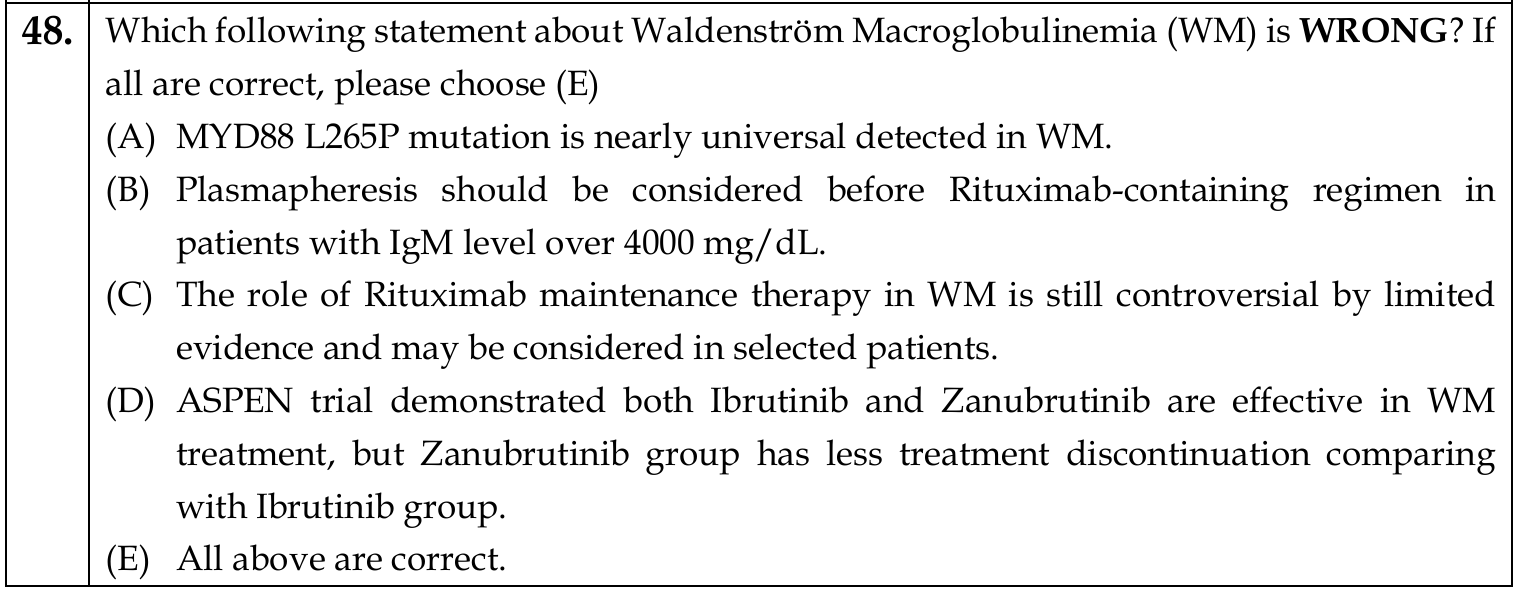
Q48. Which following statement about Waldenström Macroglobulinemia (WM) is WRONG? If all are correct, please choose (E)
- (A) MYD88 L265P mutation is nearly universal detected in WM.
- (B) Plasmapheresis should be considered before Rituximab-containing regimen in patients with IgM level over 4000 mg/dL.
- (C) The role of Rituximab maintenance therapy in WM is still controversial by limited evidence and may be considered in selected patients.
- (D) ASPEN trial demonstrated both Ibrutinib and Zanubrutinib are effective in WM treatment, but Zanubrutinib group has less treatment discontinuation comparing with Ibrutinib group.
- (E) All above are correct.
點此顯示正解
(E) All above are correct.
詳解
Based on the stem framing asking for the WRONG statement, the answer is (E) All above are correct because all statements (A) through (D) are actually correct, making (E) the false statement.
1. Why (E) matches the stem framing
The question asks "Which following statement about Waldenström Macroglobulinemia (WM) is WRONG?" Since statements (A) through (D) are all accurate, the statement "(E) All above are correct" is wrong because it claims all statements are correct when the question is asking for an incorrect statement. This is a self-referential logic question where (E) becomes the false statement by virtue of the question's framing.
2. Why each other option is TRUE (opposite property)
(A) TRUE - MYD88 L265P mutation is nearly universal in WM
The MYD88 L265P mutation is present in >90-95% of WM cases, making it nearly universal and a hallmark of the disease134. Studies using sensitive allele-specific PCR detected MYD88 L265P in 93-100% of WM patients35. One study found 100% positivity in 58 WM patients using allele-specific PCR5, while another reported >95% prevalence1. Even in a Chinese cohort with lower rates, the mutation was still detected in 87.8% of cases2. This makes statement (A) accurate.
(B) TRUE - Plasmapheresis should be considered before rituximab in high IgM levels
Plasmapheresis is recommended before rituximab-containing regimens in patients with very high IgM levels (typically >4000 mg/dL or 40 g/L) to prevent IgM flare, a phenomenon where rituximab can transiently increase IgM levels and precipitate hyperviscosity syndrome[9][10]. The consensus recommendations from the Tenth International Workshop for Waldenström Macroglobulinaemia support this practice, particularly in symptomatic patients or those at risk of hyperviscosity[^9]. Statement (B) is correct.
(C) TRUE - Rituximab maintenance therapy role is controversial
Multiple guidelines confirm that rituximab maintenance therapy in WM lacks strong evidence and remains controversial[9][11]. The Mayo mSMART guidelines 2016 state it is "not recommended"[^11]. The Tenth International Workshop consensus panel found "no consensus" on rituximab maintenance, noting it may be considered in selected patients but is not routinely recommended[^9]. The NCCN guidelines list it as "considered in patients responding to rituximab-based induction" but without strong evidence[^11]. This confirms statement (C) is accurate.
(D) TRUE - ASPEN trial showed both agents effective, with zanubrutinib having less discontinuation
The ASPEN trial was a randomized phase 3 study comparing ibrutinib and zanubrutinib in WM6. Both BTK inhibitors demonstrated high effectiveness, but zanubrutinib showed a better toxicity profile than ibrutinib, resulting in less treatment discontinuation6. This led to zanubrutinib's approval and its preferential recommendation in current NCCN guidelines as a preferred first-line option (Category 1)8, while ibrutinib is listed as "other recommended"8. Statement (D) is correct.
Summary
All statements (A) through (D) are factually correct based on current evidence and guidelines. Therefore, the statement "(E) All above are correct" is wrong in the context of a question asking for the wrong statement, making (E) the correct answer to this board question.
詳解 · 中文翻譯
根據題幹框架要求 錯誤 陳述,答案是 (E) 以上全部正確,因為所有陳述 (A) 至 (D) 實際上都正確,使 (E) 成為假陳述。
1. 為何 (E) 符合題幹框架
問題要求「關於 Waldenström 巨球蛋白血症(WM)的以下哪個陳述是 錯誤的?」由於陳述 (A) 至 (D) 都準確,陳述「(E) 以上全部正確」是錯誤的,因為當問題尋找不正確陳述時它聲稱所有陳述都正確。這是一個自我參考邏輯問題,其中 (E) 通過問題的框架而變成假陳述。
2. 為何每個其他選項都真實(相反屬性)
(A) 真實 - MYD88 L265P 突變在 WM 中幾乎通用
MYD88 L265P 突變存在於 >90-95% 的 WM 病例中,使其幾乎通用且是疾病的標誌134。使用敏感等位基因特異性 PCR 的研究在 93-100% 的 WM 患者中檢測到 MYD88 L265P35。一項研究使用等位基因特異性 PCR 在 58 名 WM 患者中發現 100% 陽性率5,而另一項報告 >95% 患病率1。即使在患病率更低的中國隊列中,突變仍在 87.8% 的病例中被檢測到2。這使陳述 (A) 準確。
(B) 真實 - 高 IgM 水平時應在 rituximab 之前考慮血漿置換
在 rituximab 含有方案之前建議血漿置換用於 IgM 水平非常高的患者(通常 >4000 mg/dL 或 40 g/L),以防止 IgM 閃耀,一種現象,其中 rituximab 可暫時增加 IgM 水平並引發高粘滯症候群[9][10]。來自第十國際 Waldenström 巨球蛋白血症研討會的共識建議支持此實踐,特別是在有症狀患者或有高粘滯症風險患者[^9]。陳述 (B) 正確。
(C) 真實 - Rituximab 維持治療作用有爭議
多項指南確認 WM 中的 rituximab 維持治療 缺乏強有力證據 並保持有爭議[9][11]。Mayo mSMART 指南 2016 指出它是「不推薦」[^11]。第十國際研討會共識小組發現關於 rituximab 維持「無共識」,指出在選定患者中可考慮但未常規推薦[^9]。NCCN 指南將其列為「在對 rituximab 基礎誘導有反應的患者中考慮」,但無強有力證據[^11]。這確認陳述 (C) 準確。
(D) 真實 - ASPEN 試驗顯示兩種代理都有效,zanubrutinib 有更少停用
ASPEN 試驗 是在 WM 中比較 ibrutinib 和 zanubrutinib 的隨機第 3 期研究6。兩種 BTK 抑制劑均顯示高效性,但 zanubrutinib 相比 ibrutinib 顯示 更好的毒性譜,導致更少的治療停用6。這導致 zanubrutinib 的批准及其在當前 NCCN 指南中作為首選一線選項(第 1 類)的優先推薦8,而 ibrutinib 被列為「其他推薦」8。陳述 (D) 正確。
摘要
陳述 (A) 至 (D) 都根據當前證據和指南在事實上正確。因此,陳述「(E) 以上全部正確」在要求錯誤陳述的問題背景下是錯誤的,使 (E) 成為此棋盤問題的正確答案。
參考文獻 (AMA)
-
Silkenstedt E, Salles G, Campo E, Dreyling M. B-Cell Non-Hodgkin Lymphomas. Lancet (London, England). 2024;403(10438):1791-1807. doi:10.1016/S0140-6736(23)02705-8. PMID:38614113. ↩↩↩↩
-
Xu L, Hunter ZR, Yang G, et al. MYD88 L265P in Waldenström Macroglobulinemia, Immunoglobulin M Monoclonal Gammopathy, and Other B-Cell Lymphoproliferative Disorders Using Conventional and Quantitative Allele-Specific Polymerase Chain Reaction. Blood. 2013;121(11):2051-8. doi:10.1182/blood-2012-09-454355. PMID:23321251. ↩↩
-
Banerjee Nair S, Hyun TS, Naresh KN. MYD88 Gene and Protein: Molecular Architecture, Signalling Mechanisms and Clinical Implications in Lymphoid Malignancies. Journal of Clinical Pathology. 2026;79(6):363-369. doi:10.1136/jcp-2026-210690. PMID:41922162. ↩↩↩↩
-
Varettoni M, Arcaini L, Zibellini S, et al. Prevalence and Clinical Significance of the MYD88 (L265P) Somatic Mutation in Waldenstrom's Macroglobulinemia and Related Lymphoid Neoplasms. Blood. 2013;121(13):2522-8. doi:10.1182/blood-2012-09-457101. PMID:23355535. ↩↩
-
Yan Y, Yu Y, Xiong W, et al. Determination of MYD88 and CXCR4 Mutations for Clinical Detection and Their Significance in Waldenström Macroglobulinemia. Clinical Cancer Research : An Official Journal of the American Association for Cancer Research. 2024;30(23):5483-5493. doi:10.1158/1078-0432.CCR-23-3939. PMID:39373694. ↩↩↩↩
-
Castillo JJ, Advani RH, Branagan AR, et al. Consensus Treatment Recommendations From the Tenth International Workshop for Waldenström Macroglobulinaemia. The Lancet. Haematology. 2020;7(11):e827-e837. doi:10.1016/S2352-3026(20)30224-6. PMID:33091356. ↩↩↩↩
-
Kapoor P, Ansell SM, Fonseca R, et al. Diagnosis and Management of Waldenström Macroglobulinemia: Mayo Stratification of Macroglobulinemia and Risk-Adapted Therapy (mSMART) Guidelines 2016. JAMA Oncology. 2017;3(9):1257-1265. doi:10.1001/jamaoncol.2016.5763. PMID:28056114. ↩
-
National Comprehensive Cancer Network. Waldenström Macroglobulinemia/Lymphoplasmacytic Lymphoma. https://www.nccn.org/professionals/physician_gls/pdf/waldenstroms.pdf#page=10. ↩↩↩↩
Figures