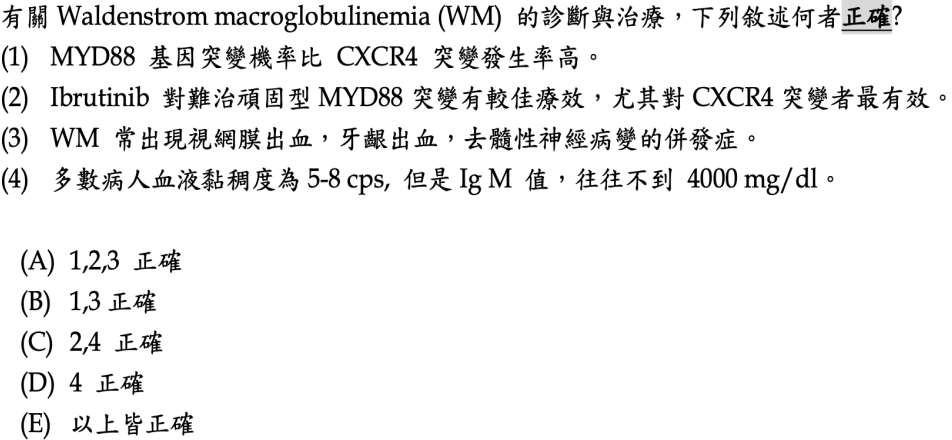
Q1. 有關 Waldenstrom macroglobulinemia (WM) 的診斷與治療,下列敘述何者正確?
- (A) 1,2,3 正確
- (B) 1,3 正確
- (C) 2,4 正確
- (D) 4 正確
- (E) 以上皆正確
點此顯示正解
(B) 1,3 正確
詳解
Analysis of Taiwan Hematology Board Exam Question on Waldenström Macroglobulinemia
The correct answer is (B) — statements 1 and 3 are TRUE, while statements 2 and 4 are FALSE.
1. Why Answer (B) is Correct
Statement 1 is TRUE: MYD88 mutations occur in 95-97% of WM patients, while CXCR4 mutations occur in only 30-40% of cases15[^10]. The MYD88 L265P mutation is considered the hallmark of WM and has a substantially higher frequency than CXCR4 mutations.
Statement 3 is TRUE: WM commonly presents with hyperviscosity-related complications including retinal hemorrhage, gingival bleeding, and demyelinating neuropathy. The hyperviscosity syndrome results from shear forces that rupture unsupported venous channels, leading to epistaxis, gingival bleeding, and visual changes from retinal hemorrhage789. Additionally, peripheral neuropathy (including demyelinating forms) is a well-recognized manifestation of WM, occurring in approximately 20-30% of patients.
2. Why Statement 2 is FALSE
Statement 2 claims ibrutinib has better efficacy in CXCR4-mutated patients, which is the opposite of clinical reality.
CXCR4 mutations are associated with WORSE ibrutinib outcomes: - Patients with wild-type CXCR4 achieve higher major response rates (94% vs 71%) and very good partial response rates (31% vs 7%) compared to CXCR4-mutated patients4 - Time to major response is significantly delayed in CXCR4-mutated patients (7.3 months vs 1.8 months, P=0.01)4 - CXCR4 mutations promote drug resistance through AKT and ERK-1/2 signaling in the presence of CXCL12 ligand1 - Best responses to ibrutinib occur in patients with mutated MYD88 and wild-type CXCR415
The CXCR4 mutation status emerged as an independent adverse prognostic factor in BTK inhibitor-treated patients (HR 3.349, P=0.012)2.
3. Why Statement 4 is FALSE
Statement 4 claims most patients have viscosity of 5-8 cps but IgM levels below 4000 mg/dL, which contradicts established thresholds.
Actual hyperviscosity thresholds: - Symptomatic hyperviscosity is rare when IgM <4000 mg/dL789 - Hyperviscosity syndrome is not likely unless serum viscosity exceeds 4 cps (not 5-8 cps)789 - The median IgM level at symptomatic hyperviscosity is 61.8 g/L (6180 mg/dL), with a range of 31-124 g/L6 - IgM levels >60 g/L (6000 mg/dL) are associated with a 370-fold higher odds of developing symptomatic hyperviscosity6 - Normal serum viscosity is 1.8 cps (reference); hyperviscosity symptoms typically occur when viscosity >4 cps789
The statement incorrectly suggests high viscosity (5-8 cps) occurs with low IgM (<4000 mg/dL), when in reality symptomatic hyperviscosity typically requires both elevated viscosity (>4 cps) AND elevated IgM (usually >4000-6000 mg/dL).
4. Supporting Evidence from Key Studies
The evidence base includes: - Treon et al. (JCO 2018, 2020): Landmark studies establishing MYD88/CXCR4 mutation frequencies and their impact on ibrutinib efficacy45 - Hunter et al. (JCO 2017): Comprehensive genomic analysis showing 95-97% MYD88 and 30-40% CXCR4 mutation rates, with CXCR4 mutations conferring lower response rates and delayed responses to ibrutinib1 - Gustine et al. (Br J Haematol 2017): Large retrospective study of 825 patients establishing median IgM of 61.8 g/L at symptomatic hyperviscosity6 - Gertz reviews (Am J Hematol 2021, 2023, 2025): Authoritative reviews establishing viscosity >4 cps threshold and IgM >4000 mg/dL as the level below which symptomatic hyperviscosity is rare789
詳解 · 中文翻譯
關於 Waldenström 巨球蛋白血症台灣血液學委員會考試問題的分析
正確答案是 (B) — 敘述 1 和 3 是真實的,而敘述 2 和 4 是虛假的。
1. 為什麼答案 (B) 是正確的
敘述 1 是真實的:MYD88 突變發生在 95-97% 的 WM 患者中,而 CXCR4 突變僅發生在 30-40% 的病例中15[^10]。MYD88 L265P 突變被認為是 WM 的特徵,頻率實質上高於 CXCR4 突變。
敘述 3 是真實的:WM 通常呈現與高粘度相關的並發症,包括視網膜出血、牙齦出血和脫髓鞘神經病變。高粘度綜合症源自分切力導致不支持的靜脈通道破裂,導致鼻衄、牙齦出血和視網膜出血的視覺變化789。此外,周邊神經病變(包括脫髓鞘形式)是 WM 公認的表現,發生在約 20-30% 的患者中。
2. 為什麼敘述 2 是虛假的
敘述 2 聲稱 ibrutinib 在 CXCR4 突變患者中具有更好療效,這是臨床現實的相反。
CXCR4 突變與較差的 ibrutinib 結果相關: - 與 CXCR4 突變患者相比,具有野生型 CXCR4 的患者達到更高的主要反應率(94% vs 71%)和非常好的部分反應率(31% vs 7%)4 - CXCR4 突變患者的達到主要反應時間明顯延遲(7.3 個月 vs 1.8 個月,P=0.01)4 - CXCR4 突變通過在 CXCL12 配體存在時的 AKT 和 ERK-1/2 信號轉導促進藥物耐藥性1 - 對 ibrutinib 的最佳反應發生在具有突變 MYD88 和野生型 CXCR4 的患者中15
CXCR4 突變狀態成為 BTK 抑制劑治療患者的獨立不利預後因素(HR 3.349,P=0.012)2。
3. 為什麼敘述 4 是虛假的
敘述 4 聲稱大多數患者的粘度為 5-8 cps 但 IgM 水平低於 4000 mg/dL,這與既定閾值相矛盾。
實際高粘度閾值: - 當 IgM <4000 mg/dL 時,症狀性高粘度是罕見的789 - 除非血清粘度超過 4 cps(而不是 5-8 cps),否則高粘度綜合症不太可能789 - 症狀性高粘度時的中位 IgM 水平是 61.8 g/L(6180 mg/dL),範圍為 31-124 g/L6 - IgM 水平 >60 g/L(6000 mg/dL) 與發展症狀性高粘度的 370 倍更高的優勢相關6 - 正常血清粘度是 1.8 cps(參考);高粘度症狀通常在粘度 >4 cps 時發生789
敘述錯誤地暗示高粘度(5-8 cps)伴低 IgM(<4000 mg/dL)發生,而實際上症狀性高粘度通常需要升高的粘度(>4 cps)和升高的 IgM(通常 >4000-6000 mg/dL)。
4. 來自關鍵研究的支持證據
證據基礎包括: - Treon 等人(JCO 2018、2020):確立 MYD88/CXCR4 突變頻率及其對 ibrutinib 療效影響的標誌性研究45 - Hunter 等人(JCO 2017):全面基因組分析顯示 95-97% MYD88 和 30-40% CXCR4 突變率,CXCR4 突變賦予較低反應率和延遲對 ibrutinib 的反應1 - Gustine 等人(Br J Haematol 2017):825 名患者的大型回顧性研究,建立症狀性高粘度時的中位 IgM 為 61.8 g/L6 - Gertz 綜述(Am J Hematol 2021、2023、2025):權威綜述,確立粘度 >4 cps 閾值和 IgM >4000 mg/dL 是症狀性高粘度罕見的水平789
參考文獻 (AMA)
-
Hunter ZR, Yang G, Xu L, et al. Genomics, Signaling, and Treatment of Waldenström Macroglobulinemia. Journal of Clinical Oncology : Official Journal of the American Society of Clinical Oncology. 2017;35(9):994-1001. doi:10.1200/JCO.2016.71.0814. PMID:28294689. ↩↩↩↩↩↩↩↩
-
Treon SP, Xu L, Guerrera ML, et al. Genomic Landscape of Waldenström Macroglobulinemia and Its Impact on Treatment Strategies. Journal of Clinical Oncology : Official Journal of the American Society of Clinical Oncology. 2020;38(11):1198-1208. doi:10.1200/JCO.19.02314. PMID:32083995. ↩↩
-
Silkenstedt E, Salles G, Campo E, Dreyling M. B-Cell Non-Hodgkin Lymphomas. Lancet (London, England). 2024;403(10438):1791-1807. doi:10.1016/S0140-6736(23)02705-8. PMID:38614113. ↩
-
Gertz MA. Waldenström Macroglobulinemia: 2021 Update on Diagnosis, Risk Stratification, and Management. American Journal of Hematology. 2021;96(2):258-269. doi:10.1002/ajh.26082. PMID:33368476. ↩↩↩↩↩↩
-
Gertz MA. Waldenström Macroglobulinemia: 2025 Update on Diagnosis, Risk Stratification, and Management. American Journal of Hematology. 2025;100(6):1061-1073. doi:10.1002/ajh.27666. PMID:40095219. ↩↩↩↩↩↩
-
Gertz MA. Waldenström Macroglobulinemia: 2023 Update on Diagnosis, Risk Stratification, and Management. American Journal of Hematology. 2023;98(2):348-358. doi:10.1002/ajh.26796. PMID:36588395. ↩↩↩↩↩↩
-
Treon SP, Gustine J, Meid K, et al. Ibrutinib Monotherapy in Symptomatic, Treatment-Naïve Patients With Waldenström Macroglobulinemia. Journal of Clinical Oncology : Official Journal of the American Society of Clinical Oncology. 2018;36(27):2755-2761. doi:10.1200/JCO.2018.78.6426. PMID:30044692. ↩↩↩↩↩↩↩↩↩↩
-
Yan Y, Yu Y, Xiong W, et al. Determination of MYD88 and CXCR4 Mutations for Clinical Detection and Their Significance in Waldenström Macroglobulinemia. Clinical Cancer Research : An Official Journal of the American Association for Cancer Research. 2024;30(23):5483-5493. doi:10.1158/1078-0432.CCR-23-3939. PMID:39373694. ↩↩↩↩↩↩↩↩↩↩
-
Gustine JN, Meid K, Dubeau T, et al. Serum IgM Level as Predictor of Symptomatic Hyperviscosity in Patients With Waldenström Macroglobulinaemia. British Journal of Haematology. 2017;177(5):717-725. doi:10.1111/bjh.14743. PMID:28485115. ↩↩↩↩↩↩↩↩↩↩
Slide annotations
IgM >= 3000
IgG >=4000 IgA > =6000
Figures