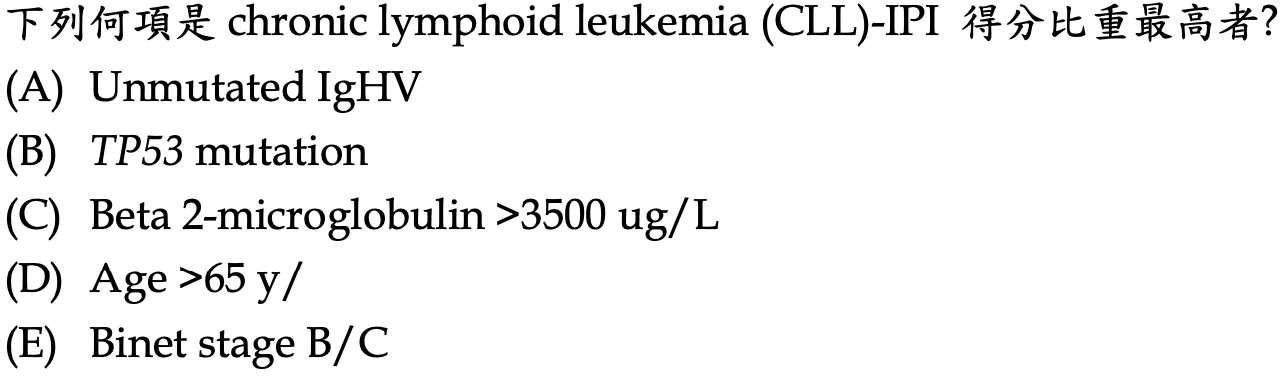
Q1. 下列何項是 chronic lymphoid leukemia (CLL)-IPI 得分比重最高者?
- (A) Unmutated IgHV
- (B) TP53 mutation
- (C) Beta 2-microglobulin >3500 ug/L
- (D) Age >65 y/
- (E) Binet stage B/C
點此顯示正解
(B) TP53 mutation
詳解
1. Why TP53 mutation carries the highest CLL-IPI score weight
TP53 mutation/deletion receives 4 points in the CLL-IPI, the highest weight of any variable12. This scoring reflects the profound adverse prognostic impact of TP53 disruption on overall survival in CLL patients.
The CLL-IPI developers assigned weights based on regression coefficients from multivariable Cox modeling. The weighted risk score of TP53 status was designed to be at least triple the weighted risk score of age and clinical stage, and double the weighted risk score of IGHV mutational status1[^4]. The rationale was that TP53 disruption (del[17p] and/or TP53 mutation) demonstrated the strongest independent association with inferior overall survival in the training dataset of 1,214 patients1[^7].
In the original CLL-IPI validation, 5-year overall survival for the very high-risk group (scores 7-10, typically driven by TP53 abnormalities) was only 23.3% compared to 93.2% for low-risk patients1[^7]. Even in the era of targeted therapies, TP53 status retains independent prognostic value for both progression-free survival and overall survival[^6].
2. Why other options have lower CLL-IPI score weights
| Variable | CLL-IPI Points | Rationale for Lower Weight | References |
|---|---|---|---|
| (A) Unmutated IGHV | 2 points | Regression coefficients showed IGHV status should receive at least double the weight of age/stage but half the weight of TP53 status. Patients with elevated β2-microglobulin and unmutated IGHV had similar overall survival, justifying equal 2-point weights for both factors. | 12[^4] |
| (C) β2-microglobulin >3.5 mg/L | 2 points | Assigned the same weight as unmutated IGHV based on subgroup analyses showing similar overall survival between patients with elevated β2-microglobulin and those with unmutated IGHV. | 12[^10] |
| (D) Age >65 years | 1 point | Age and clinical stage had similar regression coefficients in the multivariable model, warranting identical lowest scores. These factors had substantially weaker associations with overall survival than molecular/genetic markers. | 12[^4] |
| (E) Binet B/C or Rai I-IV stage | 1 point | Clinical stage received the same weight as age (1 point) due to similar regression coefficients. Advanced stage had less prognostic impact than genetic factors like TP53 status or IGHV mutation status. | 12[^4] |
The hierarchical weighting system (TP53: 4 points > IGHV/β2M: 2 points each > age/stage: 1 point each) creates a total possible score of 0-10 points, stratifying patients into four risk groups with significantly different 5-year overall survival outcomes1[^7].
詳解 · 中文翻譯
1. 為什麼 TP53 突變具有最高的 CLL-IPI 風險評分權重
TP53 突變/缺失在 CLL-IPI 中獲得 4 分,是所有變量中權重最高的12。此評分反映了 TP53 中斷對慢性淋巴細胞白血病患者整體存活率的深遠不利預後影響。
CLL-IPI 開發者根據多變量 Cox 迴歸模型的迴歸係數分配權重。TP53 狀態的加權風險評分被設計為至少是年齡和臨床分期加權風險評分的三倍,以及 IGHV 基因突變狀態加權風險評分的兩倍1[^4]。其原理是 TP53 中斷(del[17p] 和/或 TP53 突變)在 1,214 名患者的訓練數據集中顯示了與整體存活率不良的最強獨立關聯1[^7]。
在原始 CLL-IPI 驗證中,超高危險群組(評分 7-10,通常由 TP53 異常驅動)的 5 年整體存活率僅為 23.3%,而低危險患者為 93.2%1[^7]。即使在標靶治療時代,TP53 狀態對無進展生存期和整體存活率仍保持獨立預後價值[^6]。
2. 為什麼其他選項的 CLL-IPI 評分權重較低
| 變量 | CLL-IPI 分數 | 權重較低的原因 | 參考文獻 |
|---|---|---|---|
| (A) 未突變 IGHV | 2 分 | 迴歸係數顯示 IGHV 狀態的權重應至少是年齡/分期的兩倍,但是 TP53 狀態的一半。β2 微球蛋白升高和未突變 IGHV 的患者有相似的整體存活率,因此兩個因素都合理地獲得 2 分的相等權重。 | 12[^4] |
| (C) β2 微球蛋白 >3.5 mg/L | 2 分 | 根據亞組分析結果,分配與未突變 IGHV 相同的權重,該分析顯示 β2 微球蛋白升高和未突變 IGHV 患者的整體存活率相似。 | 12[^10] |
| (D) 年齡 >65 歲 | 1 分 | 在多變量模型中,年齡和臨床分期具有相似的迴歸係數,因此獲得相同的最低評分。這些因素與整體存活率的關聯遠弱於分子/遺傳標誌物。 | 12[^4] |
| (E) Binet B/C 或 Rai I-IV 分期 | 1 分 | 臨床分期因迴歸係數相似而獲得與年齡相同的權重(1 分)。進階分期的預後影響遠低於 TP53 狀態或 IGHV 基因突變狀態等遺傳因素。 | 12[^4] |
階層加權系統(TP53:4 分 > IGHV/β2M:各 2 分 > 年齡/分期:各 1 分)建立了 0-10 分的總可能評分,將患者分層為四個風險群組,各具有顯著不同的 5 年整體存活率預後1[^7]。
參考文獻 (AMA)
-
International CLL-IPI working group. An International Prognostic Index for Patients With Chronic Lymphocytic Leukaemia (CLL-IPI): A Meta-Analysis of Individual Patient Data. The Lancet. Oncology. 2016;17(6):779-790. doi:10.1016/S1470-2045(16)30029-8. PMID:27185642. ↩↩↩↩↩↩↩↩↩↩↩↩↩↩↩↩↩↩
-
Kreuzberger N, Damen JA, Trivella M, et al. Prognostic Models for Newly-Diagnosed Chronic Lymphocytic Leukaemia in Adults: A Systematic Review and Meta-Analysis. The Cochrane Database of Systematic Reviews. 2020;7:CD012022. doi:10.1002/14651858.CD012022.pub2. PMID:32735048. ↩↩↩↩↩↩↩↩↩↩
-
Langerbeins P, Giza A, Robrecht S, et al. Reassessing the Chronic Lymphocytic Leukemia International Prognostic Index in the Era of Targeted Therapies. Blood. 2024;143(25):2588-2598. doi:10.1182/blood.2023022564. PMID:38620092. ↩
Slide annotations
CLL-IPI table provided for reference.
Figures