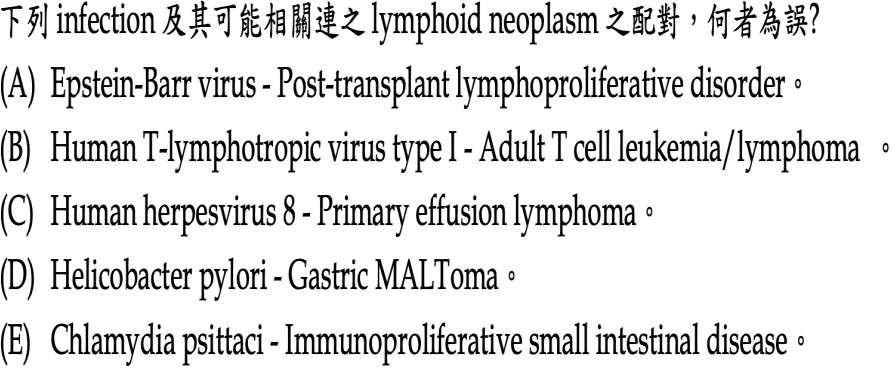
Q1. 下列 infection 及其可能相關連之 lymphoid neoplasm 之配對,何者為誤?
- (A) Epstein-Barr virus - Post-transplant lymphoproliferative disorder。
- (B) Human T-lymphotropic virus type I - Adult T cell leukemia/lymphoma。
- (C) Human herpesvirus 8 - Primary effusion lymphoma。
- (D) Helicobacter pylori - Gastric MALToma。
- (E) Chlamydia psittaci - Immunoproliferative small intestinal disease。
點此顯示正解
(E) Chlamydia psittaci - Immunoproliferative small intestinal disease。
詳解
Option (E) is the WRONG pairing because immunoproliferative small intestinal disease (IPSID, also known as alpha heavy-chain disease) is associated with Campylobacter jejuni, not Chlamydia psittaci. Chlamydia psittaci is associated with ocular adnexal MALT lymphoma, not IPSID2[^9].
Why (E) is incorrect:
IPSID is a variant of intestinal MALT lymphoma characterized by extensive plasmacytic differentiation and production of truncated alpha heavy chains without light chains. Lecuit et al. (2004) demonstrated through PCR, DNA sequencing, and fluorescence in situ hybridization that Campylobacter jejuni is present in intestinal tissue of IPSID patients, with the organism localized in the lamina propria2. This landmark study identified C. jejuni in the index patient who had a dramatic response to antibiotics, and subsequently found campylobacter species in 4 of 6 additional IPSID patients2. The association between C. jejuni and IPSID is now well-established, with early-stage disease responding to antibiotics in 30-70% of cases35.
In contrast, Chlamydia psittaci is associated with ocular adnexal MALT lymphoma, not IPSID. Ferreri et al. (2004) found C. psittaci DNA in 80% of ocular adnexal lymphoma samples, with antibiotic therapy (doxycycline) leading to objective responses in some patients[^9]. This association shows considerable geographic variability, with highest prevalence in Italy and Korea[8][10].
Why the other options are CORRECT pairings:
(A) EBV → Post-transplant lymphoproliferative disorder (PTLD): Epstein-Barr virus is a well-established causative agent of PTLD, particularly in immunocompromised transplant recipients. EBV-driven B-cell proliferation in the setting of immunosuppression is a hallmark of this disorder.
(B) HTLV-1 → Adult T-cell leukemia/lymphoma (ATLL): Human T-lymphotropic virus type I is the definitive etiologic agent of ATLL, an aggressive T-cell malignancy endemic to Japan, the Caribbean, and parts of Africa.
(C) HHV-8 → Primary effusion lymphoma: Human herpesvirus 8 (also known as Kaposi sarcoma-associated herpesvirus) is consistently associated with primary effusion lymphoma, a rare B-cell lymphoma presenting as malignant effusions without tumor masses.
(D) H. pylori → Gastric MALT lymphoma: Helicobacter pylori is the prototypical infectious trigger for gastric MALT lymphoma, with antibiotic eradication therapy achieving remission in many early-stage cases.
詳解 · 中文翻譯
選項 (E) 是錯誤的配對因為免疫增殖性小腸病(IPSID,也稱為 alpha 重鏈病)與 Campylobacter jejuni 相關,而不是鸚鵡熱衣原體。鸚鵡熱衣原體與眼附屬 MALT 淋巴瘤相關,而不是 IPSID2[^9]。
為什麼 (E) 不正確:
IPSID 是腸 MALT 淋巴瘤的變體,特徵是廣泛的漿細胞分化和無光鏈截斷 alpha 重鏈的產生。Lecuit 等人(2004)通過 PCR、DNA 測序和熒光原位雜交證示 Campylobacter jejuni 存在於 IPSID 患者的腸組織中,有機體定位於固有層2。此標誌性研究在出現對抗生素戲劇性反應的索引患者中識別了彎曲桿菌,隨後在 6 名額外 IPSID 患者中的 4 名中發現了彎曲桿菌種2。C. jejuni 與 IPSID 之間的關聯現在眾所周知,早期病例對抗生素的反應為 30-70%35。
相比之下,鸚鵡熱衣原體與眼附屬 MALT 淋巴瘤相關,而不是 IPSID。Ferreri 等人(2004)在 80% 的眼附屬淋巴瘤樣本中發現 C. psittaci DNA,抗生素治療(多西環素)導致一些患者出現目標反應[9]。此關聯顯示相當大的地理變異性,在意大利和韓國中最高流行率[8][^10]。
為什麼其他選項是正確的配對:
(A) EBV → 移植後淋巴增殖性疾病 (PTLD): Epstein-Barr 病毒是 PTLD 的眾所周知的致病因子,特別是在免疫受損的移植受者中。免疫抑制環境中的 EBV 驅動 B 細胞增殖是此疾病的特徵。
(B) HTLV-1 → 成人 T 細胞白血病/淋巴瘤 (ATLL): Human T 淋巴營養病毒 I 型是 ATLL 的明確病因病原體,是日本、加勒比海和非洲部分地區流行的攻擊性 T 細胞惡性腫瘤。
(C) HHV-8 → 原發性積液淋巴瘤: Human 皰疹病毒 8(也稱為 Kaposi 肉瘤相關皰疹病毒)與原發性積液淋巴瘤持續相關,這是罕見 B 細胞淋巴瘤表現為惡性積液無腫瘤腫塊。
(D) 幽門螺桿菌 → 胃 MALT 淋巴瘤: 幽門螺桿菌是胃 MALT 淋巴瘤的原型傳染性觸發因子,抗生素根除療法在許多早期病例中達成緩解。
參考文獻 (AMA)
-
Lecuit M, Abachin E, Martin A, et al. Immunoproliferative Small Intestinal Disease Associated With Campylobacter Jejuni. The New England Journal of Medicine. 2004;350(3):239-48. doi:10.1056/NEJMoa031887. PMID:14724303. ↩
-
Ferreri AJ, Guidoboni M, Ponzoni M, et al. Evidence for an Association Between Chlamydia Psittaci and Ocular Adnexal Lymphomas. Journal of the National Cancer Institute. 2004;96(8):586-94. doi:10.1093/jnci/djh102. PMID:15100336. ↩↩↩↩↩↩
-
Foukas PG, de Leval L. Recent Advances in Intestinal Lymphomas. Histopathology. 2015;66(1):112-36. doi:10.1111/his.12596. PMID:25639480. ↩↩
-
Al-Saleem T, Al-Mondhiry H. Immunoproliferative Small Intestinal Disease (IPSID): A Model for Mature B-Cell Neoplasms. Blood. 2005;105(6):2274-80. doi:10.1182/blood-2004-07-2755. PMID:15542584. ↩
-
Travaglino A, Pace M, Varricchio S, et al. Prevalence of Chlamydia Psittaci, Chlamydia Pneumoniae, and Chlamydia Trachomatis Determined by Molecular Testing in Ocular Adnexa Lymphoma Specimens. American Journal of Clinical Pathology. 2020;153(4):427-434. doi:10.1093/ajcp/aqz181. PMID:31755895. ↩↩
-
Cheah CY, Seymour JF. Marginal Zone Lymphoma: 2023 Update on Diagnosis and Management. American Journal of Hematology. 2023;98(10):1645-1657. doi:10.1002/ajh.27058. PMID:37605344. ↩
Slide annotations
Campylobacter jejuni
Figures