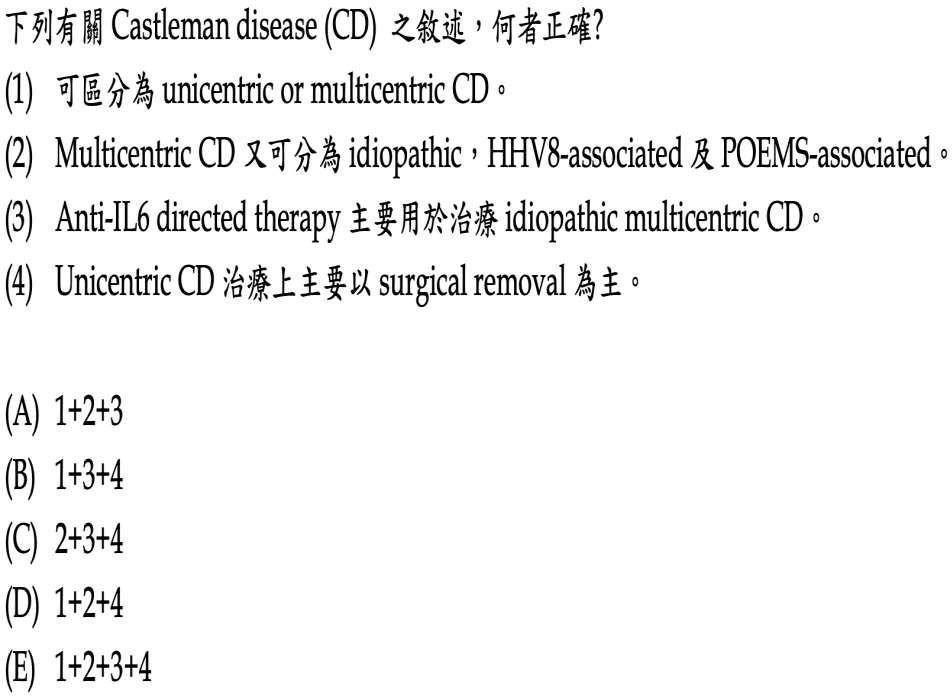
Q1. 下列有關 Castleman disease (CD) 之敘述,何者正確? (1) 可區分為 unicentric or multicentric CD 。 (2) Multicentric CD 又可分為 idiopathic 、 HHV8-associated 及 POEMS-associated 。 (3) Anti-IL6 directed therapy 主要用於治療 idiopathic multicentric CD 。 (4) Unicentric CD 治療上主要以 surgical removal 為主 。
- (A) 1+2+3
- (B) 1+3+4
- (C) 2+3+4
- (D) 1+2+4
- (E) 1+2+3+4
點此顯示正解
(E) 1+2+3+4
詳解
The correct answer is (E) 1+2+3+4 all correct. All four statements about Castleman disease are accurate based on current classification systems and treatment guidelines.
Explanation of Each Statement
(1) CD can be classified as unicentric (UCD) or multicentric (MCD) - CORRECT
Castleman disease is anatomically classified based on the number of lymph node regions involved123. Unicentric CD (UCD) involves one enlarged lymph node region, presenting as a solitary enlarged lymph node, typically with mild or no symptoms12. Multicentric CD (MCD) involves multiple enlarged lymph node regions with systemic inflammation, cytopenias, and potentially life-threatening multiple organ dysfunction123. This fundamental classification is universally accepted and forms the basis for all subsequent diagnostic and therapeutic approaches.
(2) Multicentric CD subtypes include idiopathic (iMCD), HHV-8-associated, and POEMS-associated - CORRECT
MCD is further subclassified by etiology into three distinct subtypes235:
-
Idiopathic MCD (iMCD): HHV-8-negative cases with unknown etiology, accounting for more than half of MCD cases13. iMCD can be further subdivided into iMCD-TAFRO (thrombocytopenia, anasarca, fever, reticulin fibrosis/renal dysfunction, organomegaly), iMCD-IPL (idiopathic plasmacytic lymphadenopathy), and iMCD-NOS (not otherwise specified)18
-
HHV-8-associated MCD (HHV-8-MCD): Caused by uncontrolled human herpesvirus-8 infection, often occurring in immunocompromised individuals, particularly those with HIV infection125. Viral IL-6 production drives the inflammatory cascade5
-
POEMS-associated MCD (POEMS-MCD): Associated with polyneuropathy, organomegaly, endocrinopathy, monoclonal plasma cell disorder, and skin changes235. An underlying clonal plasma cell population leads to excessive VEGF and IL-12 production5
(3) Anti-IL-6 directed therapy (siltuximab) is mainly used for idiopathic multicentric CD - CORRECT
Siltuximab, an anti-IL-6 monoclonal antibody, is the first-line therapy for all subtypes of iMCD1689. In 2014, siltuximab became the first FDA-approved treatment for iMCD based on a randomized placebo-controlled trial demonstrating a 34% durable response rate8. Consensus treatment guidelines recommend siltuximab as front-line therapy for iMCD89. Real-world data from the ACCELERATE Natural History Registry showed that siltuximab with or without corticosteroids was associated with a 52% response rate9.
In contrast, HHV-8-MCD is primarily treated with rituximab-based regimens (B cell-directed therapy)25[^10], and POEMS-MCD treatment is directed toward the underlying plasma cell clone5. Therefore, anti-IL-6 therapy is specifically indicated for iMCD rather than the other MCD subtypes.
(4) Unicentric CD is mainly treated by surgical removal (curative in most cases) - CORRECT
Surgical resection is the preferred treatment modality for UCD and is often curative247. UCD typically has an indolent course, and complete excision of the solitary enlarged lymph node region results in favorable outcomes47. A real-world study demonstrated that surgical resection was the preferred treatment for UCD with favorable symptomatic, laboratory, and radiologic outcomes7. The overall survival for UCD is excellent, and patients have significantly better progression-free survival compared to MCD patients7. However, a small percentage of UCD patients may develop severe autoimmune or malignant complications requiring additional monitoring4.
Requested Citations
The explanation above synthesizes evidence from multiple sources including: - CDCN consensus guidelines: Referenced in sources discussing siltuximab as first-line therapy for iMCD and treatment recommendations89[^10] - Fajgenbaum diagnostic criteria: The first-ever diagnostic criteria for iMCD and clinical subtypes (iMCD-TAFRO, iMCD-NOS) are discussed8 - Classification and treatment approaches: Comprehensive reviews covering UCD/MCD classification, subtypes, and treatment strategies123
詳解 · 中文翻譯
正確答案是 (E) 1+2+3+4 都正確。所有四個關於 Castleman 疾病的敘述基於目前分類系統和治療指南都是準確的。
每個敘述的解釋
(1) CD 可分為單中心(UCD)或多中心(MCD)- 正確
Castleman 疾病基於涉及的淋巴結區域數量在解剖上分類123。單中心 CD (UCD) 涉及一個擴大的淋巴結區域,呈現為孤立的擴大淋巴結,通常伴有輕微或無症狀12。多中心 CD (MCD) 涉及多個擴大的淋巴結區域伴隨全身炎症、細胞減少症和潛在危及生命的多器官功能障礙123。此基本分類被普遍接受,形成所有後續診斷和治療方法的基礎。
(2) 多中心 CD 亞型包括特發性 (iMCD)、HHV-8 相關和 POEMS 相關 - 正確
-
特發性 MCD (iMCD):HHV-8 陰性病例,病因未知,佔 MCD 病例的一半以上13。iMCD 可進一步細分為 iMCD-TAFRO(血小板減少症、腫脹、發熱、網狀纖維/腎功能障礙、肝脾腫大)、iMCD-IPL(特發性漿細胞淋巴結病)和 iMCD-NOS(未另有說明)18
-
HHV-8 相關 MCD (HHV-8-MCD):由不受控制的人類皰疹病毒-8 感染引起,經常發生在免疫功能低下的個體中,特別是 HIV 感染患者中125。病毒 IL-6 生產驅動炎症級聯5
-
POEMS 相關 MCD (POEMS-MCD):與多神經病變、肝脾腫大、內分泌病變、單克隆漿細胞紊亂和皮膚變化相關235。潛在的克隆漿細胞群導致過度的 VEGF 和 IL-12 生產5
(3) 抗 IL-6 定向治療(siltuximab)主要用於治療特發性多中心 CD - 正確
Siltuximab,抗 IL-6 單克隆抗體,是所有 iMCD 亞型的一線治療1689。2014 年,siltuximab 基於隨機安慰劑對照試驗成為首個 FDA 批准的 iMCD 治療,該試驗證明 34% 的持久反應率8。共識治療指南推薦 siltuximab 作為 iMCD 的前線治療89。來自加速天然歷史註冊表的真實世界數據顯示 siltuximab 伴或不伴皮質類固醇與 52% 的反應率相關9。
相比之下,HHV-8-MCD 主要用利妥昔單抗基礎方案(B 細胞定向療法)治療25[^10],POEMS-MCD 治療針對潛在漿細胞克隆5。因此,抗 IL-6 治療特別適用於 iMCD 而不是其他 MCD 亞型。
(4) 單中心 CD 主要以手術切除治療(在大多數病例中有治癒效果)- 正確
手術切除是 UCD 的首選治療方式,通常有治癒效果247。UCD 通常具有惰性過程,孤立擴大淋巴結區域的完全切除導致良好的結果47。真實世界研究證明手術切除是 UCD 的首選治療,具有有利的症狀、實驗室和放射學結果7。UCD 的整體存活率優異,患者與 MCD 患者相比有顯著更好的無進展生存期7。然而,少數 UCD 患者可能發展為嚴重的自身免疫或惡性並發症,需要進一步監測4。
參考文獻 (AMA)
-
Chen LYC, Zhang L, Fajgenbaum DC. Expert Perspective: Diagnosis and Treatment of Castleman Disease. Arthritis & Rheumatology (Hoboken, N.J.). 2026;78(1):12-25. doi:10.1002/art.43269. PMID:40457814. ↩↩↩↩↩↩↩↩↩↩↩↩↩↩↩
-
Carbone A, Borok M, Damania B, et al. Castleman Disease. Nature Reviews. Disease Primers. 2021;7(1):84. doi:10.1038/s41572-021-00317-7. PMID:34824298. ↩↩↩↩↩↩↩↩↩↩↩↩↩↩↩↩↩
-
Dispenzieri A, Fajgenbaum DC. Overview of Castleman Disease. Blood. 2020;135(16):1353-1364. doi:10.1182/blood.2019000931. PMID:32106302. ↩↩↩↩↩↩↩↩↩↩↩
-
Goodman AM, Jeong AR, Phillips A, et al. Novel Somatic Alterations in Unicentric and Idiopathic Multicentric Castleman Disease. European Journal of Haematology. 2021;107(6):642-649. doi:10.1111/ejh.13702. PMID:34431136. ↩↩↩↩↩↩
-
Fajgenbaum DC. Novel Insights and Therapeutic Approaches in Idiopathic Multicentric Castleman Disease. Blood. 2018;132(22):2323-2330. doi:10.1182/blood-2018-05-848671. PMID:30487129. ↩↩↩↩↩↩↩↩↩↩↩↩↩↩
-
Pierson SK, Lim MS, Srkalovic G, et al. Treatment Consistent With Idiopathic Multicentric Castleman Disease Guidelines Is Associated With Improved Outcomes. Blood Advances. 2023;7(21):6652-6664. doi:10.1182/bloodadvances.2023010745. PMID:37656441. ↩↩
-
Abdallah NH, Habermann T, Buadi FK, et al. Multicentric Castleman Disease: A Single Center Experience of Treatment With a Focus on Autologous Stem Cell Transplantation. American Journal of Hematology. 2022;97(4):401-410. doi:10.1002/ajh.26466. PMID:35015310. ↩↩↩↩↩↩↩↩
-
Oksenhendler E, Malphettes M, Meignin V, Boutboul D, Galicier L. Deciphering the Full Spectrum of Castleman Diseases Based on a Cohort of 700 Patients in a Western Country. British Journal of Haematology. 2026;. doi:10.1111/bjh.70480. PMID:41968947. ↩↩↩↩↩↩↩↩↩↩
-
Min GJ, Jeon YW, Kim TY, et al. Long-Term Treatment Outcome of Castleman's Disease: A Real-World Experience. Frontiers in Oncology. 2022;12:974770. doi:10.3389/fonc.2022.974770. PMID:35992883. ↩↩↩↩↩↩↩
Figures