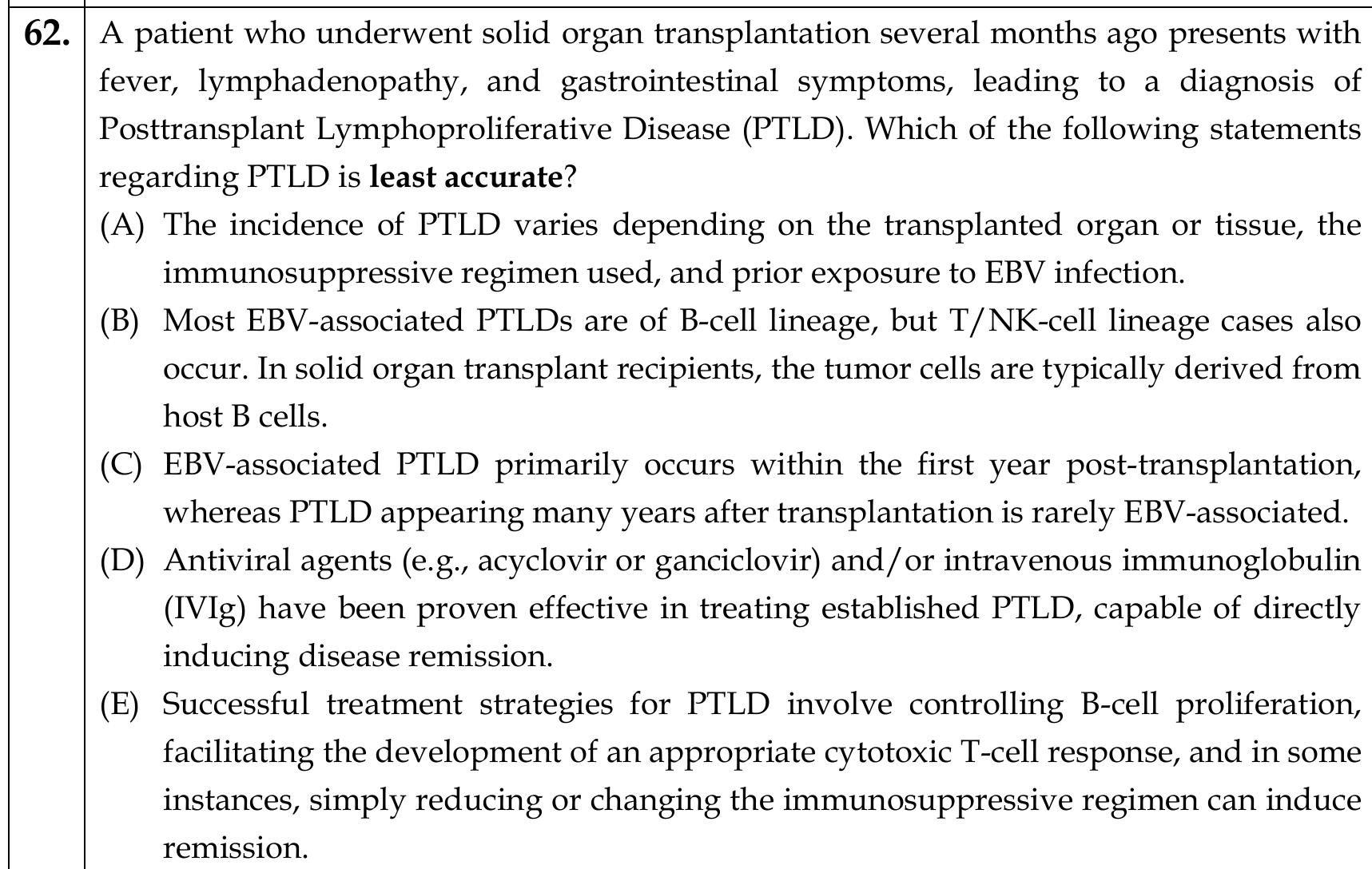
Q62. A patient who underwent solid organ transplantation several months ago presents with fever, lymphadenopathy, and gastrointestinal symptoms, leading to a diagnosis of Posttransplant Lymphoproliferative Disease (PTLD). Which of the following statements regarding PTLD is least accurate?
- (A) The incidence of PTLD varies depending on the transplanted organ or tissue, the immunosuppressive regimen used, and prior exposure to EBV infection.
- (B) Most EBV-associated PTLDs are of B-cell lineage, but T/NK-cell lineage cases also occur. In solid organ transplant recipients, the tumor cells are typically derived from host B cells.
- (C) EBV-associated PTLD primarily occurs within the first year post-transplantation, whereas PTLD appearing many years after transplantation is rarely EBV-associated.
- (D) Antiviral agents (e.g., acyclovir or ganciclovir) and/or intravenous immunoglobulin (IVIg) have been proven effective in treating established PTLD, capable of directly inducing disease remission.
- (E) Successful treatment strategies for PTLD involve controlling B-cell proliferation, facilitating the development of an appropriate cytotoxic T-cell response, and in some instances, simply reducing or changing the immunosuppressive regimen can induce remission.
點此顯示正解
(D) Antiviral agents (e.g., acyclovir or ganciclovir) and/or intravenous immunoglobulin (IVIg) have been proven effective in treating established PTLD, capable of directly inducing disease remission.
詳解
Analysis of Board Question on PTLD
1. Why Option (D) is FALSE (the correct answer to "least accurate"):
Option (D) states that antiviral agents and/or IVIg have been proven effective in treating established PTLD, capable of directly inducing disease remission. This statement is false. The evidence clearly demonstrates that antiviral agents (acyclovir, ganciclovir) have no proven efficacy as monotherapy for established PTLD and cannot directly induce remission12. The American Society of Transplantation guidelines explicitly state that "there is no evidence to support the use of antiviral agents in the absence of other interventions such as decreasing immunosuppression or anti-CD20 therapy"1. The reason for this lack of efficacy is that EBV-transformed cells in PTLD predominantly exhibit latent viral infection and lack the viral thymidine kinase necessary for activation of drugs like ganciclovir25. While antivirals may have a theoretical role when combined with agents that induce the lytic cycle (such as arginine butyrate), these combinations remain experimental and arginine butyrate is no longer clinically available12. Similarly, IVIg has not been proven effective as a treatment for established PTLD capable of inducing remission15.
2. Why the Other Options are TRUE:
(A) TRUE - Risk factors vary by organ, immunosuppression, and EBV status: The incidence of PTLD indeed varies significantly based on multiple factors. Different transplanted organs carry different risks (e.g., intestinal and lung transplants have higher rates than kidney transplants), the intensity and type of immunosuppressive regimen directly impacts PTLD risk, and EBV serostatus is a critical determinant—with EBV-seronegative recipients receiving organs from EBV-seropositive donors at particularly high risk8[9][10].
(B) TRUE - Cell lineage and origin: Most EBV-associated PTLDs are indeed of B-cell lineage (monomorphic PTLD and B-cell lymphomas account for the majority of cases)36. However, T/NK-cell lineage cases do occur, particularly in late-onset PTLD[^9]. In solid organ transplant recipients, the tumor cells are typically derived from recipient (host) B cells rather than donor cells, which distinguishes SOT-PTLD from HSCT-PTLD where donor-derived lymphoproliferation is more common[^9].
(C) TRUE - Temporal relationship with EBV association: EBV-associated PTLD predominantly occurs within the first year post-transplantation (early PTLD), when immunosuppression is most intense and EBV-specific T-cell surveillance is most impaired[^9]. In contrast, PTLD appearing many years after transplantation (late PTLD) is frequently EBV-negative and may be of T-cell, NK-cell, or null-cell origin, generally carrying a worse prognosis[9][10].
(E) TRUE - Treatment strategies: Successful PTLD management does involve the principles stated: controlling B-cell proliferation (through rituximab and/or chemotherapy), facilitating cytotoxic T-cell responses (through reduction of immunosuppression and potentially adoptive immunotherapy with EBV-specific cytotoxic T cells), and reduction or modification of immunosuppressive regimens, which alone can induce remission in approximately 25% of patients, particularly those with nondestructive or early-stage PTLD2367.
詳解 · 中文翻譯
PTLD 棋盤問題分析
1. 為何選項 (D) 是假(「最不準確」的正確答案):
選項 (D) 指出 抗病毒代理和/或 IVIg 在治療已建立 PTLD 時被證明有效,能夠直接誘導疾病緩解。此陳述是假的。證據明確證明抗病毒代理(acyclovir、ganciclovir)作為單藥治療已建立 PTLD 具有 無證實療效,無法直接誘導緩解12。美國移植學會指南明確指出「無證據支持在沒有其他干預如減少免疫抑制或抗 CD20 治療等情況下使用抗病毒代理」1。此缺乏療效的原因是 PTLD 中 EBV 轉化細胞主要表現為潛伏病毒感染,缺乏激活 ganciclovir 等藥物所需的病毒胸腺激酶25。雖然當與誘導溶解周期的代理(如精氨酸丁酸鹽)組合時,抗病毒可能有理論作用,但這些組合仍然是實驗性的,精氨酸丁酸鹽已不再臨床可用12。類似地,IVIg 尚未被證明對可誘導緩解的已建立 PTLD 有效15。
2. 為何其他選項都真實:
(A) 真實 - 風險因素根據器官、免疫抑制和 EBV 狀態而異: PTLD 的發生率確實根據多個因素變化顯著。不同移植器官攜帶不同風險(例如腸道和肺移植比腎移植有更高發生率)、免疫抑制方案的強度和類型直接影響 PTLD 風險,EBV 血清狀態是關鍵決定因素——EBV 血清陰性接收者接收來自 EBV 血清陽性捐獻者的器官風險特別高8[9][10]。
(B) 真實 - 細胞譜系和來源: 大多數 EBV 相關 PTLD 確實為 B 細胞譜系(單形 PTLD 和 B 細胞淋巴瘤構成大多數病例)36。然而,T/NK 細胞譜系病例確實發生,特別是在晚發 PTLD 中[^9]。在固體器官移植接收者中,腫瘤細胞通常源於 接收者(宿主)B 細胞 而非捐獻者細胞,這將 SOT-PTLD 與 HSCT-PTLD 區分,在後者中捐獻者來源的淋巴增殖更常見[^9]。
(C) 真實 - 與 EBV 相關的時間關係: EBV 相關 PTLD 主要發生於 移植後第一年(早期 PTLD),當免疫抑制最強烈且 EBV 特異性 T 細胞監視最受損時[^9]。相反,在移植後許多年出現的 PTLD(晚期 PTLD)頻繁 EBV 陰性,可能為 T 細胞、NK 細胞或空細胞來源,通常預後較差[9][10]。
(E) 真實 - 治療策略: 成功的 PTLD 管理確實涉及所述原則:控制 B 細胞增殖(通過 rituximab 和/或化療)、促進細胞毒性 T 細胞反應(通過減少免疫抑制和潛在地採用 EBV 特異性細胞毒性 T 細胞的過繼免疫治療),以及免疫抑制方案的減少或修改,單獨可在約 25% 的患者中誘導緩解,特別是具有非破壞性或早期 PTLD 的患者2367。
參考文獻 (AMA)
-
Allen UD, Preiksaitis JK, AST Infectious Diseases Community of Practice. Post-Transplant Lymphoproliferative Disorders, Epstein-Barr Virus Infection, and Disease in Solid Organ Transplantation: Guidelines From the American Society of Transplantation Infectious Diseases Community of Practice. Clinical Transplantation. 2019;33(9):e13652. doi:10.1111/ctr.13652. PMID:31230381. ↩↩↩↩↩↩↩↩
-
Dierickx D, Habermann TM. Post-Transplantation Lymphoproliferative Disorders in Adults. The New England Journal of Medicine. 2018;378(6):549-562. doi:10.1056/NEJMra1702693. PMID:29414277. ↩↩↩↩↩↩↩↩
-
Murukesan V, Mukherjee S. Managing Post-Transplant Lymphoproliferative Disorders in Solid-Organ Transplant Recipients: A Review of Immunosuppressant Regimens. Drugs. 2012;72(12):1631-43. doi:10.2165/11635690-000000000-00000. PMID:22867044. ↩↩↩↩
-
Markouli M, Ullah F, Omar N, et al. Recent Advances in Adult Post-Transplant Lymphoproliferative Disorder. Cancers. 2022;14(23):5949. doi:10.3390/cancers14235949. PMID:36497432. ↩
-
Fishman JA. Infection in Solid-Organ Transplant Recipients. The New England Journal of Medicine. 2007;357(25):2601-14. doi:10.1056/NEJMra064928. PMID:18094380. ↩↩↩↩
-
Sprangers B, Riella LV, Dierickx D. Posttransplant Lymphoproliferative Disorder Following Kidney Transplantation: A Review. American Journal of Kidney Diseases : The Official Journal of the National Kidney Foundation. 2021;78(2):272-281. doi:10.1053/j.ajkd.2021.01.015. PMID:33774079. ↩↩↩↩
-
Amengual JE, Pro B. How I Treat Posttransplant Lymphoproliferative Disorder. Blood. 2023;142(17):1426-1437. doi:10.1182/blood.2023020075. PMID:37540819. ↩↩
-
Atallah-Yunes SA, Salman O, Robertson MJ. Post-Transplant Lymphoproliferative Disorder: Update on Treatment and Novel Therapies. British Journal of Haematology. 2023;201(3):383-395. doi:10.1111/bjh.18763. PMID:36946218. ↩↩
Figures