Q1. There are the different etiologies in extranodal marginal zone lymphoma in various sites? Which of the following is wrong?
- (A) Helicobacter pylori in stomach
- (B) Achromabacter xylosoxidans in skin
- (C) Sjogren syndrome in salivary gland
- (D) Hashimoto thyroiditis in thyroid
- (E) Chlamydia psittaci in ocular adnexa
點此顯示正解
(B) Achromabacter xylosoxidans in skin
詳解
1. Why Option (B) is the WRONG/FALSE Statement
Achromobacter xylosoxidans is associated with pulmonary (lung) MALT lymphoma, not cutaneous (skin) MALT lymphoma124[^7]. The correct pathogen associated with cutaneous MALT lymphoma is Borrelia burgdorferi146[7][9]. This makes option (B) an incorrect site-pathogen pairing, which matches the stem framing asking for the "wrong" answer.
The NEJM review explicitly states that "MZLs of the lung may have involved infection by Achromobacter xylosoxidans" and separately notes "Borrelia burgdorferi for cutaneous MZLs"26. The comprehensive table from this landmark review clearly delineates: Lung is associated with Achromobacter xylosoxidans, while Skin is associated with Borrelia burgdorferi[^7].
2. Why the Other Options are CORRECT Pairings
(A) Helicobacter pylori in stomach — This is the most well-established infectious association in MALT lymphoma145. Chronic H. pylori gastritis is a predisposing factor for gastric MALT lymphoma, accounting for approximately two-thirds of gastric MALT cases4. H. pylori eradication therapy is the initial treatment for gastric MALT lymphoma with confirmed infection, often leading to clinical remission5.
(C) Sjögren syndrome in salivary gland — This is a correct autoimmune association24[^7]. Sjögren's syndrome is a well-recognized predisposing factor for salivary gland MALT lymphoma2[^8]. Patients with Sjögren's syndrome should be monitored for unilateral, firm-to-hard, painless gland swelling that may indicate underlying lymphoma2.
(D) Hashimoto thyroiditis in thyroid — This is a correct autoimmune association24[^7]. Hashimoto's thyroiditis is a predisposing factor for thyroid MALT lymphoma2[^8]. Thyroid MALT lymphoma shows frequent inactivating mutations in TET2, CD274, and TNFRSF14, which may impede coinhibitory interactions between neoplastic B cells and T-helper cells3.
(E) Chlamydia psittaci in ocular adnexa — This is a correct infectious association based on strong evidence146[9][10]. Chlamydia psittaci (also referred to as Chlamydophila psittaci) has been associated with ocular adnexal MALT lymphoma4[^9]. Ocular adnexal MALT lymphoma shows frequent TNFAIP3 (A20) mutation/deletion3[^7].
詳解 · 中文翻譯
1. 為什麼選項 (B) 是錯誤的/假的敘述
Achromobacter xylosoxidans 與肺(肺)MALT 淋巴瘤相關,而不是皮膚(皮膚)MALT 淋巴瘤124[^7]。與皮膚 MALT 淋巴瘤相關的正確病原體是 Borrelia burgdorferi146[7][9]。這使選項 (B) 成為不正確的位置-病原體配對,符合題幹框架要求尋找「錯誤的」答案。
NEJM 評論明確指出「肺的 MZL 可能涉及 Achromobacter xylosoxidans 的感染」並分別注意「Borrelia burgdorferi 用於皮膚 MZL」26。此標誌性評論的全面表格清楚地描繪:肺與 Achromobacter xylosoxidans 相關,而皮膚與 Borrelia burgdorferi 相關[^7]。
2. 為什麼其他選項是正確的配對
(A) 幽門螺桿菌在胃中 — 這是 MALT 淋巴瘤中最眾所周知的傳染性關聯145。慢性幽門螺桿菌胃炎是胃 MALT 淋巴瘤的易感因素,佔約三分之二的胃 MALT 病例4。幽門螺桿菌根除療法是確認感染的胃 MALT 淋巴瘤的初始治療,通常導致臨床緩解5。
(C) Sjögren 綜合症在唾液腺中 — 這是一個正確的自身免疫關聯24[^7]。Sjögren 綜合症是唾液腺 MALT 淋巴瘤的眾所周知的易感因素2[^8]。具有 Sjögren 綜合症的患者應監測單側、堅硬、無痛腺體腫脹,可能表示基礎淋巴瘤2。
(D) 橋本甲狀腺炎在甲狀腺中 — 這是一個正確的自身免疫關聯24[^7]。橋本甲狀腺炎是甲狀腺 MALT 淋巴瘤的易感因素2[^8]。甲狀腺 MALT 淋巴瘤顯示 TET2、CD274 和 TNFRSF14 中的頻繁失活突變,可能阻礙新生物 B 細胞與 T 輔助細胞之間的共抑制相互作用3。
(E) 鸚鵡熱衣原體在眼附屬器中 — 這是基於強有力證據的正確的傳染性關聯146[9][10]。鸚鵡熱衣原體(也稱為鸚鵡熱衣原體)與眼附屬 MALT 淋巴瘤相關4[^9]。眼附屬 MALT 淋巴瘤顯示 TNFAIP3(A20)突變/缺失中的頻繁3[^7]。
參考文獻 (AMA)
-
Rossi D, Bertoni F, Zucca E. Marginal-Zone Lymphomas. The New England Journal of Medicine. 2022;386(6):568-581. doi:10.1056/NEJMra2102568. PMID:35139275. ↩↩↩↩↩↩↩↩
-
Cheah CY, Seymour JF. Marginal Zone Lymphoma: 2023 Update on Diagnosis and Management. American Journal of Hematology. 2023;98(10):1645-1657. doi:10.1002/ajh.27058. PMID:37605344. ↩↩↩↩↩↩↩↩↩↩↩↩↩↩
-
Suarez F, Lortholary O, Hermine O, Lecuit M. Infection-Associated Lymphomas Derived From Marginal Zone B Cells: A Model of Antigen-Driven Lymphoproliferation. Blood. 2006;107(8):3034-44. doi:10.1182/blood-2005-09-3679. PMID:16397126. ↩↩↩↩
-
Silkenstedt E, Salles G, Campo E, Dreyling M. B-Cell Non-Hodgkin Lymphomas. Lancet (London, England). 2024;403(10438):1791-1807. doi:10.1016/S0140-6736(23)02705-8. PMID:38614113. ↩↩↩↩↩↩↩↩↩↩↩↩↩↩↩↩
-
Du MQ. EMZL at Various Sites: Learning From Each Other. Blood. 2025;145(19):2117-2127. doi:10.1182/blood.2024025794. PMID:39912633. ↩↩↩↩
-
Ponzoni M, Ferreri AJ. Bacteria Associated With Marginal Zone Lymphomas. Best Practice & Research. Clinical Haematology. 2017 Mar - Jun;30(1-2):32-40. doi:10.1016/j.beha.2017.01.001. PMID:28288714. ↩↩↩↩↩↩
Slide annotations
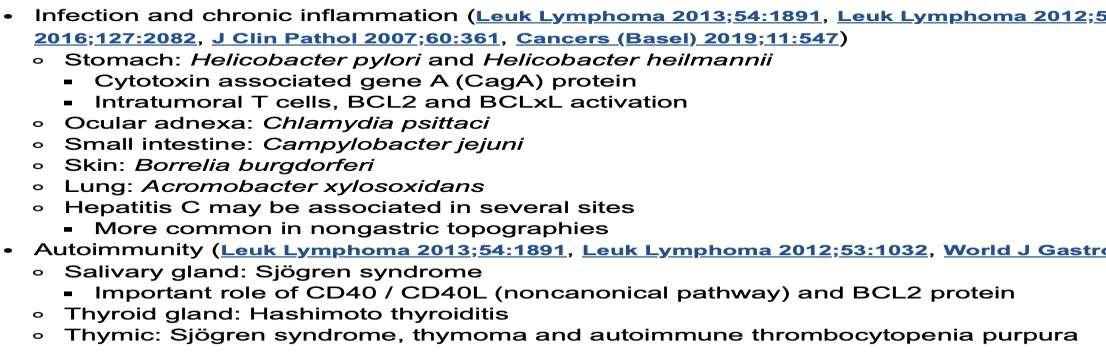
- Infection and chronic inflammation (Leuk Lymphoma 2013;54:1891, Leuk Lymphoma 2012;5 2016;127:2082, J Clin Pathol 2007;60:361, Cancers (Basel) 2019;11:547)
- Stomach: Helicobacter pylori and Helicobacter heilmannii
- Cytotoxin associated gene A (CagA) protein
- Intratumoral T cells, BCL2 and BCLxL activation
- Ocular adnexa: Chlamydia psittaci
- Small intestine: Campylobacter jejuni
- Skin: Borrelia burgdorferi
- Lung: Acromobacter xylosoxidans
- Hepatitis C may be associated in several sites
- More common in nongastric topographies
- Autoimmunity (Leuk Lymphoma 2013;54:1891, Leuk Lymphoma 2012;53:1032, World J Gastro)
- Salivary gland: Sjogren syndrome
- Important role of CD40 / CD40L (noncanonical pathway) and BCL2 protein
- Thyroid gland: Hashimoto thyroiditis
- Thymic: Sjogren syndrome, thymoma and autoimmune thrombocytopenia purpura
Figures