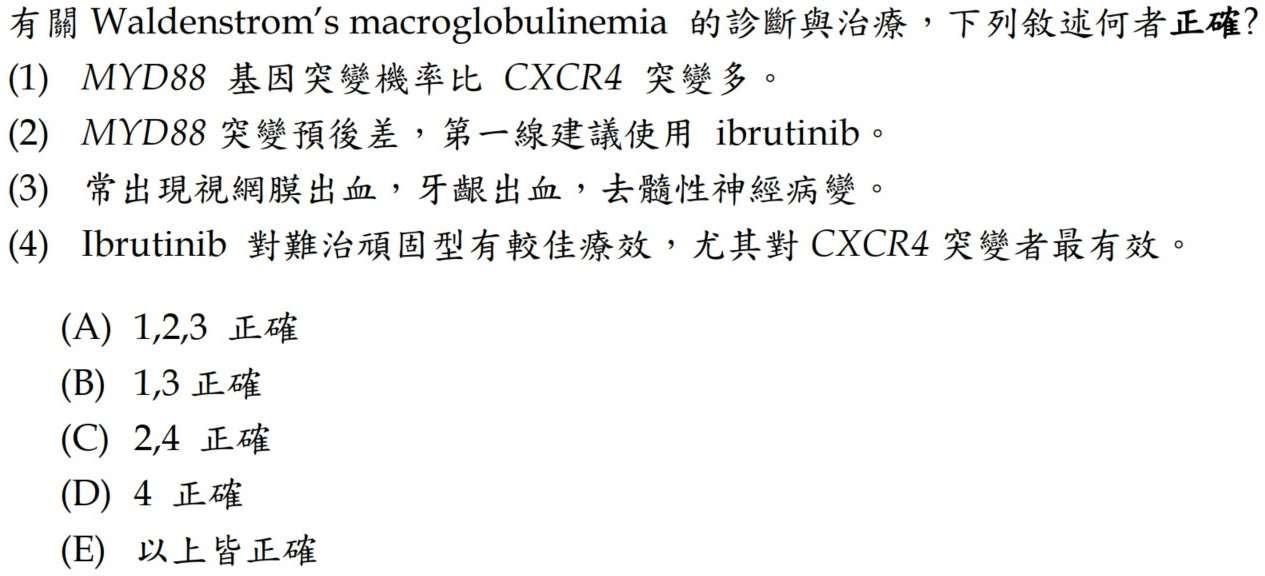
Q1. 有關 Waldenstrom’s macroglobulinemia 的診斷與治療,下列敘述何者正確?
- (A) 1,2,3 正確
- (B) 1,3 正確
- (C) 2,4 正確
- (D) 4 正確
- (E) 以上皆正確
點此顯示正解
(B) 1,3 正確
詳解
Analysis of the Taiwan Board Question
The correct answer is (B) — statements 1 and 3 are TRUE, while statements 2 and 4 are FALSE.
1. Why Answer (B) Matches the Stem
Statement 1 is TRUE: MYD88 mutations occur more frequently than CXCR4 mutations in Waldenström macroglobulinemia. MYD88 L265P mutations are present in 90-97% of WM cases, making it the hallmark genetic alteration235. In contrast, CXCR4 mutations occur in 30-40% of patients2310. This frequency difference is well-established across multiple cohorts.
Statement 3 is TRUE: Bleeding manifestations including retinal hemorrhage, gum bleeding, and CNS involvement (Bing-Neel syndrome) are characteristic features of WM. These complications arise from hyperviscosity syndrome due to elevated IgM monoclonal protein, which causes mucosal bleeding, blurred vision, and headache2. Bing-Neel syndrome, the CNS manifestation of WM, occurs in approximately 1% of patients2. The question's reference to "去髓性神經病變" (demyelinating neuropathy) aligns with both peripheral neuropathy and CNS involvement seen in WM.
2. Why Statements 2 and 4 are FALSE
Statement 2 is FALSE for two critical reasons:
First, MYD88 mutations alone do NOT confer worse prognosis — in fact, the opposite is true. Patients with wild-type MYD88 show increased risk of death despite lower bone marrow disease burden310. MYD88-mutated patients actually have favorable outcomes, particularly when treated with BTK inhibitors45. The adverse prognostic impact emerges when MYD88 mutations are co-mutated with CXCR4, not from MYD88 alone14.
Second, ibrutinib is not universally recommended as first-line therapy. While ibrutinib is approved and effective in WM, alkylating drugs (bendamustine or cyclophosphamide) combined with rituximab remain established first-line options28. BTK inhibitors are particularly indicated for patients unsuitable for immunochemotherapy or in the relapsed/refractory setting8[^11].
Statement 4 is FALSE: While ibrutinib is effective in relapsed/refractory WM, CXCR4 mutations are associated with REDUCED efficacy, not enhanced efficacy. Patients with MYD88-mutated/CXCR4 wild-type genotype exhibit the best responses to ibrutinib (94% major response rate, 1.8 months to major response)710. In contrast, patients with CXCR4 mutations show: - Lower response rates (71% vs 94% major response)7 - Delayed time to response (7.3 vs 1.8 months)7 - Shorter progression-free survival (18 months median PFS in CXCR4-mutated vs not reached in wild-type)9
CXCR4 mutations promote drug resistance through AKT and ERK signaling in the presence of CXCL12310. This is why next-generation BTK inhibitors like zanubrutinib may offer advantages in CXCR4-mutated patients[^11].
3. Supporting Evidence
The genomic landscape of WM demonstrates the near-universal presence of MYD88 mutations compared to the subset with CXCR4 mutations. ![Figure 1: Mutational and cytogenetic analyses of Waldenström macroglobulinemia (WM) samples by chromosome banding analysis (CBA), FISH and/or targeted sequencing. Each column represents a patient sample and each row a mutated gene (italic) or cytogenetic abnormality. The percentage of each mutated gene or cytogenetic abnormality in the whole cohort are indicated on the right of the grid. Complex karyotypes (CK) are represented at the top for highly CK (high‐CK) and non‐high‐CK in respective dark blue and light blue. Colored box, presence; white box, absence; light gray box, not available [Color figure can be viewed at wileyonlinelibrary.com ]](https://storage.googleapis.com/wiley-multimedia/cms/10.1002_ajh.26339/asset/7113a84d-75d5-45e9-95fb-b1df0f990261/assets/images/large/ajh26339-fig-0001.jpg)
The iNNOVATE trial established that combining ibrutinib with rituximab provides benefit across all genotypes, though single-agent ibrutinib efficacy remains genotype-dependent.
The cited reference (Am J Hematol 2018;93:187-194) likely corresponds to consensus recommendations on WM diagnosis and management that would support these distinctions regarding mutation frequencies, prognostic implications, and treatment selection based on molecular features3710.
詳解 · 中文翻譯
台灣血液委員會試題分析
正確答案為 (B) — 第 1 和 3 敘述正確,第 2 和 4 敘述錯誤。
1. 為何答案 (B) 符合題幹
敘述 1 正確:MYD88 突變比 CXCR4 突變更常見於 Waldenström 巨球蛋白血症。MYD88 L265P 突變存在於 90-97% 的 WM 患者中,為該疾病的特徵性遺傳改變235。相比之下,CXCR4 突變僅出現於 30-40% 的患者2310。這個頻率差異在多個隊列研究中得到證實。
敘述 3 正確:出血表現包括視網膜出血、牙齦出血及中樞神經系統受累(Bing-Neel 症候群)是 WM 的特徵。這些併發症源於高粘度症候群,由升高的 IgM 單克隆蛋白引起,導致粘膜出血、視物模糊及頭痛2。Bing-Neel 症候群為 WM 的中樞神經系統表現,發生於約 1% 的患者2。題目提及的「去髓性神經病變」與 WM 中所見的周邊神經病變及中樞神經系統受累相符。
2. 為何敘述 2 和 4 錯誤
敘述 2 錯誤,原因有二:
首先,MYD88 突變單獨不會導致預後惡化 — 實際上相反。野生型 MYD88 患者儘管骨髓疾病負荷較低,卻顯示 死亡風險增加310。MYD88 突變患者實際上預後良好,特別是接受 BTK 抑制劑治療者45。不良預後影響僅在 MYD88 突變 合併 CXCR4 突變時出現,而非 MYD88 單獨引起14。
其次,ibrutinib 並非通用的一線治療。雖然 ibrutinib 在 WM 中已批准且有效,含有烷化劑(bendamustine 或 cyclophosphamide)合併 rituximab 的方案仍為確立的一線選擇28。BTK 抑制劑特別適用於不適合免疫化療或復發/難治患者8[^11]。
敘述 4 錯誤:雖然 ibrutinib 對復發/難治 WM 有效,CXCR4 突變與療效降低相關,非增強。具有 MYD88 突變/CXCR4 野生型基因型的患者展現 最佳應答(主要應答率 94%,達到主要應答時間 1.8 個月)710。相對地,CXCR4 突變患者表現為: - 應答率較低(71% vs 94% 主要應答)7 - 應答時間延遲(7.3 vs 1.8 個月)7 - 無進展存活期較短(CXCR4 突變患者中位無進展存活期 18 個月,vs 野生型未達中位)9
CXCR4 突變通過 CXCL12 存在下的 AKT 和 ERK 信號傳導促進藥物耐藥310。這是為何下一代 BTK 抑制劑如 zanubrutinib 在 CXCR4 突變患者中可能提供優勢的原因[^11]。
3. 支持證據
WM 的基因組圖譜顯示 MYD88 突變幾乎通用,而 CXCR4 突變則僅見於部分患者。
iNNOVATE 試驗確立 ibrutinib 合併 rituximab 在各基因型患者中均有益,雖然單一藥物 ibrutinib 的療效仍取決於基因型。
所引用參考文獻 (Am J Hematol 2018;93:187-194) 可能對應 WM 診斷與治療的共識建議,支持這些關於突變頻率、預後影響及基於分子特徵的治療選擇的區別3710。
參考文獻 (AMA)
-
Silkenstedt E, Salles G, Campo E, Dreyling M. B-Cell Non-Hodgkin Lymphomas. Lancet (London, England). 2024;403(10438):1791-1807. doi:10.1016/S0140-6736(23)02705-8. PMID:38614113. ↩↩
-
Hunter ZR, Yang G, Xu L, et al. Genomics, Signaling, and Treatment of Waldenström Macroglobulinemia. Journal of Clinical Oncology : Official Journal of the American Society of Clinical Oncology. 2017;35(9):994-1001. doi:10.1200/JCO.2016.71.0814. PMID:28294689. ↩↩↩↩↩↩↩↩↩↩
-
Banerjee Nair S, Hyun TS, Naresh KN. MYD88 Gene and Protein: Molecular Architecture, Signalling Mechanisms and Clinical Implications in Lymphoid Malignancies. Journal of Clinical Pathology. 2026;79(6):363-369. doi:10.1136/jcp-2026-210690. PMID:41922162. ↩↩↩↩↩↩↩↩↩↩
-
Yan Y, Chen W, Yu Y, et al. Prognostic Significance of Clinical Risk Models and Genomic Alterations in Waldenström Macroglobulinemia Before or After the BTK Inhibitor Era. Leukemia. 2026;:10.1038/s41375-026-02919-0. doi:10.1038/s41375-026-02919-0. PMID:41912911. ↩↩↩↩
-
Yan Y, Yu Y, Xiong W, et al. Determination of MYD88 and CXCR4 Mutations for Clinical Detection and Their Significance in Waldenström Macroglobulinemia. Clinical Cancer Research : An Official Journal of the American Association for Cancer Research. 2024;30(23):5483-5493. doi:10.1158/1078-0432.CCR-23-3939. PMID:39373694. ↩↩↩↩
-
Buske C, Jurczak W, Salem JE, Dimopoulos MA. Managing Waldenström's Macroglobulinemia With BTK Inhibitors. Leukemia. 2023;37(1):35-46. doi:10.1038/s41375-022-01732-9. PMID:36402930. ↩
-
Treon SP, Gustine J, Meid K, et al. Ibrutinib Monotherapy in Symptomatic, Treatment-Naïve Patients With Waldenström Macroglobulinemia. Journal of Clinical Oncology : Official Journal of the American Society of Clinical Oncology. 2018;36(27):2755-2761. doi:10.1200/JCO.2018.78.6426. PMID:30044692. ↩↩↩↩↩↩↩↩
-
Trotman J, Buske C, Tedeschi A, et al. Single-Agent Ibrutinib for Rituximab-Refractory Waldenström Macroglobulinemia: Final Analysis of the Substudy of the Phase III InnovateTM Trial. Clinical Cancer Research : An Official Journal of the American Association for Cancer Research. 2021;27(21):5793-5800. doi:10.1158/1078-0432.CCR-21-1497. PMID:34380643. ↩↩↩↩
-
Krzisch D, Guedes N, Boccon-Gibod C, et al. Cytogenetic and Molecular Abnormalities in Waldenström's Macroglobulinemia Patients: Correlations and Prognostic Impact. American Journal of Hematology. 2021;96(12):1569-1579. doi:10.1002/ajh.26339. PMID:34462944. ↩↩
-
Dimopoulos MA, Tedeschi A, Trotman J, et al. Phase 3 Trial of Ibrutinib Plus Rituximab in Waldenström's Macroglobulinemia. The New England Journal of Medicine. 2018;378(25):2399-2410. doi:10.1056/NEJMoa1802917. PMID:29856685. ↩↩↩↩↩↩↩↩↩↩
Slide annotations
Am J Hematol. 2018;93(2):187-194.
Figures