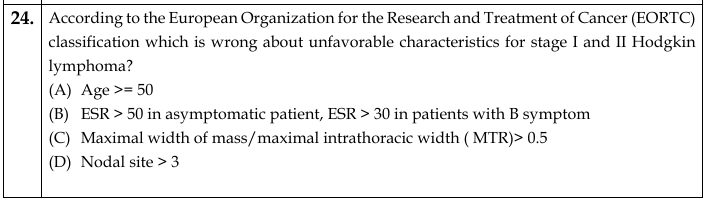
Q24. According to the European Organization for the Research and Treatment of Cancer (EORTC) classification which is wrong about unfavorable characteristics for stage I and II Hodgkin lymphoma?
- (A) Age >= 50
- (B) ESR > 50 in asymptomatic patient, ESR > 30 in patients with B symptom
- (C) Maximal width of mass/maximal intrathoracic width (MTR)> 0.5
- (D) Nodal site > 3
點此顯示正解
(C) Maximal width of mass/maximal intrathoracic width (MTR)> 0.5
詳解
Answer
Option (C) is the incorrect statement because the EORTC uses a mediastinal-to-thoracic ratio (MTR) threshold of >0.35, not >0.5, to define unfavorable characteristics in early-stage Hodgkin lymphoma4[7][8][^9].
The NCCN guidelines provide a helpful comparison table showing the differences between major risk stratification systems:

Why (C) is Wrong
The EORTC defines bulky mediastinal disease as a mediastinal/thoracic ratio >0.35 (measured as the maximum width of mediastinal mass divided by the intrathoracic diameter at T5-6 on chest radiograph)4[7][8][^9]. The threshold of 0.5 stated in option (C) is incorrect and would miss a substantial proportion of patients with unfavorable disease. For comparison, the German Hodgkin Study Group (GHSG) uses an even lower threshold of >0.33 for their mediastinal mass ratio[^7].
Why the Other Options Are Correct
(A) Age ≥50 is a true EORTC unfavorable factor. The EORTC specifically defines age ≥50 years (or "older than 49 years") as an unfavorable prognostic factor for stage I-II disease124[7][9][^10].
(B) ESR >50 in asymptomatic patients, ESR >30 in patients with B symptoms is a true EORTC unfavorable factor. The EORTC criteria specify ESR >50 mm/h in asymptomatic (A symptom) patients or ESR >30 mm/h in patients with B symptoms as unfavorable124[7][9][^10].
(D) Nodal site >3 is a true EORTC unfavorable factor. The EORTC defines involvement of ≥4 nodal areas (i.e., more than 3) as an unfavorable characteristic124[7][9][^10]. This differs from the GHSG, which uses ≥3 nodal regions as their threshold[^7].
詳解 · 中文翻譯
答案
選項 (C) 是不正確的陳述,因為 EORTC 使用縱隔對胸腔比率 (MTR) 閾值 >0.35(而非 >0.5)來定義早期霍奇金淋巴瘤的不利特徵4[7][8][^9]。
為何 (C) 錯誤
EORTC 定義為 mediastinal/thoracic 比率 >0.35 的大塊縱隔疾病(測定為胸部 X 線 T5-6 處縱隔病塊的最大寬度除以胸腔內直徑)4[7][8][^9]。選項 (C) 中陳述的 0.5 閾值是不正確的,將遺漏大量具有不利疾病的患者。相比之下,德國霍奇金研究組(GHSG)對其縱隔腫塊比率使用更低的 >0.33 閾值[^7]。
其他選項為何正確
(A) 年齡 ≥50 是真實的 EORTC 不利因素。EORTC 特別定義年齡 ≥50 歲(或「超過 49 歲」)為第 I-II 期疾病的不利預後因素124[7][9][^10]。
(B) 無症狀患者 ESR >50,有 B 症狀患者 ESR >30 是真實的 EORTC 不利因素。EORTC 標準指定無症狀(A 症狀)患者 ESR >50 mm/h 或有 B 症狀患者 ESR >30 mm/h 為不利124[7][9][^10]。
(D) 結點位點 >3 是真實的 EORTC 不利因素。EORTC 定義 ≥4 個結點區域(即超過 3)的浸潤為不利特徵124[7][9][^10]。這不同於使用 ≥3 個結點區域作為其閾值的 GHSG[^7]。
參考文獻 (AMA)
-
Yung L, Linch D. Hodgkin's Lymphoma. Lancet (London, England). 2003;361(9361):943-51. doi:10.1016/S0140-6736(03)12777-8. PMID:12648984. ↩↩↩↩↩↩
-
National Comprehensive Cancer Network. Hodgkin Lymphoma. https://www.nccn.org/professionals/physician_gls/pdf/hodgkins.pdf#page=11. ↩↩↩↩↩↩
-
Townsend W, Linch D. Hodgkin's Lymphoma in Adults. Lancet (London, England). 2012;380(9844):836-47. doi:10.1016/S0140-6736(12)60035-X. PMID:22835602. ↩
-
Goldkuhle M, Kreuzberger N, von Tresckow B, et al. Chemotherapy Alone Versus Chemotherapy Plus Radiotherapy for Adults With Early-Stage Hodgkin's Lymphoma. The Cochrane Database of Systematic Reviews. 2024;12:CD007110. doi:10.1002/14651858.CD007110.pub4. PMID:39620432. ↩↩↩↩↩↩↩↩↩↩
-
Brice P, de Kerviler E, Friedberg JW. Classical Hodgkin Lymphoma. Lancet (London, England). 2021;398(10310):1518-1527. doi:10.1016/S0140-6736(20)32207-8. PMID:33493434. ↩
Slide correction
0.35
Slide annotations
Risk factor table provided for GHSG, EORTC, and NCCN classifications.
Figures