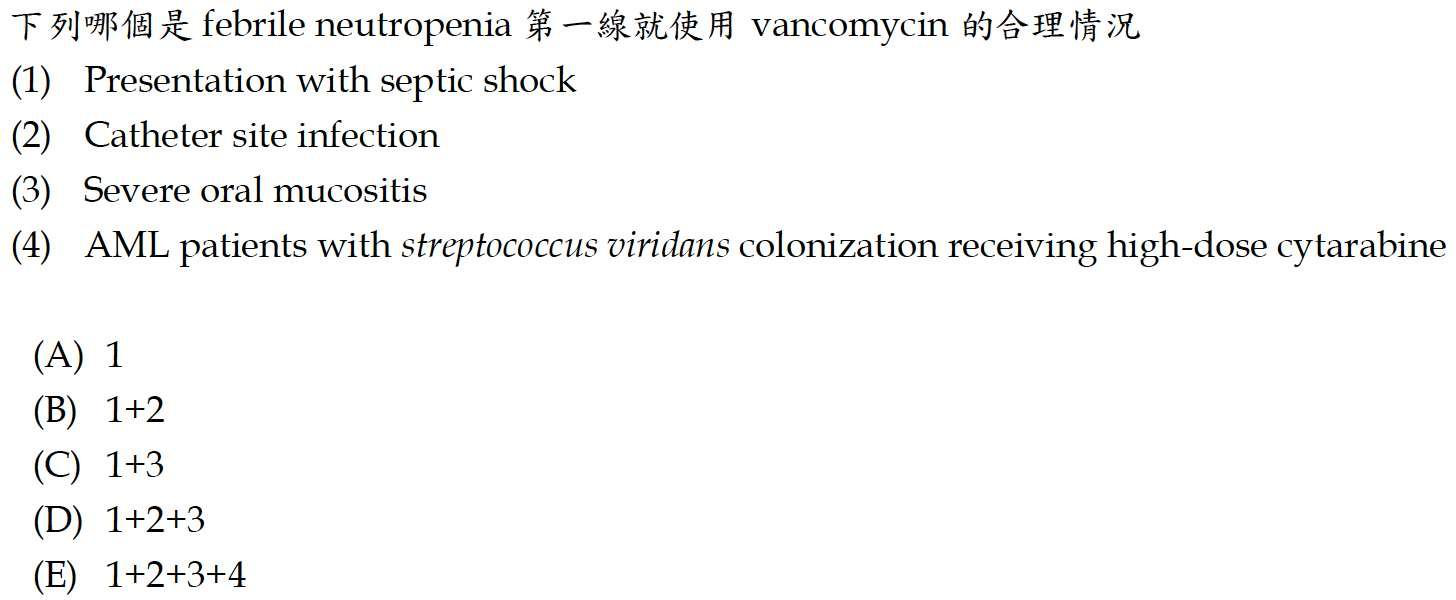
Q1. 下列哪個是 febrile neutropenia 第一線就使用 vancomycin 的合理情況
(1) Presentation with septic shock (2) Catheter site infection (3) Severe oral mucositis (4) AML patients with streptococcus viridans colonization receiving high-dose cytarabine
- (A) 1
- (B) 1+2
- (C) 1+3
- (D) 1+2+3
- (E) 1+2+3+4
點此顯示正解
(D) 1+2+3
詳解
Analysis of the Board Question
The correct answer (D) "1+2+3" aligns with guideline-based indications for empiric vancomycin in febrile neutropenia.
Why statements (1), (2), and (3) are appropriate indications:
(1) Presentation with septic shock is a clear indication for empiric vancomycin. Hemodynamic instability and septic shock are consistently cited as specific clinical indications requiring gram-positive coverage in febrile neutropenia134[^17]. Adequate empirical antibiotic therapy is protective against early death, and shock is associated with increased mortality in febrile neutropenia[^11].
(2) Catheter site infection is an established indication for empiric vancomycin. Both IDSA/ASCO and NCCN guidelines specifically recommend vancomycin for suspected or proven catheter-related infections1234[^17]. The NCCN algorithm states "Vancomycin initially or add if site not responding after 48 hours of empiric therapy" for vascular access device entry site inflammation2.
(3) Severe oral mucositis is an appropriate indication for empiric vancomycin due to the risk of viridans group streptococcal (VGS) bacteremia. While not explicitly listed in the basic IDSA recommendations shown above, severe mucositis is recognized as a risk factor for VGS bacteremia, particularly in patients receiving intensive chemotherapy4[^16]. Mucositis causes mucosal barrier injury that predisposes to translocation of oral flora, especially viridans streptococci, which can cause severe sepsis and adult respiratory distress syndrome[^16]. The NCCN guidelines reference mouth and esophageal complications requiring site-specific evaluation2.
Why statement (4) is NOT a standard first-line empiric vancomycin indication:
(4) AML patients with streptococcus viridans colonization receiving high-dose cytarabine represents a more nuanced scenario. While these patients are at increased risk for VGS bacteremia, the statement as written suggests routine prophylactic vancomycin for all such patients, which is not standard practice.
Key considerations: - High-dose cytarabine (HDAC) causes fever that is often drug-induced rather than infectious. A pediatric study found that among 82 febrile episodes during HDAC administration, there were essentially no positive blood cultures, suggesting that "broad-spectrum empiric antibiotic regimens including vancomycin may be unnecessary for these patients, particularly before they become neutropenic"[^13]. - VGS colonization alone does not mandate empiric vancomycin. Guidelines recommend vancomycin for known colonization with resistant organisms (MRSA, penicillin-resistant streptococci), not simply VGS colonization1[^17]. - Empiric vancomycin would be appropriate if these patients develop febrile neutropenia with severe mucositis (which combines statements 3 and 4), but not routinely for all AML patients on HDAC with VGS colonization. - Studies show that while VGS bacteremia is common in AML patients (particularly with mucositis and neutropenia), many VGS strains remain susceptible to standard beta-lactam therapy[^15]. Routine vancomycin prophylaxis raises concerns about antimicrobial resistance[14][15].
The distinction is that statement (4) describes a risk profile rather than an active clinical indication. When these high-risk patients actually develop febrile neutropenia with severe mucositis, empiric vancomycin becomes appropriate (statement 3). But colonization status and chemotherapy regimen alone do not constitute an indication for first-line empiric vancomycin at fever onset.
詳解 · 中文翻譯
董事會問題的分析
正確答案 (D)「1+2+3」 符合發熱性中性粒細胞減少症經驗性萬古黴素使用的指南適應症。
為什麼敘述 (1)、(2) 和 (3) 是適當的適應症:
(1) 膿毒性休克表現是經驗性萬古黴素的明確適應症。血液動力學不穩定性和膿毒性休克被一致引用為發熱性中性粒細胞減少症中需要革蘭氏陽性菌覆蓋的特定臨床適應症134[17]。充分的經驗性抗生素治療對預防早期死亡有保護作用,休克與發熱性中性粒細胞減少症死亡率增加相關[11]。
(2) 導管部位感染是經驗性萬古黴素的既定適應症。IDSA/ASCO 和 NCCN 指南都特別推薦對懷疑或已證實的導管相關感染使用萬古黴素1234[^17]。NCCN 演算法為血管通路裝置進入部位炎症規定「初始時使用萬古黴素或在經驗性治療 48 小時後無反應時添加」2。
(3) 嚴重口腔黏膜炎由於綠色鏈球菌(VGS)菌血症的風險,是經驗性萬古黴素的適當適應症。雖然在上述基本 IDSA 建議中未明確列出,但嚴重黏膜炎被公認為 VGS 菌血症的風險因素,特別是在接受密集化療的患者中4[16]。黏膜炎導致黏膜屏障損傷,傾向於口腔菌群易位,特別是綠色鏈球菌,可引起嚴重膿毒症和成人呼吸窘迫症候群[16]。NCCN 指南涉及需要部位特異性評估的口腔和食管並發症2。
為什麼敘述 (4) 不是標準的一線經驗性萬古黴素適應症:
(4) 接受高劑量阿糖胞苷的 AML 患者且綠色鏈球菌殖民化代表更複雜的情景。儘管這些患者的 VGS 菌血症風險增加,但所述敘述提示對所有此類患者進行常規預防性萬古黴素,這不是標準實踐。
關鍵考慮: - 高劑量阿糖胞苷(HDAC)導致發熱,通常是藥物引起而非感染性。一項小兒研究發現,在 HDAC 給藥期間的 82 個發熱事件中,基本上沒有陽性血液培養,提示「對這些患者,特別是在他們變得中性粒細胞減少症前,包括萬古黴素的廣譜經驗性抗生素治療方案可能是不必要的」[^13]。 - 單獨的 VGS 殖民化不強制經驗性萬古黴素。指南建議對已知殖民於耐藥生物(MRSA、青黴素耐受鏈球菌)使用萬古黴素,而不僅是 VGS 殖民化1[^17]。 - 經驗性萬古黴素將是適當的,如果這些患者發展為發熱性中性粒細胞減少症伴嚴重黏膜炎(結合敘述 3 和 4),但不是對所有 HDAC 患者及 VGS 殖民化的常規治療。 - 研究表明,儘管 VGS 菌血症在 AML 患者中常見(特別是伴黏膜炎和中性粒細胞減少症),許多 VGS 菌株仍對標準 beta-內酰胺類抗生素敏感[15]。常規萬古黴素預防引發了對抗菌素耐受性的關注[14][^15]。
區別在於敘述 (4) 描述了風險特徵而不是活躍的臨床適應症。當這些高風險患者實際發展為發熱性中性粒細胞減少症伴嚴重黏膜炎時,經驗性萬古黴素變得適當(敘述 3)。但殖民化狀態和化療方案單獨不構成發熱起始時一線經驗性萬古黴素的適應症。
參考文獻 (AMA)
-
Taplitz RA, Kennedy EB, Bow EJ, et al. Outpatient Management of Fever and Neutropenia in Adults Treated for Malignancy: American Society of Clinical Oncology and Infectious Diseases Society of America Clinical Practice Guideline Update. Journal of Clinical Oncology : Official Journal of the American Society of Clinical Oncology. 2018;36(14):1443-1453. doi:10.1200/JCO.2017.77.6211. PMID:29461916. ↩↩↩↩↩↩
-
Stevens DL, Bisno AL, Chambers HF, et al. Practice Guidelines for the Diagnosis and Management of Skin and Soft Tissue Infections: 2014 Update by the Infectious Diseases Society of America. Clinical Infectious Diseases : An Official Publication of the Infectious Diseases Society of America. 2014;59(2):147-59. doi:10.1093/cid/ciu296. PMID:24947530. ↩↩↩↩↩↩
-
Perreault S, McManus D, Bar N, et al. The Impact of a Multimodal Approach to Vancomycin Discontinuation in Hematopoietic Stem Cell Transplant Recipients (HSCT) With Febrile Neutropenia (FN). Transplant Infectious Disease : An Official Journal of the Transplantation Society. 2019;21(2):e13059. doi:10.1111/tid.13059. PMID:30737868. ↩↩↩↩
-
Guarana M, Nucci M, Nouér SA. Shock and Early Death in Hematologic Patients With Febrile Neutropenia. Antimicrobial Agents and Chemotherapy. 2019;63(11):e01250-19. doi:10.1128/AAC.01250-19. PMID:31405857. ↩↩↩↩↩↩
-
National Comprehensive Cancer Network. Prevention and Treatment of Cancer-Related Infections. https://www.nccn.org/professionals/physician_gls/pdf/infections.pdf#page=36. ↩
-
Blijlevens NM, Donnelly JP, de Pauw BE. Empirical Therapy of Febrile Neutropenic Patients With Mucositis: Challenge of Risk-Based Therapy. Clinical Microbiology and Infection : The Official Publication of the European Society of Clinical Microbiology and Infectious Diseases. 2001;7 Suppl 4:47-52. doi:10.1046/j.1469-0691.2001.00058.x. PMID:11688534. ↩
-
Hoover A, Zimmerman JAO, Wiese S, Modi A. Evaluation of Empiric Vancomycin for Fevers During High-Dose Cytarabine Administration. Journal of Pediatric Hematology/Oncology. 2021;43(7):e1010-e1014. doi:10.1097/MPH.0000000000002073. PMID:33560084. ↩
-
Johannsen KH, Handrup MM, Lausen B, Schrøder H, Hasle H. High Frequency of Streptococcal Bacteraemia During Childhood AML Therapy Irrespective of Dose of Cytarabine. Pediatric Blood & Cancer. 2013;60(7):1154-60. doi:10.1002/pbc.24448. PMID:23281248. ↩
-
Sun Y, Huskey RL, Tang L, et al. Adverse Effects of Intravenous Vancomycin-Based Prophylaxis During Therapy for Pediatric Acute Myeloid Leukemia. Antimicrobial Agents and Chemotherapy. 2018;62(3):e01838-17. doi:10.1128/AAC.01838-17. PMID:29229640. ↩
Figures