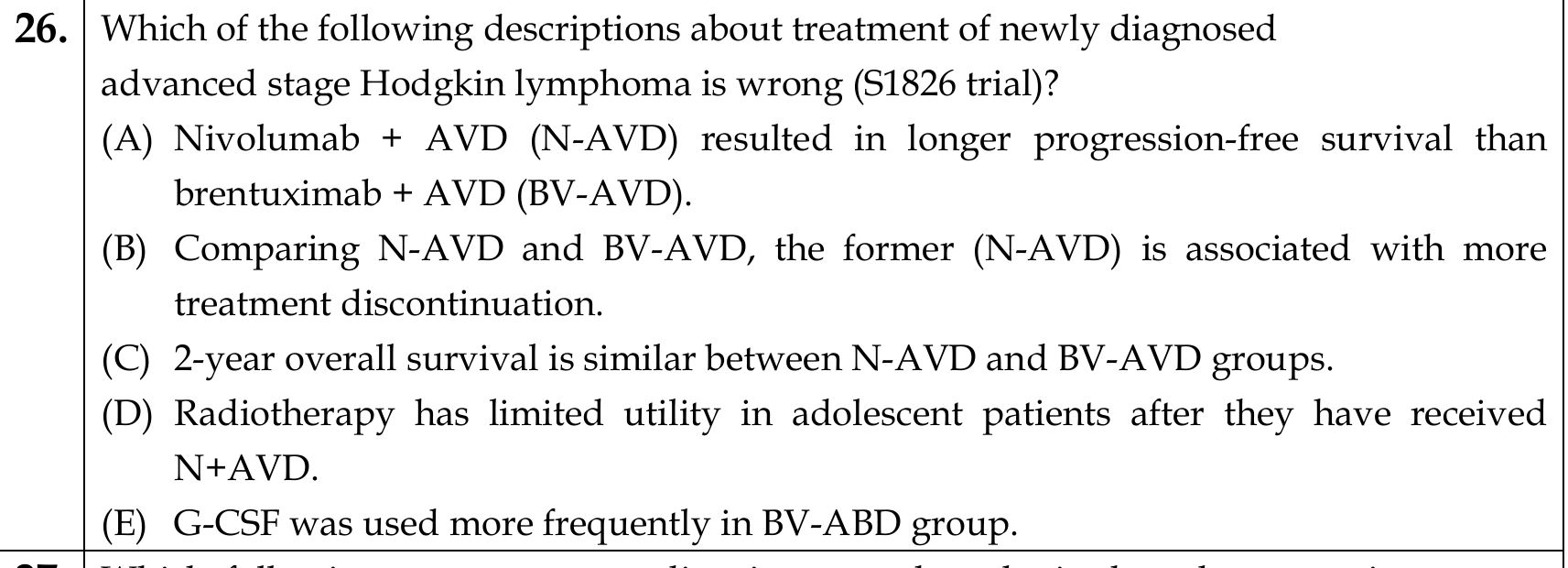
Q26. Which of the following descriptions about treatment of newly diagnosed advanced stage Hodgkin lymphoma is wrong (S1826 trial)?
- (A) Nivolumab + AVD (N-AVD) resulted in longer progression-free survival than brentuximab + AVD (BV-AVD).
- (B) Comparing N-AVD and BV-AVD, the former (N-AVD) is associated with more treatment discontinuation.
- (C) 2-year overall survival is similar between N-AVD and BV-AVD groups.
- (D) Radiotherapy has limited utility in adolescent patients after they have received N+AVD.
- (E) G-CSF was used more frequently in BV-ABD group.
點此顯示正解
(B) Comparing N-AVD and BV-AVD, the former (N-AVD) is associated with more treatment discontinuation.
詳解
Analysis of S1826 Trial Question
The stem asks for the WRONG (incorrect) statement about the S1826 trial. The correct answer is (B).
1. Why (B) is the INCORRECT statement
Option (B) states that "N-AVD is associated with more treatment discontinuation" compared to BV-AVD. This is false. In the S1826 trial, brentuximab vedotin was associated with more treatment discontinuation than nivolumab2[16][17]. The trial explicitly reported that "brentuximab vedotin was associated with more treatment discontinuation"2[^17]. In the subset analysis of older patients (≥60 years), 55% discontinued brentuximab vedotin compared to only 14% who discontinued nivolumab[14][15]. N-AVD had a superior safety profile with fewer patients stopping treatment early1.
2. Why the other options are TRUE statements
(A) TRUE: N-AVD resulted in longer progression-free survival than BV-AVD. At 2-year follow-up, PFS was 92% (95% CI, 89-94) with N-AVD versus 83% (95% CI, 79-86) with BV-AVD (HR 0.45; 95% CI, 0.30-0.65)24. This was the primary endpoint of the trial and demonstrated statistically significant superiority24.
(C) TRUE: 2-year overall survival was similar between the two groups. While N-AVD showed a trend toward better OS, the difference did not reach statistical significance at the 2-year analysis, likely due to short follow-up and small number of death events14. Both regimens demonstrated excellent overall survival rates.
(D) TRUE: Radiotherapy had limited utility after N-AVD. Overall, only 7 patients in the entire trial received end-of-treatment radiotherapy2[^17]. In the adolescent subset specifically, only 1 patient receiving N-AVD received protocol-specified residual site radiotherapy[7][8]. This represented a "dramatic reduction in the use of radiation in adolescent patients as compared with contemporary regimens"1.
(E) TRUE: G-CSF was used more frequently in the BV-AVD group. The trial required G-CSF use with BV-AVD but made it optional with N-AVD[^16]. This differential G-CSF use likely ameliorated the frequency of neutropenia in the BV-AVD arm[^16]. Despite higher rates of neutropenia with N-AVD, febrile neutropenia and infections were not increased, and the reduced G-CSF use led to less bone pain in the N-AVD group[^16].
詳解 · 中文翻譯
S1826 試驗問題分析
題目要求關於 S1826 試驗的錯誤(不正確)敘述。正確答案是 (B)。
1. 為什麼 (B) 是不正確的敘述
選項 (B) 指出「相比 BV-AVD,N-AVD 與更多的治療中止相關」。這是假的。在 S1826 試驗中,brentuximab vedotin 與比 nivolumab 更多的治療中止相關2[^17]。試驗明確報告「brentuximab vedotin 與更多的治療中止相關」2[^17]。在較老患者(≥60 歲)的亞組分析中,55% 中止 brentuximab vedotin 與只有 14% 中止 nivolumab[14][15]。N-AVD 有優越的安全性檔案,少數患者提早停止治療1。
2. 為什麼其他選項是真實陳述
(A) 真實:N-AVD 導致比 BV-AVD 更長的無進展生存。在 2 年隨訪時,PFS 為 92%(95% CI,89-94)與 N-AVD 相比 83%(95% CI,79-86)與 BV-AVD(HR 0.45;95% CI,0.30-0.65)24。這是試驗的主要終點並證實統計學上的顯著優越性24。
(C) 真實:2 年總生存在兩個組之間相似。雖然 N-AVD 顯示對更好的 OS 的趨勢,差異在 2 年分析時沒有達到統計學意義,可能因短隨訪和小死亡事件數14。兩種方案都展示優越的總生存率。
(D) 真實:放療在 N-AVD 後有限效用。整體上,整個試驗中只有 7 名患者接受治療結束放療2[^17]。在青年亞群特別地,只有 1 名接受 N-AVD 的患者接受協議指定的殘留位點放療[7][8]。這代表「與當代方案相比在青年患者中放射使用的戲劇性減少」1。
(E) 真實:G-CSF 在 BV-AVD 組中更頻繁使用。試驗需要 G-CSF 與 BV-AVD 一起使用,但用 N-AVD 使其可選[^16]。此差異 G-CSF 使用可能改善了 BV-AVD 臂中中性粒細胞減少症的頻率[^16]。儘管 N-AVD 具有更高的中性粒細胞減少症率,發熱性中性粒細胞減少症和感染沒有增加,並且減少的 G-CSF 使用導致 N-AVD 組中較少的骨痛[^16]。
參考文獻 (AMA)
-
Herrera AF, LeBlanc M, Castellino SM, et al. Nivolumab+AVD in Advanced-Stage Classic Hodgkin's Lymphoma. The New England Journal of Medicine. 2024;391(15):1379-1389. doi:10.1056/NEJMoa2405888. PMID:39413375. ↩↩↩↩↩↩
-
Rutherford SC, Li H, Herrera AF, et al. Nivolumab-Avd Versus Brentuximab Vedotin-Avd in Older Patients With Advanced-Stage Classic Hodgkin Lymphoma Enrolled on S1826. Journal of Clinical Oncology : Official Journal of the American Society of Clinical Oncology. 2025;:JCO2500204. doi:10.1200/JCO-25-00204. PMID:40523203. ↩↩↩↩↩↩↩↩↩↩
-
Rutherford SC, Li H, Herrera AF, et al. Nivolumab-Avd Versus Brentuximab Vedotin-Avd in Older Patients With Advanced-Stage Classic Hodgkin Lymphoma Enrolled on S1826. Journal of Clinical Oncology : Official Journal of the American Society of Clinical Oncology. 2025;43(27):2968-2973. doi:10.1200/JCO-25-00204. PMID:40523203. ↩
-
Castellino SM, Li H, Herrera AF, et al. Three-Year Follow-Up Of Nivolumab-Avd Versus Brentuximab Vedotin-Avd in Adolescents With Advanced-Stage Classic Hodgkin Lymphoma on S1826. Journal of Clinical Oncology : Official Journal of the American Society of Clinical Oncology. 2026;44(6):449-454. doi:10.1200/JCO-25-00203. PMID:41512237. ↩↩↩↩↩↩
Figures