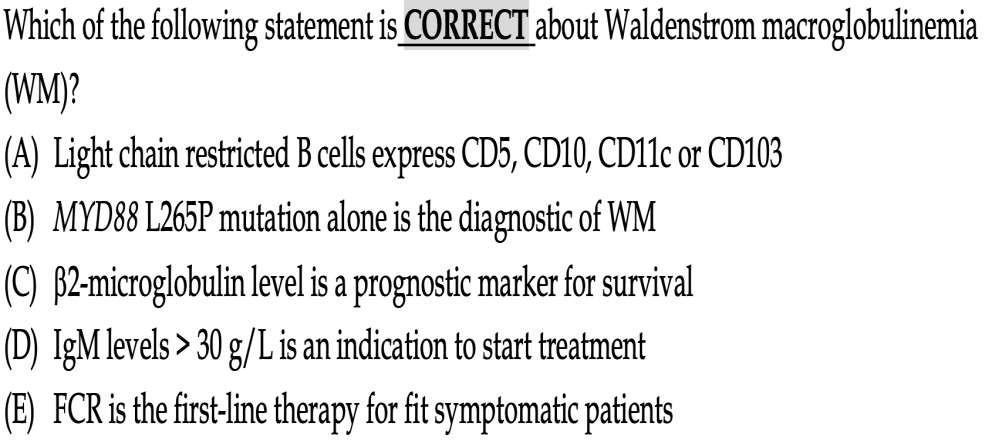
Q1. Which of the following statement is CORRECT about Waldenstrom macroglobulinemia (WM)?
- (A) Light chain restricted B cells express CD5, CD10, CD11c or CD103
- (B) MYD88 L265P mutation alone is the diagnostic of WM
- (C) β2-microglobulin level is a prognostic marker for survival
- (D) IgM levels > 30 g/L is an indication to start treatment
- (E) FCR is the first-line therapy for fit symptomatic patients
點此顯示正解
(C) β2-microglobulin level is a prognostic marker for survival
詳解
Analysis of Board Question
1) Why (C) is CORRECT:
β2-microglobulin level is a prognostic marker for survival in Waldenström macroglobulinemia. The NCCN guidelines list β2-microglobulin as an essential component of the workup2, and it is incorporated into the Modified Staging System for WM (MSS-WM) as a prognostic factor4. Additionally, β2-microglobulin can be used along with bone marrow involvement, serum IgM, and albumin to estimate time until treatment initiation[^9]. This makes statement (C) the correct answer to the question asking for a true statement.
2) Why the other options are INCORRECT:
(A) Light chain restricted B cells express CD5, CD10, CD11c or CD103 - FALSE
The typical immunophenotype of WM cells is CD19+, CD20+, sIgM+, and the cells typically test negative for CD3 and CD1033. While CD5, CD10, and CD23 may be positive in 10-20% of cases, this does not exclude the diagnosis24. The statement is incorrect because it suggests these markers (particularly CD103) are characteristically expressed, when in fact CD103 is typically negative. CD103 expression is more characteristic of hairy cell leukemia, not WM.
(B) MYD88 L265P mutation alone is diagnostic of WM - FALSE
While the MYD88 L265P mutation is the hallmark of WM and present in over 95% of cases1, it is not diagnostic by itself. The diagnosis of WM requires clinicopathological criteria including: (1) bone marrow infiltration by lymphoplasmacytic lymphoma cells, (2) serum IgM monoclonal paraprotein, and (3) presence of MYD88 L265P mutation[^9]. The NCCN guidelines explicitly state that MYD88 wild-type occurs in <10% of patients and should not be used to exclude diagnosis if other criteria are met2. Furthermore, MYD88 L265P can also be found in IgM MGUS, so it is not specific to WM alone3.
(D) IgM levels > 30 g/L is an indication to start treatment - FALSE
Treatment should be initiated in symptomatic patients, and elevated IgM levels alone in asymptomatic patients should not be a reason to start treatment except in cases with IgM levels over 60 g/L (not 30 g/L)1[^10]. The consensus recommendations clearly state that initiation of therapy should not be based on serum IgM levels alone, and asymptomatic patients should be observed[^8]. The threshold of 60 g/L is used because patients at this level are at considerably higher risk of developing symptomatic hyperviscosity1.
(E) FCR is the first-line therapy for fit symptomatic patients - FALSE
FCR (fludarabine, cyclophosphamide, rituximab) is not the recommended first-line therapy for WM. The established first-line therapy options are alkylating drugs (bendamustine or cyclophosphamide) in combination with rituximab1[^10]. Other recommended first-line regimens include rituximab combinations with cyclophosphamide/dexamethasone, bendamustine, or bortezomib/dexamethasone[^7]. BTK inhibitors such as zanubrutinib are also approved as first-line treatment[^11]. FCR, which contains the nucleoside analog fludarabine, is not a standard first-line regimen for WM and may be associated with increased toxicity.
詳解 · 中文翻譯
題目分析
1) 為什麼 (C) 是正確的:
β2-微球蛋白水平是 Waldenström 巨球蛋白血症的生存預後標誌。NCCN 指南列出 β2-微球蛋白作為工作核心成分2,並且它納入了 WM 修改分期系統(MSS-WM)作為預後因素4。此外,β2-微球蛋白可與骨髓受累、血清 IgM 和白蛋白一起使用估計治療開始時間[^9]。這使敘述 (C) 成為要求真實敘述的問題的正確答案。
2) 為什麼其他選項是不正確的:
(A) 輕鏈限制 B 細胞表達 CD5、CD10、CD11c 或 CD103 - 假
WM 細胞的典型免疫表型是 CD19+、CD20+、sIgM+,細胞通常測試 CD3 和 CD103 陰性3。雖然 CD5、CD10 和 CD23 可在 10-20% 的病例中為陽性,這不排除診斷24。敘述是不正確的因為它暗示這些標誌(特別是 CD103)特徵性表達,當實際上 CD103 通常為陰性。CD103 表達對毛細胞白血病更特徵性,而不是 WM。
(B) MYD88 L265P 突變單獨診斷 WM - 假
雖然 MYD88 L265P 突變是 WM 的標誌並存在於超過 95% 的病例中1,它本身不是診斷性的。WM 的診斷需要臨床病理標準,包括:(1) 骨髓淋巴漿細胞淋巴瘤細胞浸潤,(2) 血清 IgM 單克隆副蛋白,和 (3) MYD88 L265P 突變的存在[^9]。NCCN 指南明確指出 MYD88 wild-type 發生於 <10% 的患者,如果滿足其他標準,不應被用於排除診斷2。此外,MYD88 L265P 也可在 IgM MGUS 中發現,所以它不是特有於 WM 單獨3。
(D) IgM 水平 > 30 g/L 是開始治療的適應 - 假
治療應在症狀性患者中開始,升高的 IgM 水平單獨在無症狀患者中不應成為開始治療的原因除了 IgM 水平超過 60 g/L(不是 30 g/L)的病例1[^10]。共識建議清楚地指出 therapy 開始不應基於血清 IgM 水平單獨,無症狀患者應被觀察[^8]。60 g/L 的閾值被使用因為在此水平的患者有相當更高的開發症狀性高黏稠度的風險1。
(E) FCR 是適合症狀性患者的一線療法 - 假
FCR(氟達拉濱、環磷酰胺、rituximab)不是 WM 推薦的一線療法。既定的一線療法選項是 alkylating 藥物(苯達莫司汀或環磷酰胺)與 rituximab 組合1[^10]。其他推薦的一線方案包括 rituximab 與環磷酰胺/地塞米松、苯達莫司汀或硼替佐米/地塞米松組合[^7]。BTK 抑制劑如 zanubrutinib 也被批准作為一線治療[^11]。FCR,包含核苷類似物氟達拉濱,不是 WM 的標準一線方案並可與增加的毒性相關。
參考文獻 (AMA)
-
National Comprehensive Cancer Network. Waldenström Macroglobulinemia/Lymphoplasmacytic Lymphoma. https://www.nccn.org/professionals/physician_gls/pdf/waldenstroms.pdf#page=5. ↩↩↩↩↩↩↩↩
-
Castillo JJ, Treon SP. Management of Waldenström Macroglobulinemia in 2020. Hematology. American Society of Hematology. Education Program. 2020;2020(1):372-379. doi:10.1182/hematology.2020000121. PMID:33275726. ↩↩↩↩↩↩
-
Gertz MA. Waldenström Macroglobulinemia: 2017 Update on Diagnosis, Risk Stratification, and Management. American Journal of Hematology. 2017;92(2):209-217. doi:10.1002/ajh.24557. PMID:28094456. ↩↩↩↩
-
Silkenstedt E, Salles G, Campo E, Dreyling M. B-Cell Non-Hodgkin Lymphomas. Lancet (London, England). 2024;403(10438):1791-1807. doi:10.1016/S0140-6736(23)02705-8. PMID:38614113. ↩↩↩↩
-
Dimopoulos MA, Gertz MA, Kastritis E, et al. Update on Treatment Recommendations From the Fourth International Workshop on Waldenstrom's Macroglobulinemia. Journal of Clinical Oncology : Official Journal of the American Society of Clinical Oncology. 2009;27(1):120-6. doi:10.1200/JCO.2008.17.7865. PMID:19047284. ↩
-
Dimopoulos MA, Kastritis E, Owen RG, et al. Treatment Recommendations for Patients With Waldenström Macroglobulinemia (WM) and Related Disorders: IWWM-7 Consensus. Blood. 2014;124(9):1404-11. doi:10.1182/blood-2014-03-565135. PMID:25027391. ↩
Slide annotations
BR/Ibrutibin+/-R/Zanubrutinib ISSWM
Figures