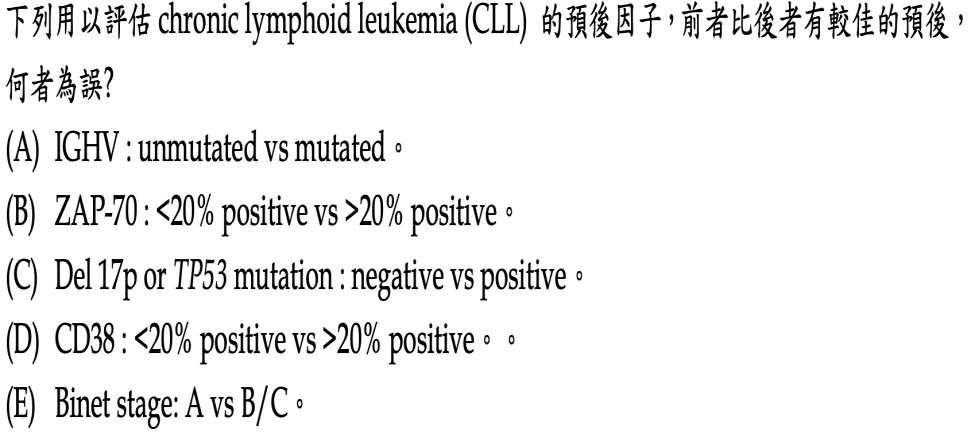
Q1. 下列用以評估 chronic lymphoid leukemia (CLL) 的預後因子,前者比後者有較佳的預後,何者為誤?
- (A) IGHV : unmutated vs mutated 。
- (B) ZAP-70 : <20% positive vs >20% positive 。
- (C) Del 17p or TP53 mutation : negative vs positive 。
- (D) CD38 : <20% positive vs >20% positive 。
- (E) Binet stage: A vs B/C 。
點此顯示正解
(A) IGHV : unmutated vs mutated 。
詳解
Analysis
Option (A) is INCORRECT because it reverses the prognostic significance of IGHV mutation status. Mutated IGHV (not unmutated) indicates a better prognosis in CLL1237[^8]. The question stem asks which pairing incorrectly identifies the former as better prognosis than the latter.
Why (A) is the incorrect pairing:
IGHV mutation status is defined as mutated when there is <98% homology with germline (≥2% deviation) and unmutated when there is ≥98% homology (<2% deviation)127. Patients with mutated IGHV have indolent disease with longer progression-free survival (9.2-18.9 years vs 1-5 years) and overall survival (17.9-25.8 years vs 3.2-10 years) compared to unmutated IGHV37[^9]. Mutated CLL clones grow at a slower pace and have improved outcomes, particularly with chemoimmunotherapy and time-limited venetoclax-based regimens1[^8]. The NCCN guidelines confirm that unmutated IGHV is associated with shorter time-to-first treatment and progression-free survival2. Option (A) incorrectly states that unmutated (former) indicates better prognosis than mutated (latter), which is the reverse of the true relationship.
Why the other options are correct pairings:
(B) ZAP-70: <20% positive vs >20% positive - CORRECT pairing. ZAP-70 expression <20% indicates better prognosis. ZAP-70 positivity (>20%) functions as a surrogate marker for unmutated IGHV and indicates unfavorable prognosis with higher risk of progression, shorter time to treatment, and poorer survival367.
(C) Del 17p or TP53 mutation: negative vs positive - CORRECT pairing. Absence of del(17p)/TP53 mutation indicates better prognosis. The presence of del(17p) or TP53 mutation predicts inferior response, shorter progression-free survival and overall survival with all treatment modalities, and increased resistance to both chemotherapy and targeted therapies1245.
(D) CD38: <20% positive vs >20% positive - CORRECT pairing. CD38 expression <20% (or <30% by some criteria) indicates better prognosis. CD38 positivity (>20-30%) is associated with unmutated IGHV and indicates unfavorable prognosis with inferior survival3467.
(E) Binet stage: A vs B/C - CORRECT pairing. Binet stage A indicates better prognosis than stages B or C. The Binet and Rai staging systems have been the backbone of CLL prognostication for 40 years, with higher stages predicting shorter survival based on disease burden (lymphadenopathy, organomegaly, cytopenias)456.
詳解 · 中文翻譯
(A) 選項錯誤,因為它顛倒了 IGHV 突變狀態的預後意義。IGHV 突變(非未突變)在 CLL 中表示更好的預後1237[^8]。題目問的是哪一對的前者與後者預後比較關係是錯誤的。
為什麼 (A) 是錯誤的配對:
IGHV 突變狀態定義為:與生殖系相比<98% 同源性(≥2% 偏差)時為突變,≥98% 同源性(<2% 偏差)時為未突變127。IGHV 突變患者疾病進展緩慢,無進展存活期(9.2-18.9 年 vs 1-5 年)和總體存活期(17.9-25.8 年 vs 3.2-10 年)均長於未突變 IGHV 患者37[^9]。IGHV 突變的 CLL 克隆生長步伐較慢,治療預後良好,尤其是在化學免疫療法和時限性 venetoclax 為主的治療方案中表現更佳1[^8]。NCCN 指南證實未突變 IGHV 與首次治療時間及無進展存活期縮短相關2。(A) 選項錯誤地指出未突變(前者)比突變(後者)有更好的預後,這與真實關係相反。
為什麼其他選項的配對都是正確的:
(B) ZAP-70: <20% 陽性 vs >20% 陽性 - 正確配對。ZAP-70 表達<20% 表示預後較佳。ZAP-70 陽性(>20%)作為未突變 IGHV 的替代標誌物,表示預後不良,具有更高的進展風險、更短的首次治療時間及更差的存活率367。
(C) Del 17p 或 TP53 突變:陰性 vs 陽性 - 正確配對。缺乏 del(17p)/TP53 突變表示預後較佳。del(17p) 或 TP53 突變的存在預示療效較差、無進展存活期及總體存活期縮短,對所有治療方式都有耐受性,並且對化療和標靶藥物治療的耐受性都增加1245。
(D) CD38: <20% 陽性 vs >20% 陽性 - 正確配對。CD38 表達 <20%(某些標準為 <30%)表示預後較佳。CD38 陽性(>20-30%)與未突變 IGHV 相關,表示預後不良、存活率較差3467。
(E) Binet 分期:A vs B/C - 正確配對。Binet A 期預後優於 B/C 期。Binet 和 Rai 分期系統 40 年來一直是 CLL 預後判斷的骨幹,更高的分期預示存活期縮短,基於疾病負荷(淋巴結腫大、器官脾腫大、血球減少)456。
參考文獻 (AMA)
-
Jain N, Wierda WG, O'Brien S. Chronic Lymphocytic Leukaemia. Lancet (London, England). 2024;404(10453):694-706. doi:10.1016/S0140-6736(24)00595-6. PMID:39068951. ↩↩↩↩↩↩↩↩
-
National Comprehensive Cancer Network. Chronic Lymphocytic Leukemia/Small Lymphocytic Lymphoma. https://www.nccn.org/professionals/physician_gls/pdf/cll.pdf#page=16. ↩↩↩↩↩↩↩↩
-
Burger JA. Treatment of Chronic Lymphocytic Leukemia. The New England Journal of Medicine. 2020;383(5):460-473. doi:10.1056/NEJMra1908213. PMID:32726532. ↩↩↩↩↩↩↩↩
-
Crombie J, Davids MS. IGHV Mutational Status Testing in Chronic Lymphocytic Leukemia. American Journal of Hematology. 2017;92(12):1393-1397. doi:10.1002/ajh.24808. PMID:28589701. ↩↩↩↩↩↩
-
Nabhan C, Raca G, Wang YL. Predicting Prognosis in Chronic Lymphocytic Leukemia in the Contemporary Era. JAMA Oncology. 2015;1(7):965-74. doi:10.1001/jamaoncol.2015.0779. PMID:26181643. ↩↩↩↩
-
Hallek M, Shanafelt TD, Eichhorst B. Chronic Lymphocytic Leukaemia. Lancet (London, England). 2018;391(10129):1524-1537. doi:10.1016/S0140-6736(18)30422-7. PMID:29477250. ↩↩↩↩↩↩
-
International CLL-IPI working group. An International Prognostic Index for Patients With Chronic Lymphocytic Leukaemia (CLL-IPI): A Meta-Analysis of Individual Patient Data. The Lancet. Oncology. 2016;17(6):779-790. doi:10.1016/S1470-2045(16)30029-8. PMID:27185642. ↩↩↩↩↩↩↩↩↩↩
Slide annotations
CD38 expression is an important prognostic marker in chronic lymphocytic leukaemia. Leukemia. 2002 Jan;16(1):30-5
Figures