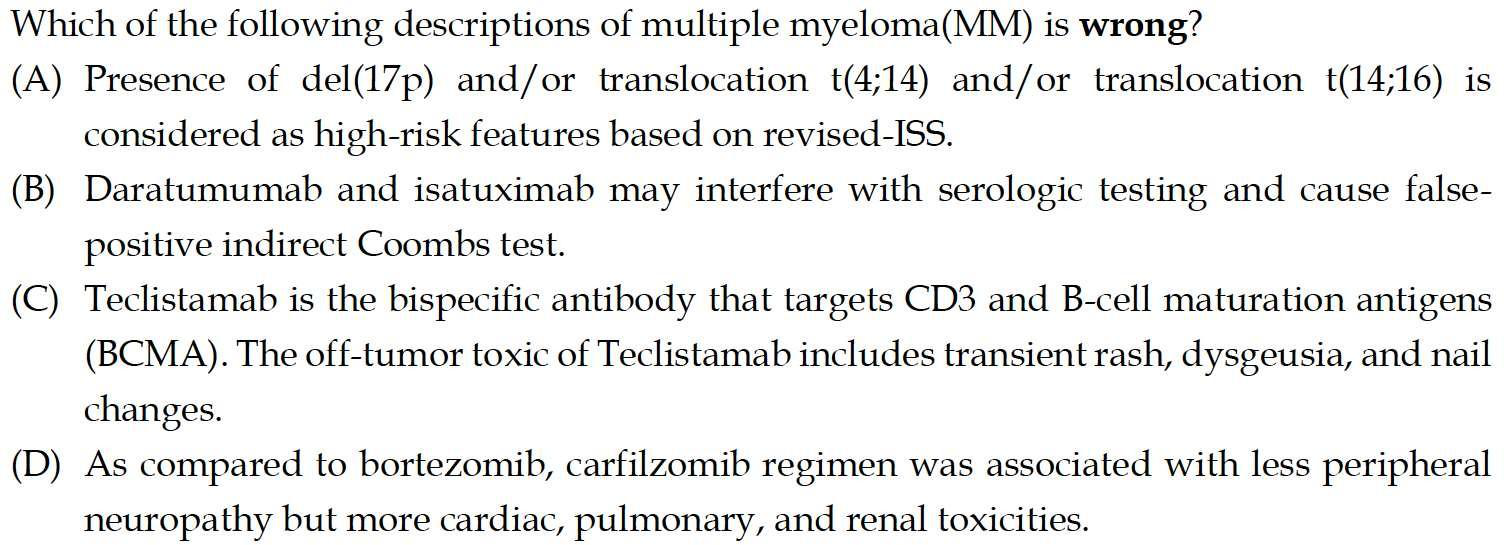
Q1. Which of the following descriptions of multiple myeloma (MM) is wrong?
- (A) Presence of del(17p) and/or translocation t(4;14) and/or translocation t(14;16) is considered as high-risk features based on revised-ISS.
- (B) Daratumumab and isatuximab may interfere with serologic testing and cause false-positive indirect Coombs test.
- (C) Teclistamab is the bispecific antibody that targets CD3 and B-cell maturation antigens (BCMA). The off-tumor toxic of Teclistamab includes transient rash, dysgeusia, and nail changes.
- (D) As compared to bortezomib, carfilzomib regimen was associated with less peripheral neuropathy but more cardiac, pulmonary, and renal toxicities.
點此顯示正解
(C) Teclistamab is the bispecific antibody that targets CD3 and B-cell maturation antigens (BCMA). The off-tumor toxic of Teclistamab includes transient rash, dysgeusia, and nail changes.
詳解
Based on the board exam question asking for the WRONG statement, option (C) is incorrect because it misattributes the characteristic "off-tumor" toxicities to the wrong bispecific antibody.
Why (C) is the WRONG Statement
Teclistamab is correctly described as a CD3 × BCMA bispecific antibody. However, the off-tumor toxicities listed (transient rash, dysgeusia, and nail changes) are characteristic of talquetamab, not teclistamab12345.
Teclistamab's actual toxicity profile includes cytokine release syndrome (CRS), hematologic toxicities (particularly neutropenia), hypogammaglobulinemia, and infections—not the skin and taste changes described in the question stem.
Talquetamab targets GPRC5D × CD3 and causes GPRC5D-associated adverse events including dysgeusia (taste changes), nonrash skin events, nail changes, and oral symptoms12345. These are the "off-tumor" toxicities mentioned in option (C), making this statement false when attributed to teclistamab.
Why the Other Options Are CORRECT
(A) R-ISS high-risk cytogenetics: The Revised International Staging System (R-ISS) for multiple myeloma defines high-risk cytogenetics as the presence of del(17p), t(4;14), or t(14;16). This is a well-established classification used for risk stratification in multiple myeloma.
(B) Anti-CD38 antibody interference with blood bank testing: Daratumumab and isatuximab bind to CD38 expressed on red blood cells, causing false-positive indirect antiglobulin (Coombs) tests. This interference with serologic testing is a well-documented phenomenon that requires special blood bank protocols (such as treating red cells with dithiothreitol) to enable accurate crossmatching and antibody screening.
(D) Carfilzomib vs bortezomib toxicity differences: The ENDEAVOR trial demonstrated that carfilzomib was associated with significantly less peripheral neuropathy compared to bortezomib (grade ≥2 peripheral neuropathy: 6% vs 32%, P<0.0001), but more cardiac, pulmonary, and renal toxicities[6][7][8][9][^10]. Specifically, carfilzomib showed higher rates of grade ≥3 cardiac failure (6% vs 2%), dyspnea (6% vs 2%), acute renal failure (6% vs 3%), and hypertension (15% vs 3%)[7][8][^9]. Peripheral neuropathy was the most common cause of bortezomib discontinuation, while cardiac and renal events were more common discontinuation reasons for carfilzomib[7][10].
詳解 · 中文翻譯
基於要求錯誤敘述的板考問題,選項 (C) 是不正確的,因為它將特徵「非腫瘤」毒性錯誤歸因於錯誤的雙特異性抗體。
為什麼 (C) 是錯誤敘述
Teclistamab 被正確描述為 CD3 × BCMA 雙特異性抗體。然而,列出的非腫瘤毒性(暫時性皮疹、味覺喪失和指甲變化)是 talquetamab 的特徵,而不是 teclistamab12345。
Teclistamab 的實際毒性譜包括細胞因子釋放綜合症 (CRS)、血液學毒性(特別是中性粒細胞減少症)、低免疫球蛋白血症和感染—而不是題幹描述的皮膚和味覺變化。
Talquetamab 靶向 GPRC5D × CD3,導致 GPRC5D 相關不良事件,包括味覺喪失(味覺變化)、非皮疹皮膚事件、指甲變化和口腔症狀12345。這些是選項 (C) 中提及的「非腫瘤」毒性,使此敘述當歸因於 teclistamab 時虛假。
為什麼其他選項是正確的
(A) R-ISS 高危細胞遺傳學:修訂的多發性骨髓瘤國際分期系統 (R-ISS) 將高危細胞遺傳學定義為 del(17p)、t(4;14) 或 t(14;16) 的存在。這是用於多發性骨髓瘤風險分層的公認分類。
(B) 抗-CD38 抗體干擾血液銀行測試:Daratumumab 和 isatuximab 結合到紅細胞表達的 CD38,導致偽陽性間接抗球蛋白 (Coombs) 測試。這種與血清學測試的干擾是公認的現象,需要特殊的血液銀行協議(如用二硫蘇糖醇處理紅細胞)以能夠準確的交叉配型和抗體篩查。
(D) Carfilzomib vs bortezomib 毒性差異:ENDEAVOR 試驗證明 carfilzomib 與 bortezomib 相比與顯著較少的周邊神經病變相關(3 級及以上周邊神經病變:6% vs 32%,P<0.0001),但更多的心臟、肺和腎毒性[6][7][8][9][^10]。具體而言,carfilzomib 顯示 3 級及以上心臟衰竭更高的比率(6% vs 2%)、呼吸困難(6% vs 2%)、急性腎衰竭(6% vs 3%)和高血壓(15% vs 3%)[7][8][^9]。周邊神經病變是 bortezomib 停用的最常見原因,而心臟和腎事件是 carfilzomib 停用的更常見原因[7][10]。
參考文獻 (AMA)
-
Kumar S, Mateos MV, Ye JC, et al. Dual Targeting of Extramedullary Myeloma With Talquetamab and Teclistamab. The New England Journal of Medicine. 2026;394(1):51-61. doi:10.1056/NEJMoa2514752. PMID:41358582. ↩↩↩↩
-
Cohen YC, Magen H, Gatt M, et al. Talquetamab Plus Teclistamab in Relapsed or Refractory Multiple Myeloma. The New England Journal of Medicine. 2025;392(2):138-149. doi:10.1056/NEJMoa2406536. PMID:39778168. ↩↩↩↩
-
Dimopoulos MA, Moreau P, Palumbo A, et al. Carfilzomib and Dexamethasone Versus Bortezomib and Dexamethasone for Patients With Relapsed or Refractory Multiple Myeloma (ENDEAVOR): A Randomised, Phase 3, Open-Label, Multicentre Study. The Lancet. Oncology. 2016;17(1):27-38. doi:10.1016/S1470-2045(15)00464-7. PMID:26671818. ↩↩↩↩
-
Dimopoulos MA, Goldschmidt H, Niesvizky R, et al. Carfilzomib or Bortezomib in Relapsed or Refractory Multiple Myeloma (ENDEAVOR): An Interim Overall Survival Analysis of an Open-Label, Randomised, Phase 3 Trial. The Lancet. Oncology. 2017;18(10):1327-1337. doi:10.1016/S1470-2045(17)30578-8. PMID:28843768. ↩↩↩↩
-
Yong K, Gonzalez-McQuire S, Szabo Z, Schoen P, Hajek R. The Start of a New Wave: Developments in Proteasome Inhibition in Multiple Myeloma. European Journal of Haematology. 2018;. doi:10.1111/ejh.13071. PMID:29603798. ↩↩↩↩
Slide annotations
talquetamab (GPRC5D bispecific antibody) (xerostomia, 30-57%) CRS, fatigue, injection site reaction, diarrhea, upper respiratory tract infection, musculoskeletal pain, pneumonia, decreased appetite, rash, cough, nausea, and pyrexia Belantamab mafodotin (BCMA ADC): ocular toxicity (keratopathy, dry eye, blurred vision, …) BCMA bispecific antibody: Elranatamab Teclistamab
Figures