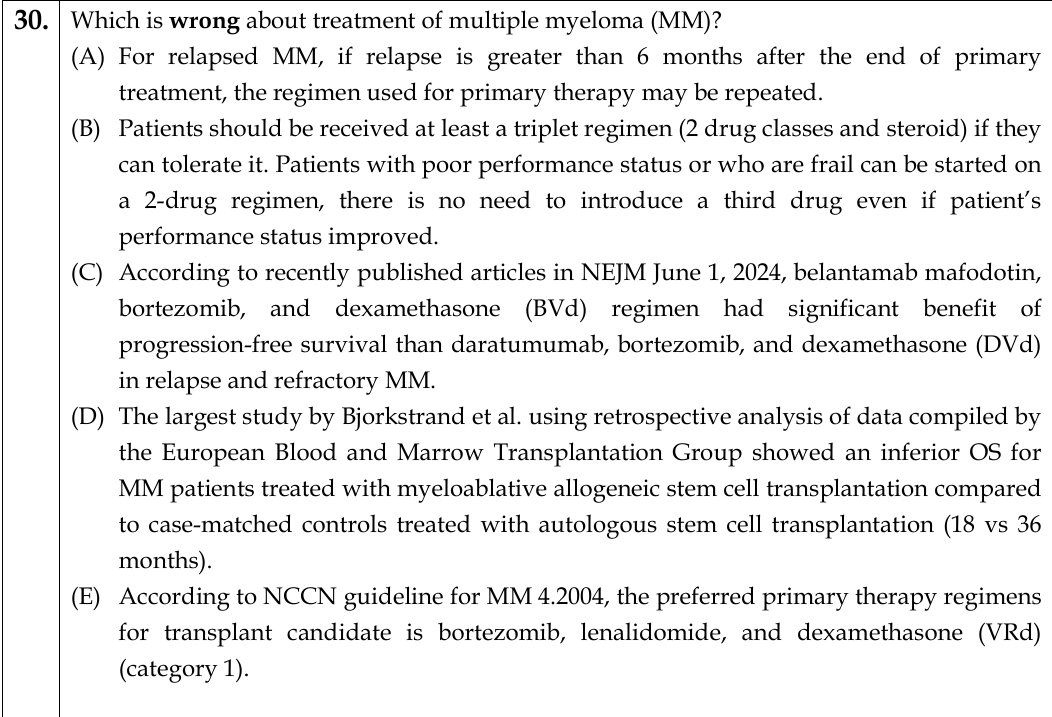
Q30. Which is wrong about treatment of multiple myeloma (MM)?
- (A) For relapsed MM, if relapse is greater than 6 months after the end of primary treatment, the regimen used for primary therapy may be repeated.
- (B) Patients should be received at least a triplet regimen (2 drug classes and steroid) if they can tolerate it. Patients with poor performance status or who are frail can be started on a 2-drug regimen, there is no need to introduce a third drug even if patient’s performance status improved.
- (C) According to recently published articles in NEJM June 1, 2024, belantamab mafodotin, bortezomib, and dexamethasone (BVd) regimen had significant benefit of progression-free survival than daratumumab, bortezomib, and dexamethasone (DVd) in relapse and refractory MM.
- (D) The largest study by Bjorkstrand et al. using retrospective analysis of data compiled by the European Blood and Marrow Transplantation Group showed an inferior OS for MM patients treated with myeloablative allogeneic stem cell transplantation compared to case-matched controls treated with autologous stem cell transplantation (18 vs 36 months).
- (E) According to NCCN guideline for MM 4.2004, the preferred primary therapy regimens for transplant candidate is bortezomib, lenalidomide, and dexamethasone (VRd) (category 1).
點此顯示正解
(B) Patients should be received at least a triplet regimen (2 drug classes and steroid) if they can tolerate it. Patients with poor performance status or who are frail can be started on a 2-drug regimen, there is no need to introduce a third drug even if patient’s performance status improved.
詳解
Analysis of Board Exam Question
Why (B) is the WRONG statement
Option (B) is incorrect because it states "there is no need to introduce a third drug even if patient's performance status improved." This contradicts current IMWG and expert consensus recommendations for frailty-adapted treatment in multiple myeloma. The evidence supports that frailty should be assessed regularly to guide treatment intensification and/or deescalation[^14]. When frail patients initially started on doublet therapy experience improvement in performance status, treatment should be escalated to a triplet regimen to optimize outcomes. Recent data demonstrate that triplet regimens are more efficacious than doublets even in frail patients, with the strongest mortality benefit observed in moderate-severely frail patients treated with VRd versus Rd (HR 0.74; 95% CI 0.56-0.97)[^16]. The principle is to match treatment intensity to the patient's current functional status, not their initial presentation.
Why the other options are CORRECT
(A) Retreatment with prior regimen for late relapse is correct. For relapsed multiple myeloma with relapse >6 months after completion of primary therapy, retreatment with the same regimen is an acceptable strategy. This approach is supported by clinical practice and reflects the principle that late relapses may retain sensitivity to previously effective therapies.
(C) DREAMM-7 trial results is correct. The DREAMM-7 trial published in NEJM June 2024 demonstrated that BVd (belantamab mafodotin, bortezomib, dexamethasone) significantly improved progression-free survival compared to DVd (daratumumab, bortezomib, dexamethasone) in relapsed/refractory multiple myeloma23. The median PFS was 36.6 months with BVd versus 13.4 months with DVd (HR 0.41; 95% CI 0.31-0.53; P<0.001)2. Updated analysis showed median overall survival was not reached with BVd versus 41.0 months with DVd (HR 0.58; P=0.0002)1.

(D) Bjorkstrand EBMT data on allogeneic transplant is correct. The European Blood and Marrow Transplantation Group retrospective analysis by Bjorkstrand et al. showed inferior overall survival with myeloablative allogeneic stem cell transplantation compared to autologous stem cell transplantation in multiple myeloma patients (18 vs 36 months median OS). This finding contributed to the current standard that autologous transplant remains the preferred transplant approach for eligible MM patients, while allogeneic transplant is not routinely recommended.
(E) NCCN guideline VRd preference is correct. The NCCN Multiple Myeloma Guidelines recommend VRd (bortezomib, lenalidomide, dexamethasone) as the preferred primary therapy regimen (Category 1) for transplant-eligible patients with newly diagnosed multiple myeloma. This recommendation is based on superior efficacy data and has been a cornerstone of upfront therapy for transplant candidates.
詳解 · 中文翻譯
棋盤考試問題分析
為何 (B) 是錯誤陳述
選項 (B) 不正確,因為它指出「即使患者表現狀態改善,也無需引進第三種藥物」。這與 IMWG 和專家共識建議對多發性骨髓瘤虛弱調整治療相矛盾。證據支持 應定期評估虛弱以指導治療強化和/或減弱[^14]。當初始在雙藥治療中的虛弱患者經歷表現狀態改善時,治療應升級至三藥方案以優化預後。最近資料證明三藥方案比雙藥方案更有效,即使在虛弱患者中也是如此,在用 VRd 對 Rd 治療的中度至重度虛弱患者中觀察到最強的死亡率益處(HR 0.74;95% CI 0.56-0.97)[^16]。原則是將治療強度與患者當前功能狀態相匹配,而非其初始表現。
其他選項為何正確
(A) 晚期復發用先前方案重新治療正確。對於 復發 >6 個月從初級治療完成後 的復發多發性骨髓瘤,用相同方案重新治療是可接受的策略。此方法由臨床實踐支持,反映晚期復發可能保留對先前有效治療的敏感性的原則。
(C) DREAMM-7 試驗結果正確。DREAMM-7 試驗發表於 2024 年 6 月 NEJM 證明 BVd(belantamab mafodotin、bortezomib、地塞米松)相比 DVd(daratumumab、bortezomib、地塞米松)在復發/難治多發性骨髓瘤中顯著改善無進展生存23。中位 PFS 為 36.6 個月 BVd 對 13.4 個月 DVd(HR 0.41;95% CI 0.31-0.53;P<0.001)2。更新分析顯示中位整體生存未在 BVd 中達到對 41.0 個月 DVd(HR 0.58;P=0.0002)1。
(D) Bjorkstrand EBMT 同種移植資料正確。歐洲血液和骨髓移植組由 Bjorkstrand 等進行的回顧性分析顯示 與自體幹細胞移植相比,滅除性同種幹細胞移植的整體生存不利於多發性骨髓瘤患者(中位 OS 18 對 36 個月)。此發現有助於當前標準,自體移植對符合條件的 MM 患者保持為首選移植方法,而同種移植不常規推薦。
(E) NCCN 指南 VRd 偏好正確。NCCN 多發性骨髓瘤指南推薦 VRd(bortezomib、lenalidomide、地塞米松)作為首選初級治療方案(第 1 類),用於移植合格患者 伴隨新診斷多發性骨髓瘤。此推薦基於優越的療效資料,已是移植候選者的前期治療基石。
參考文獻 (AMA)
-
Abdallah N, Kumar SK. Up-Front Treatment of Elderly (Age ≥75 Years) and Frail Patients With Multiple Myeloma. Journal of the National Comprehensive Cancer Network : JNCCN. 2024;22(9):e247039. doi:10.6004/jnccn.2024.7039. PMID:39536451. ↩↩
-
DuMontier C, La J, Bihn J, et al. More Intensive Therapy as More Effective Treatment for Frail Patients With Multiple Myeloma [Corrected. Blood Advances. 2023;7(20):6275-6284. doi:10.1182/bloodadvances.2023011019. PMID:37582048. ↩↩↩↩
-
Hungria V, Robak P, Hus M, et al. Belantamab Mafodotin, Bortezomib, and Dexamethasone for Multiple Myeloma. The New England Journal of Medicine. 2024;391(5):393-407. doi:10.1056/NEJMoa2405090. PMID:38828933. ↩↩
-
Hungria V, Robak P, Hus M, et al. Belantamab Mafodotin Plus Bortezomib and Dexamethasone in Patients With Relapsed or Refractory Multiple Myeloma (DREAMM-7): Updated Overall Survival Analysis From a Global, Randomised, Open-Label, Phase 3 Trial. The Lancet. Oncology. 2025;26(8):1067-1080. doi:10.1016/S1470-2045(25)00330-4. PMID:40680754. ↩
Figures