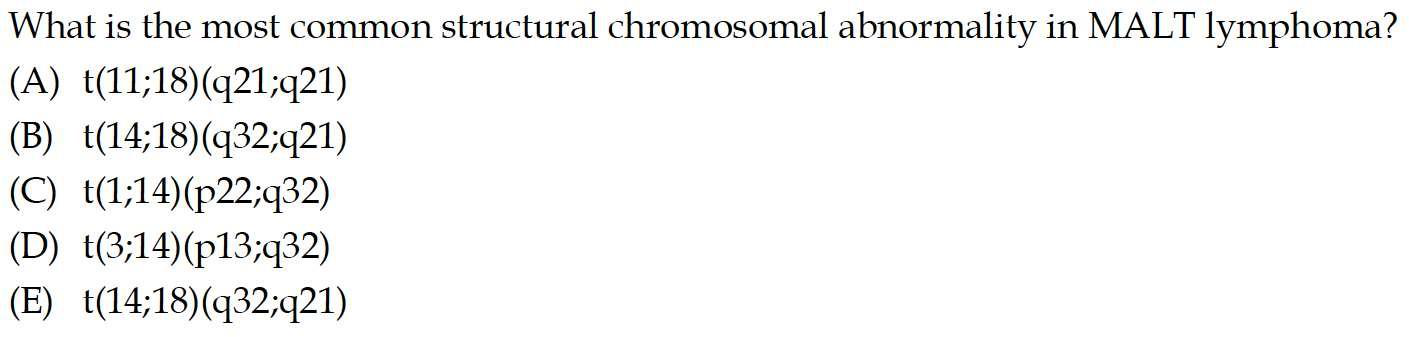
Q1. What is the most common structural chromosomal abnormality in MALT lymphoma?
- (A) t(11;18)(q21;q21) pulmonary and gastric tumors (15-40%, most common)
- (B) t(14;18)(q32;q21) ocular adnexal, orbit, skin, and salivary gland
- (C) t(1;14)(p22;q32) lung, and skin (1-2%)
- (D) t(3;14)(p13;q32)
- (E) t(14;18)(q32;q21)
點此顯示正解
(A) t(11;18)(q21;q21) pulmonary and gastric tumors (15-40%, most common)
詳解
Why (A) is Correct: t(11;18)(q21;q21) is the Most Common Structural Chromosomal Abnormality in MALT Lymphoma
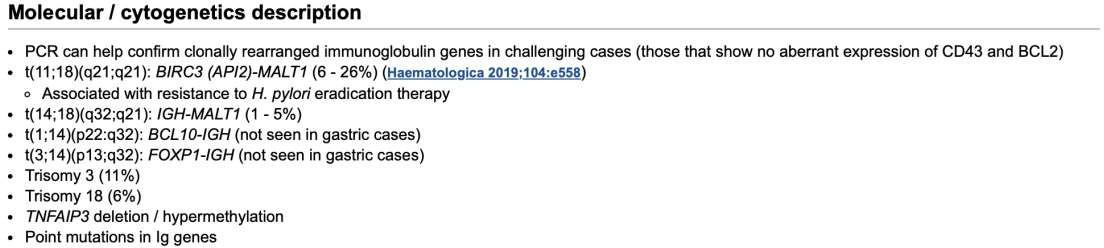
The t(11;18)(q21;q21) translocation is the most frequent structural chromosomal abnormality in MALT lymphoma overall, accounting for 15-50% of extranodal marginal zone lymphomas, with the highest frequencies observed in pulmonary (38%) and gastric (24-25%) MALT lymphomas23. This translocation generates the BIRC3/MALT1 fusion gene (also known as API2-MALT1), which results from fusion of the amino terminal of the API2 (apoptosis inhibitor-2) gene on chromosome 11 to the carboxyl terminal of the MALT1 gene on chromosome 1814. The fusion protein constitutively activates both canonical and non-canonical NF-κB signaling pathways, driving lymphomagenesis independent of microenvironmental antigenic stimulation17.
This translocation is highly specific to MALT lymphomas and is not found in other lymphoma subtypes2. The t(11;18)(q21;q21) is also found at moderate frequencies in conjunctival (19%) and orbital (14%) MALT lymphomas, but is rare or absent in salivary gland (1%), thyroid, skin, liver, and other sites2. In gastric MALT lymphoma, this translocation is associated with H. pylori-negative cases, higher-stage disease, and resistance to H. pylori eradication therapy and alkylating agents, though paradoxically these cases are less prone to transformation to diffuse large B-cell lymphoma1.
Why the Other Options Have Lower Frequencies
(B) t(14;18)(q32;q21) IGH/MALT1: This translocation occurs in 15-20% of nongastrointestinal extranodal MZLs3[^11], making it less common overall than t(11;18)(q21;q21). It is preferentially found in MALT lymphomas of the liver, skin, ocular adnexa, and salivary gland, but is notably absent in gastric, intestinal, and pulmonary MALT lymphomas[^8]. In one series, it was detected in 18% (12/66) of MALT lymphomas overall[^8]. This translocation juxtaposes the IGH locus with MALT1, leading to MALT1 overexpression and NF-κB activation7[^9].
(C) t(1;14)(p22;q32) BCL10/IGH: This is a rare translocation, occurring in only 1-2% of MALT lymphomas3[^11]. It has been reported in MALT lymphomas of the stomach, lung, and skin3. The translocation leads to BCL10 overexpression through juxtaposition with the IGH locus, activating NF-κB signaling7[^9].
(D) t(3;14)(p14.1;q32) FOXP1/IGH: This translocation occurs in approximately 10% of extranodal MZLs, mainly involving the thyroid, ocular adnexa, and cutaneous sites3[^11]. It juxtaposes the FOXP1 transcription factor next to the IGH locus, resulting in FOXP1 overexpression3.
(E) t(14;18)(q32;q21): This appears to be a duplicate of option B and represents the same translocation with the same frequency profile as described above.
All four major translocations in MALT lymphoma—t(11;18)(q21;q21), t(14;18)(q32;q21), t(1;14)(p22;q32), and t(3;14)(p14.1;q32)—are mutually exclusive and converge on activation of NF-κB signaling pathways, though their relative frequencies vary significantly by anatomic site15[^10].
詳解 · 中文翻譯
為什麼 (A) 是正確的:t(11;18)(q21;q21) 是 MALT 淋巴瘤中最常見的結構性染色體異常
t(11;18)(q21;q21) 易位是 MALT 淋巴瘤中整體最頻繁的結構性染色體異常,佔節外邊緣帶淋巴瘤的 15-50%,最高頻率在肺(38%)和胃(24-25%)MALT 淋巴瘤中觀察到23。此易位產生 BIRC3/MALT1 融合基因(也稱為 API2-MALT1),源自染色體 11 上的 API2(凋亡抑制劑-2)基因的氨基末端與染色體 18 上 MALT1 基因的羧基末端的融合14。融合蛋白組成型激活規範和非規範 NF-κB 信號通路,獨立於微環境抗原刺激驅動淋巴瘤發生17。
此易位高度特異於 MALT 淋巴瘤,未在其他淋巴瘤亞型中發現2。t(11;18)(q21;q21) 也在結膜(19%)和眼眶(14%)MALT 淋巴瘤中以中等頻率發現,但在唾液腺(1%)、甲狀腺、皮膚、肝臟和其他部位中罕見或缺失2。在胃 MALT 淋巴瘤中,此易位與幽門螺桿菌陰性病例、高期疾病和對幽門螺桿菌根除治療和烷化劑的耐藥性相關,儘管矛盾地這些病例不易轉化為瀰漫大 B 細胞淋巴瘤1。
為什麼其他選項有較低的頻率
(B) t(14;18)(q32;q21) IGH/MALT1:此易位發生在 15-20% 的非腸胃節外 MZL3[^11],使其整體上不如 t(11;18)(q21;q21) 常見。它優先存在於肝臟、皮膚、眼睛附屬器和唾液腺的 MALT 淋巴瘤中,但明顯地在胃、腸和肺 MALT 淋巴瘤中缺失[^8]。在一個系列中,在整體 MALT 淋巴瘤中檢測到 18%(12/66)[^8]。此易位使 IGH 位點與 MALT1 鄰近,導致 MALT1 過度表達和 NF-κB 激活7[^9]。
(C) t(1;14)(p22;q32) BCL10/IGH:這是罕見易位,僅發生在 1-2% 的 MALT 淋巴瘤中3[^11]。已在胃、肺和皮膚的 MALT 淋巴瘤中報告3。易位通過與 IGH 位點的鄰近導致 BCL10 過度表達,激活 NF-κB 信號轉導7[^9]。
(D) t(3;14)(p14.1;q32) FOXP1/IGH:此易位發生在約 10% 的節外 MZL 中,主要涉及甲狀腺、眼睛附屬器和皮膚部位3[^11]。它使 FOXP1 轉錄因子與 IGH 位點相鄰,導致 FOXP1 過度表達3。
(E) t(14;18)(q32;q21):這似乎是選項 B 的重複,代表與上述相同頻率譜的相同易位。
MALT 淋巴瘤中的所有四個主要易位—t(11;18)(q21;q21)、t(14;18)(q32;q21)、t(1;14)(p22;q32) 和 t(3;14)(p14.1;q32)—是互相排斥的並收斂於 NF-κB 信號通路的激活,儘管它們的相對頻率在解剖位置間顯著變化15[^10]。
參考文獻 (AMA)
-
Ye H, Liu H, Attygalle A, et al. Variable Frequencies of T(11;18)(q21;q21) in MALT Lymphomas of Different Sites: Significant Association With CagA Strains of H Pylori in Gastric MALT Lymphoma. Blood. 2003;102(3):1012-8. doi:10.1182/blood-2002-11-3502. PMID:12676782. ↩↩↩↩↩↩↩↩
-
Rossi D, Bertoni F, Zucca E. Marginal-Zone Lymphomas. The New England Journal of Medicine. 2022;386(6):568-581. doi:10.1056/NEJMra2102568. PMID:35139275. ↩↩↩↩↩↩
-
Foukas PG, Bisig B, de Leval L. Recent Advances Upper Gastrointestinal Lymphomas: Molecular Updates and Diagnostic Implications. Histopathology. 2021;78(1):187-214. doi:10.1111/his.14289. PMID:33382495. ↩↩↩↩↩↩↩↩↩↩↩↩
-
Dierlamm J, Baens M, Wlodarska I, et al. The Apoptosis Inhibitor Gene API2 and a Novel 18q Gene, MLT, Are Recurrently Rearranged in the T(11;18)(q21;q21) Associated With Mucosa-Associated Lymphoid Tissue Lymphomas. Blood. 1999;93(11):3601-9. PMID:10339464. https://pubmed.ncbi.nlm.nih.gov/10339464. ↩↩
-
Du MQ. MALT Lymphoma: Genetic Abnormalities, Immunological Stimulation and Molecular Mechanism. Best Practice & Research. Clinical Haematology. 2017 Mar - Jun;30(1-2):13-23. doi:10.1016/j.beha.2016.09.002. PMID:28288707. ↩↩
-
Streubel B, Lamprecht A, Dierlamm J, et al. T(14;18)(q32;q21) Involving IGH and MALT1 Is a Frequent Chromosomal Aberration in MALT Lymphoma. Blood. 2003;101(6):2335-9. doi:10.1182/blood-2002-09-2963. PMID:12406890. ↩
-
Rodríguez-Sevilla JJ, Salar A. Recent Advances in the Genetic of MALT Lymphomas. Cancers. 2021;14(1):176. doi:10.3390/cancers14010176. PMID:35008340. ↩↩↩↩↩↩
Slide annotations
This translocation is restricted to MALT lymphomas and has not been found in nodal or splenic marginal zone lymphomas (MZL).
Figures