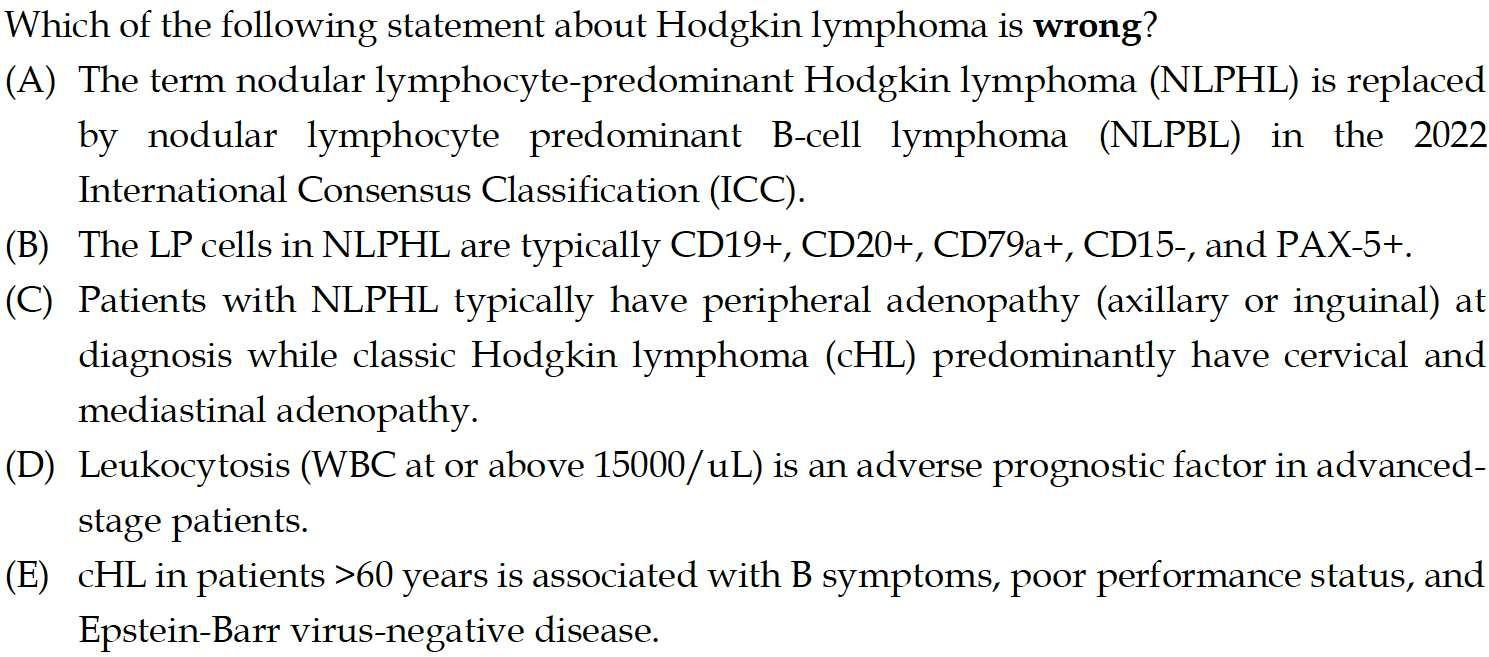
Q1. Which of the following statement about Hodgkin lymphoma is wrong?
- (A) The term nodular lymphocyte-predominant Hodgkin lymphoma (NLPHL) is replaced by nodular lymphocyte predominant B-cell lymphoma (NLPBL) in the 2022 International Consensus Classification (ICC).
- (B) The LP cells in NLPHL are typically CD19+, CD20+, CD79a+, CD15-, and PAX-5+.
- (C) Patients with NLPHL typically have peripheral adenopathy (axillary or inguinal) at diagnosis while classic Hodgkin lymphoma (cHL) predominantly have cervical and mediastinal adenopathy.
- (D) Leukocytosis (WBC at or above 15000/uL) is an adverse prognostic factor in advanced-stage patients.
- (E) cHL in patients >60 years is associated with B symptoms, poor performance status, and Epstein-Barr virus-negative disease.
點此顯示正解
(E) cHL in patients >60 years is associated with B symptoms, poor performance status, and Epstein-Barr virus-negative disease.
詳解
Why (E) is the WRONG statement
Option (E) states that cHL in patients >60 years is associated with Epstein-Barr virus-negative disease, which is incorrect. The evidence clearly demonstrates that EBV-positive disease is more frequent in older patients with classic Hodgkin lymphoma, not EBV-negative disease.
The NCCN guidelines explicitly state that "CHL in patients who are older is associated with poorer disease outcomes. B symptoms, poor performance status, mixed cellularity histologic subtype, EBV+ disease, and medical comorbidities are more frequent in this population"4. Multiple studies confirm that EBV-positive HL is more common in older adults (>45-60 years) compared to young adults6[8][10]. The bimodal age distribution of cHL shows a second peak around age 50-70 years that is "more associated with Epstein-Barr virus"6. One study found that "EBV-positive cases of HL tend to occur in older patients (>60 years)"[^10].
The other components of option (E) are correct: older patients with cHL do indeed have higher rates of B symptoms and poor performance status345.
Why the other options are TRUE statements
(A) is TRUE: The 2022 International Consensus Classification (ICC) did replace the term "nodular lymphocyte-predominant Hodgkin lymphoma (NLPHL)" with "nodular lymphocyte predominant B-cell lymphoma (NLPBL)" to better reflect the B-cell nature of this entity and distinguish it from classic Hodgkin lymphoma.
(B) is TRUE: LP (lymphocyte-predominant) cells in NLPHL/NLPBL characteristically express B-cell markers including CD19, CD20, CD79a, and PAX-5, while being negative for CD15 (unlike Reed-Sternberg cells in classic HL which are typically CD15+/CD30+).
(C) is TRUE: NLPHL typically presents with peripheral lymphadenopathy (axillary, inguinal) in contrast to classic Hodgkin lymphoma, which predominantly involves cervical and mediastinal nodes. This difference in anatomic distribution is a well-recognized clinical distinction between these entities.
(D) is TRUE: Leukocytosis (WBC ≥15,000/μL) is one of the established adverse prognostic factors in the International Prognostic Score (IPS) for advanced-stage Hodgkin lymphoma, along with other factors including age ≥45 years, male sex, stage IV disease, albumin <4 g/dL, hemoglobin <10.5 g/dL, and lymphocytopenia.
詳解 · 中文翻譯
為什麼 (E) 是錯誤的敘述
選項 (E) 指出 >60 歲患者的 cHL 與Epstein-Barr 病毒陰性病相關,這是不正確的。證據清楚地證示 EBV 陽性病在較老患者經典 Hodgkin 淋巴瘤中更頻繁,而不是 EBV 陰性病。
NCCN 指南明確指出「年較老患者中的 CHL 與較差的病預後相關。B 症狀、差的性能狀態、混合細胞組織學亞型、EBV+ 病和醫療合併症在此人口中更頻繁」4。多項研究確認 EBV 陽性 HL 在較老成人(>45-60 歲)與年輕成人相比更常見6[8][10]。cHL 的雙峰年齡分佈顯示在約 50-70 歲的第二個峰值「與 Epstein-Barr 病毒更相關」6。一項研究發現「EBV 陽性 HL 病例趨於發生在較老患者(>60 歲)」[^10]。
選項 (E) 的其他成分是正確的:年較老患者與 cHL 確實有更高的 B 症狀和差性能狀態345。
為什麼其他選項是真實陳述
(A) 為真:2022 國際共識分類 (ICC) 確實用「結節性淋巴細胞優勢 B 細胞淋巴瘤 (NLPBL)」替換了「結節性淋巴細胞優勢 Hodgkin 淋巴瘤 (NLPHL)」的術語,以更好地反映此實體的 B 細胞性質並將其與經典 Hodgkin 淋巴瘤區分開來。
(B) 為真:NLPHL/NLPBL 中的 LP(淋巴細胞優勢)細胞特徵性表達 B 細胞標誌包括 CD19、CD20、CD79a 和 PAX-5,同時對 CD15 陰性(不同於經典 HL 中的 Reed-Sternberg 細胞,其通常為 CD15+/CD30+)。
(C) 為真:NLPHL 通常表現為周邊淋巴結病變(腋下、腹股溝),與經典 Hodgkin 淋巴瘤對比,其主要涉及頸部和縱隔節點。這些實體之間的解剖分佈差異是眾所周知的臨床區別。
(D) 為真:白細胞增多症(WBC ≥15,000/μL)是晚期 Hodgkin 淋巴瘤國際預後評分 (IPS) 中已建立的不利預後因子之一,連同其他因子包括年齡 ≥45 歲、男性、IV 期病、白蛋白 <4 g/dL、血紅蛋白 <10.5 g/dL 和淋巴細胞減少症。
參考文獻 (AMA)
-
National Comprehensive Cancer Network. Hodgkin Lymphoma. https://www.nccn.org/professionals/physician_gls/pdf/hodgkins.pdf#page=26. ↩
-
Brice P, de Kerviler E, Friedberg JW. Classical Hodgkin Lymphoma. Lancet (London, England). 2021;398(10310):1518-1527. doi:10.1016/S0140-6736(20)32207-8. PMID:33493434. ↩
-
Jarrett AF, Armstrong AA, Alexander E. Epidemiology of EBV and Hodgkin's Lymphoma. Annals of Oncology : Official Journal of the European Society for Medical Oncology. 1996;7 Suppl 4:5-10. doi:10.1093/annonc/7.suppl_4.s5. PMID:8836402. ↩↩
-
Chang KC, Chen PC, Chang Y, et al. Epstein-Barr Virus Latent Membrane Protein-1 Up-Regulates Cytokines and Correlates With Older Age and Poorer Prognosis in Hodgkin Lymphoma. Histopathology. 2017;70(3):442-455. doi:10.1111/his.13085. PMID:27632954. ↩↩↩↩
-
Evens AM, Carter J, Loh KP, David KA. Management of Older Hodgkin Lymphoma Patients. Hematology. American Society of Hematology. Education Program. 2019;2019(1):233-242. doi:10.1182/hematology.2019000028. PMID:31808898. ↩↩
-
Evens AM, McKenna M, Ryu Tiger YK, Upshaw JN. Hodgkin Lymphoma Treatment for Older Persons in the Modern Era. Hematology. American Society of Hematology. Education Program. 2023;2023(1):483-499. doi:10.1182/hematology.2023000449. PMID:38066840. ↩↩↩↩
Slide annotations
There are many differences between the presentation of HL in the elderly in comparison to that of the younger patients: (a) mixed cellularity is more frequent ranging from 31% to 50%;1,13 (b) 34% of cases and up to 50% of advanced cases show the presence of EBER or LMP-1 proteins in Reed-Sternberg cells6 (these two points are not independent); (c) B-symptoms and advanced stage are much more common than in adults.7 Male sex and sub-diaphragmatic presentation are also more frequent in patients over 50.
Figures