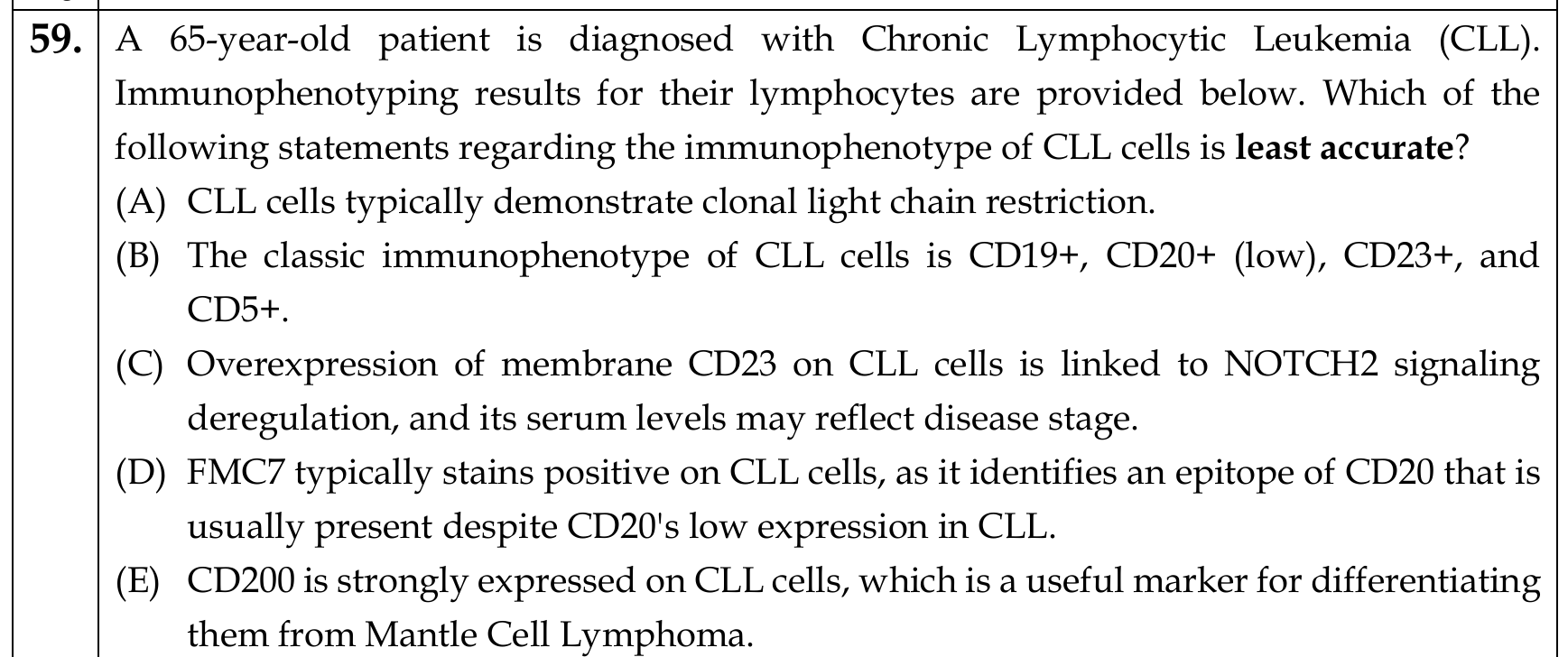
Q59. A 65-year-old patient is diagnosed with Chronic Lymphocytic Leukemia (CLL). Immunophenotyping results for their lymphocytes are provided below. Which of the following statements regarding the immunophenotype of CLL cells is least accurate?
- (A) CLL cells typically demonstrate clonal light chain restriction.
- (B) The classic immunophenotype of CLL cells is CD19+, CD20+ (low), CD23+, and CD5+.
- (C) Overexpression of membrane CD23 on CLL cells is linked to NOTCH2 signaling deregulation, and its serum levels may reflect disease stage.
- (D) FMC7 typically stains positive on CLL cells, as it identifies an epitope of CD20 that is usually present despite CD20's low expression in CLL.
- (E) CD200 is strongly expressed on CLL cells, which is a useful marker for differentiating them from Mantle Cell Lymphoma.
點此顯示正解
(D) FMC7 typically stains positive on CLL cells, as it identifies an epitope of CD20 that is usually present despite CD20's low expression in CLL.
詳解
Analysis of Board Question
The stem asks for the "least accurate" statement, meaning the FALSE statement.
1) Why (D) is the INCORRECT (FALSE) statement:
(D) is false because FMC7 is typically negative or weakly expressed in CLL, not positive. FMC7 identifies an epitope on CD20, but despite CD20 being present (albeit at low levels) on CLL cells, the FMC7 epitope is characteristically absent or only weakly expressed17[^8]. The statement incorrectly claims that FMC7 "typically stains positive" on CLL cells. In reality, FMC7 negativity is one of the classic features that helps distinguish CLL from other CD5+ B-cell lymphoproliferative disorders, particularly mantle cell lymphoma, where FMC7 is typically positive7[^11].
2) Why the other options are TRUE:
(A) is true: CLL cells demonstrate clonal light chain restriction (expressing either κ or λ, but not both), which is a fundamental characteristic of this monoclonal B-cell proliferation2. Each clone expresses only one type of immunoglobulin light chain.
(B) is true: The classic immunophenotype of CLL is CD19+, CD20+ (dim/low), CD23+, and CD5+12345. This co-expression pattern, particularly the combination of CD5 (normally a T-cell marker) with B-cell markers, along with dim CD20 expression and CD23 positivity, is the hallmark immunophenotypic profile used for CLL diagnosis.
(C) is true: CD23 is overexpressed on CLL cell membranes, and while the specific mechanistic link to NOTCH2 signaling deregulation may be complex, CD23 expression is indeed a characteristic feature of CLL124. Soluble CD23 (sCD23) levels in serum can correlate with disease burden and stage, serving as a potential biomarker for disease activity.
(E) is true: CD200 is strongly expressed on CLL cells and serves as a valuable marker for differentiating CLL from mantle cell lymphoma17[9][11]. While both diseases express CD5, CLL is characteristically CD200+ whereas mantle cell lymphoma is typically CD200−. This distinction is clinically important given the different prognoses and treatment approaches for these two CD5+ B-cell malignancies7[9][10][^11].
詳解 · 中文翻譯
題幹要求找出「最不正確」的敘述,即錯誤的敘述。
1) 為什麼 (D) 是錯誤的敘述:
(D) 錯誤,因為 FMC7 在 CLL 中通常呈陰性或弱表達,而非陽性。FMC7 辨識 CD20 上的一個表位,但儘管 CD20 在 CLL 細胞上存在(雖然水準低),FMC7 表位特徵性地缺失或僅弱表達17[^8]。該敘述錯誤地宣稱 FMC7 在 CLL 細胞上「通常呈陽性」。實際上,FMC7 陰性是幫助區分 CLL 與其他 CD5+ B 細胞淋巴增殖性疾病(特別是套細胞淋巴瘤,其中 FMC7 通常為陽性)的經典特徵之一7[^11]。
2) 為什麼其他選項都正確:
(A) 正確: CLL 細胞表現出克隆型輕鏈限制性表達(表達 κ 或 λ,但不同時表達),這是該單克隆 B 細胞增殖的基本特徵2。每個克隆只表達一種類型的免疫球蛋白輕鏈。
(B) 正確: CLL 的經典免疫表型為 CD19+、CD20+(弱/低)、CD23+ 和 CD5+12345。此共表達模式,特別是 CD5(正常為 T 細胞標誌物)與 B 細胞標誌物的聯合、CD20 弱表達及 CD23 陽性,是用於 CLL 診斷的特徵性免疫表型。
(C) 正確: CD23 在 CLL 細胞膜上過度表達,儘管與 NOTCH2 訊號脫調的特定機制關聯可能複雜,CD23 表達確實是 CLL 的特徵124。血清中的可溶性 CD23 (sCD23) 濃度可與疾病負荷和分期相關,可作為疾病活動的潛在生物標誌物。
(E) 正確: CD200 在 CLL 細胞上強表達,是區分 CLL 與套細胞淋巴瘤的有價值標誌物17[9][11]。儘管兩種疾病都表達 CD5,CLL 特徵性為 CD200+,而套細胞淋巴瘤通常為 CD200−。鑑於這兩種 CD5+ B 細胞惡性腫瘤有不同的預後和治療方法,此區別在臨床上很重要7[9][10][^11]。
參考文獻 (AMA)
-
Jain N, Wierda WG, O'Brien S. Chronic Lymphocytic Leukaemia. Lancet (London, England). 2024;404(10453):694-706. doi:10.1016/S0140-6736(24)00595-6. PMID:39068951. ↩↩↩↩↩↩↩↩
-
Armitage JO, Longo DL. Mantle-Cell Lymphoma. The New England Journal of Medicine. 2022;386(26):2495-2506. doi:10.1056/NEJMra2202672. PMID:35767440. ↩↩↩↩↩↩
-
Hallek M, Shanafelt TD, Eichhorst B. Chronic Lymphocytic Leukaemia. Lancet (London, England). 2018;391(10129):1524-1537. doi:10.1016/S0140-6736(18)30422-7. PMID:29477250. ↩↩
-
Shadman M. Diagnosis and Treatment of Chronic Lymphocytic Leukemia: A Review. Jama. 2023;329(11):918-932. doi:10.1001/jama.2023.1946. PMID:36943212. ↩↩↩↩
-
Salem DA, Stetler-Stevenson M. Clinical Flow-Cytometric Testing in Chronic Lymphocytic Leukemia. Methods in Molecular Biology (Clifton, N.J.). 2019;2032:311-321. doi:10.1007/978-1-4939-9650-6_17. PMID:31522426. ↩↩
-
Jalal SD. The Contribution of CD200 to the Diagnostic Accuracy of Matutes Score in the Diagnosis of Chronic Lymphocytic Leukemia in Limited Resources Laboratories. PloS One. 2021;16(2):e0247491. doi:10.1371/journal.pone.0247491. PMID:33606850. ↩
-
Qiu L, Xu J, Tang G, et al. Mantle Cell Lymphoma With Chronic Lymphocytic Leukemia-Like Features: A Diagnostic Mimic and Pitfall. Human Pathology. 2022;119:59-68. doi:10.1016/j.humpath.2021.11.001. PMID:34767860. ↩↩↩↩↩↩↩↩
Slide annotations
SIg(weak), CD79b/CD22 (weak), FMC7(-), cyclin D1(weak) ➔ weak pan-B marker
Figures