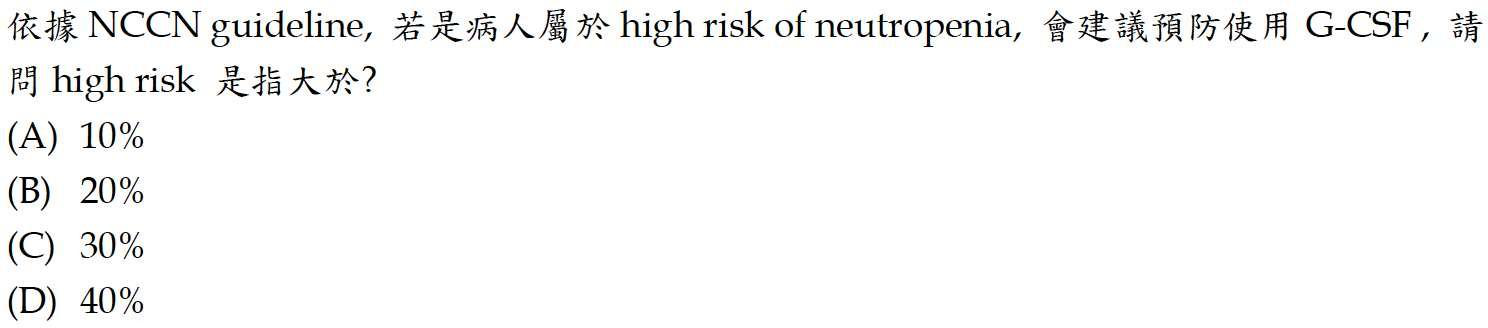
Q1. 依據 NCCN guideline, 若是病人屬於 high risk of neutropenia, 會建議預防使用 G-CSF,請問 high risk 是指大於?
- (A) 10%
- (B) 20%
- (C) 30%
- (D) 40%
點此顯示正解
(B) 20%
詳解
The correct answer is (B) 20% because the NCCN Hematopoietic Growth Factors guideline, ASCO, and EORTC all define high risk for febrile neutropenia as >20%, which is the threshold for recommending primary prophylactic G-CSF.
Why 20% is the threshold:
According to the NCCN Hematopoietic Growth Factors guideline, patients are stratified into three risk categories based on their expected risk of febrile neutropenia12:
- High risk (>20%): Primary prophylaxis with G-CSF is recommended (Category 1 recommendation)
- Intermediate risk (10-20%): G-CSF prophylaxis should be considered based on patient-specific risk factors (age >65 years, prior chemotherapy/radiation, bone marrow involvement, liver/renal dysfunction, recent surgery, persistent neutropenia)
- Low risk (<10%): G-CSF is not routinely recommended, but may be considered in patients with ≥2 risk factors
This 20% threshold is consistently endorsed across major guidelines. The ASCO 2015 guideline update by Smith et al. states: "Prophylactic use of CSFs to reduce the risk of febrile neutropenia is warranted when the risk of febrile neutropenia is approximately 20% or higher and no other equally effective and safe regimen that does not require CSFs is available"3[^7]. The most recent ASCO 2026 guideline update reaffirms this same threshold[^6].
Why the other options are incorrect:
- (A) 10%: This represents the lower bound of intermediate risk, not high risk. At 10-20% risk, prophylaxis is only considered based on additional patient factors, not routinely recommended12
- (C) 30% and (D) 40%: These percentages are well above the threshold and would certainly warrant prophylaxis, but they are not the defined cutoff. The guideline-established threshold is >20%
The 20% threshold has been validated in multiple studies and represents the point at which the benefits of G-CSF prophylaxis (reduced febrile neutropenia, hospitalizations, and infection-related mortality) outweigh the risks and costs of routine prophylactic use3[7][9].
詳解 · 中文翻譯
正確答案是 (B) 20%,因為 NCCN 造血生長因子指南、ASCO 和 EORTC 都定義 發熱性中性粒細胞減少症高風險為 >20%,這是推薦初級預防性 G-CSF 的閾值。
為何 20% 是閾值:
根據 NCCN 造血生長因子指南,患者根據其預期的發熱性中性粒細胞減少症風險分為三個風險類別12:
- 高風險 (>20%):初級預防性 G-CSF 推薦 (第 1 級建議)
- 中等風險 (10-20%):應根據患者特異性風險因素(年齡 >65 歲、既往化療/放療、骨髓浸潤、肝/腎功能不全、近期手術、持續中性粒細胞減少症)考慮 G-CSF 預防
- 低風險 (<10%):G-CSF 不常規推薦,但可在具有 ≥2 個風險因素的患者中考慮
此 20% 閾值在主要指南中得到一致認可。Smith 等人的 ASCO 2015 指南更新指出:「當發熱性中性粒細胞減少症風險約為 20% 或更高且沒有其他同樣有效且安全的不需要 CSF 的方案時,建議預防性使用 CSF」3[^7]。最近的 ASCO 2026 指南更新重申同一閾值[^6]。
其他選項為何不正確:
- (A) 10%:這代表 中等風險的下限,而非高風險。在 10-20% 風險時,預防只基於額外患者因素考慮,不是常規推薦12
- (C) 30% 和 (D) 40%:這些百分比遠高於閾值,肯定會保證預防,但它們不是定義的截斷點。指南確定的閾值是 >20%
20% 閾值已在多項研究中得到驗證,代表 G-CSF 預防的益處(減少發熱性中性粒細胞減少症、住院和感染相關死亡率)超過常規預防性使用的風險和成本的點3[7][9]。
參考文獻 (AMA)
-
National Comprehensive Cancer Network. Hematopoietic Growth Factors. https://www.nccn.org/professionals/physician_gls/pdf/growthfactors.pdf#page=8. ↩↩↩↩
-
Smith TJ, Bohlke K, Lyman GH, et al. Recommendations for the Use of WBC Growth Factors: American Society of Clinical Oncology Clinical Practice Guideline Update. Journal of Clinical Oncology : Official Journal of the American Society of Clinical Oncology. 2015;33(28):3199-212. doi:10.1200/JCO.2015.62.3488. PMID:26169616. ↩↩↩↩
-
Gyawali B, Bohlke K, Dickter JK, et al. WBC Growth Factors: ASCO Guideline Update. Journal of Clinical Oncology : Official Journal of the American Society of Clinical Oncology. 2026;44(9):812-824. doi:10.1200/JCO-25-02938. PMID:41740078. ↩↩↩↩
-
Procopio G, Niger M, Testa I. Lecture: Management of Chemotherapy-Induced Febrile Neutropenia; Guidelines and Colony Stimulating Factors. Neurological Sciences : Official Journal of the Italian Neurological Society and of the Italian Society of Clinical Neurophysiology. 2011;32 Suppl 2:S217-9. doi:10.1007/s10072-011-0795-x. PMID:22002072. ↩
Figures