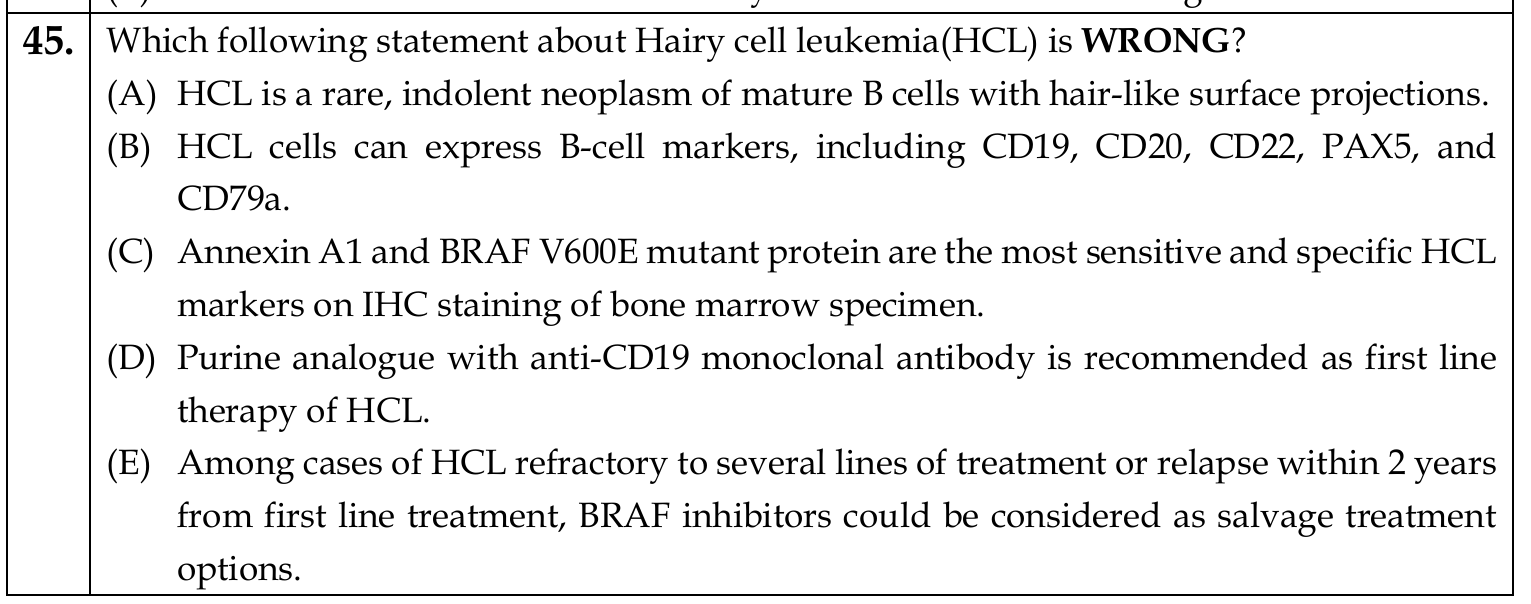
Q45. Which following statement about Hairy cell leukemia (HCL) is WRONG?
- (A) HCL is a rare, indolent neoplasm of mature B cells with hair-like surface projections.
- (B) HCL cells can express B-cell markers, including CD19, CD20, CD22, PAX5, and CD79a.
- (C) Annexin A1 and BRAF V600E mutant protein are the most sensitive and specific HCL markers on IHC staining of bone marrow specimen.
- (D) Purine analogue with anti-CD19 monoclonal antibody is recommended as first line therapy of HCL.
- (E) Among cases of HCL refractory to several lines of treatment or relapse within 2 years from first line treatment, BRAF inhibitors could be considered as salvage treatment options.
點此顯示正解
(D) Purine analogue with anti-CD19 monoclonal antibody is recommended as first line therapy of HCL.
詳解
Analysis of the Board Question
1. Why Option (D) is WRONG:
Option (D) states that "purine analogue with anti-CD19 monoclonal antibody is recommended as first line therapy of HCL." This statement is incorrect because the monoclonal antibody used in combination with purine analogues for HCL is anti-CD20 (rituximab), not anti-CD19234[^7].
The error is specific and clinically important: CD20 is the therapeutic target. First-line therapy for HCL consists of purine nucleoside analogues (cladribine or pentostatin) either as monotherapy or combined with the anti-CD20 monoclonal antibody rituximab234. Chemoimmunotherapy with cladribine followed by rituximab achieves 100% complete response rates in phase II trials, with 5-year failure-free survival of 94.8%1. While HCL cells do express CD19 as a B-cell marker (see option B), CD19 is not the target of therapeutic monoclonal antibodies in HCL treatment. The substitution of "anti-CD19" for "anti-CD20" makes this statement false.
2. Why the Other Options are CORRECT:
(A) HCL is a rare, indolent neoplasm of mature B cells with hair-like surface projections.
This is the classic definition of HCL. It is indeed a rare, indolent B-cell neoplasm characterized by circulating cells with distinctive hairlike cytoplasmic projections that preferentially infiltrate bone marrow and spleen4[^7]. The disease has a remitting-relapsing pattern and an almost normal life expectancy with current therapies[^7].
(B) HCL cells can express B-cell markers, including CD19, CD20, CD22, PAX5, and CD79a.
This accurately describes the immunophenotype of HCL. HCL cells express pan-B-cell markers including CD19, CD20, CD22, and CD79a, along with other markers such as CD11c, CD25, CD103, DBA44, FMC7, CD200, and T-bet[^8]. These B-cell antigens are part of the diagnostic workup, though annexin A1 and BRAF V600E are the most specific markers.
(C) Annexin A1 and BRAF V600E mutant protein are the most sensitive and specific HCL markers on IHC staining of bone marrow specimen.
This statement is explicitly supported by the literature. Annexin A1 and BRAF V600E mutant protein, both detectable on immunohistochemical staining of bone marrow trephine biopsy specimens, are the most sensitive and specific HCL markers[8][7]. These markers are particularly valuable for distinguishing HCL from diseases that mimic it (HCL variant, splenic marginal-zone lymphoma, splenic diffuse red pulp small B-cell lymphoma), which are negative for both markers[^8]. The BRAF V600E mutation is present in at least 95% of HCL cases and is the clonal genetic event underlying pathogenesis[7][9].
(E) Among cases of HCL refractory to several lines of treatment or relapse within 2 years from first line treatment, BRAF inhibitors could be considered as salvage treatment options.
This is correct. In HCL cases that are refractory to chemotherapy or relapse very early (e.g., <2 years after treatment), as well as cases with multiple relapses after purine analogues, BRAF inhibition is a better option than chemotherapy[^5]. BRAF inhibitors (vemurafenib, dabrafenib) are increasingly used in relapsed/refractory HCL and achieve nearly 100% response rates with 35-42% complete remissions in multiply relapsed or refractory patients4[10][11]. These chemotherapy-free strategies are particularly valuable in patients with active infections and are being explored as front-line alternatives4[^7].
詳解 · 中文翻譯
題目分析
1. 為什麼選項 (D) 是錯誤的:
選項 (D) 指出「含嘌呤類似物和抗 CD19 單克隆抗體推薦作為 HCL 的一線療法」。此敘述是不正確的因為與嘌呤類似物聯合用於 HCL 的單克隆抗體是抗 CD20(rituximab),而不是抗 CD19234[^7]。
此錯誤是具體且臨床上重要的:CD20 是治療靶點。HCL 的一線療法由嘌呤核苷類似物(cladribine 或 pentostatin)單獨或聯合抗 CD20 單克隆抗體 rituximab234。包含 cladribine 後跟 rituximab 的化療免疫在第 II 期試驗中達成 100% 完全反應率,5 年無故障生存率為 94.8%1。雖然 HCL 細胞作為 B 細胞標誌確實表達 CD19(見選項 B),CD19 不是 HCL 治療中單克隆抗體的靶點。將「抗 CD19」替代為「抗 CD20」使此敘述為假。
2. 為什麼其他選項是正確的:
(A) HCL 是具有毛髮樣表面突出的成熟 B 細胞的罕見、惰性腫瘤。
這是 HCL 的經典定義。它確實是一種罕見、惰性 B 細胞腫瘤,其特徵是循環細胞具有與毛髮樣細胞質突出的顯著特性,優先浸潤骨髓和脾臟4[7]。該病具有緩解-復發模式和幾乎正常的生命預期與當前療法[7]。
(B) HCL 細胞可表達 B 細胞標誌,包括 CD19、CD20、CD22、PAX5 和 CD79a。
這準確地描述了 HCL 的免疫表型。HCL 細胞表達泛 B 細胞標誌包括 CD19、CD20、CD22 和 CD79a,連同其他標誌如 CD11c、CD25、CD103、DBA44、FMC7、CD200 和 T-bet[^8]。這些 B 細胞抗原是診斷工作的一部分,儘管 annexin A1 和 BRAF V600E 是最具體的標誌。
(C) Annexin A1 和 BRAF V600E 突變蛋白是骨髓標本 IHC 染色上最敏感和特異的 HCL 標誌。
此敘述由文獻明確支持。Annexin A1 和 BRAF V600E 突變蛋白,兩者在骨髓三檢生檢標本的免疫組織化學染色上可檢測,是最敏感和特異的 HCL 標誌[8][7]。這些標誌對於區分 HCL 與模擬它的病症(HCL 變體、脾邊緣區淋巴瘤、脾瀰漫性紅髓小 B 細胞淋巴瘤)特別有價值,兩者都對兩個標誌陰性[^8]。BRAF V600E 突變存在於至少 95% 的 HCL 病例中,是發病機制下的克隆遺傳事件[7][9]。
(E) 在難治多線治療或從一線治療後 2 年內復發的 HCL 病例中,BRAF 抑制劑可被認為是救援治療選項。
這是正確的。在難治化療或非常早期復發(例如,治療後 <2 年)的 HCL 病例中,以及在嘌呤類似物後有多次復發的病例中,BRAF 抑制是比化療更好的選項[^5]。BRAF 抑制劑(vemurafenib、dabrafenib)越來越多地用於復發/難治 HCL,並在多次復發或難治患者中達成近 100% 反應率,35-42% 完全緩解4[10][11]。這些無化療策略在具有活躍感染的患者中特別有價值,正在探索作為一線替代方案4[^7]。
參考文獻 (AMA)
-
Falini B, Tiacci E. Hairy-Cell Leukemia. The New England Journal of Medicine. 2024;391(14):1328-1341. doi:10.1056/NEJMra2406376. PMID:39383460. ↩↩
-
Maitre E, Cornet E, Troussard X. Hairy Cell Leukemia: 2020 Update on Diagnosis, Risk Stratification, and Treatment. American Journal of Hematology. 2019;94(12):1413-1422. doi:10.1002/ajh.25653. PMID:31591741. ↩↩↩↩
-
Tiacci E, Pettirossi V, Schiavoni G, Falini B. Genomics of Hairy Cell Leukemia. Journal of Clinical Oncology : Official Journal of the American Society of Clinical Oncology. 2017;35(9):1002-1010. doi:10.1200/JCO.2016.71.1556. PMID:28297625. ↩↩↩↩
-
Falini B, Martelli MP, Tiacci E. BRAF V600E Mutation in Hairy Cell Leukemia: From Bench to Bedside. Blood. 2016;128(15):1918-1927. doi:10.1182/blood-2016-07-418434. PMID:27554081. ↩↩↩↩↩↩↩↩↩↩
Slide correction
Anti-CD20
Figures