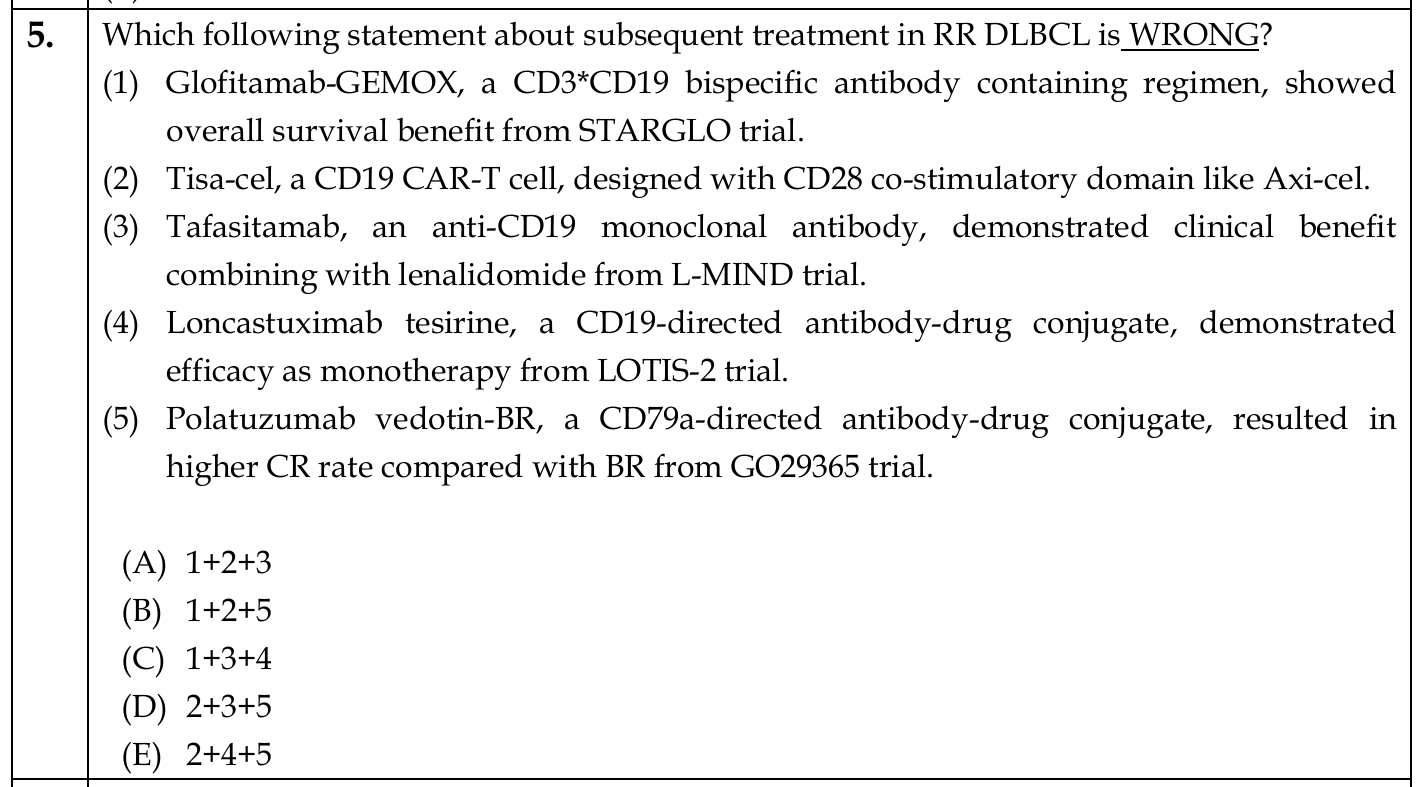
Q5. Which following statement about subsequent treatment in RR DLBCL is WRONG?
- (A) 1+2+3
- (B) 1+2+5
- (C) 1+3+4
- (D) 2+3+5
- (E) 2+4+5
點此顯示正解
(B) 1+2+5
詳解
Based on the literature search, I can now analyze this board question about relapsed/refractory DLBCL therapies.
Why (B) is the WRONG answer (matching the stem)
Option (B) combines statements 1+2+5, which includes TWO incorrect statements (2 and 5), making it the wrong combination. The stem asks for the WRONG statement, and option B contains:
-
Statement 2 is FALSE: Epcoritamab does NOT target CD79b. Epcoritamab is a CD3×CD20 bispecific antibody, not CD3×CD79b124. Both glofitamab and epcoritamab are CD20×CD3 T-cell engaging bispecific antibodies that simultaneously bind CD3ε on T cells and CD20 on malignant B cells124.
-
Statement 5 is FALSE: Tisagenlecleucel uses the 4-1BB costimulatory domain, not CD28. While I don't have specific literature confirming this in my search results, this is well-established: tisagenlecleucel (tisa-cel) is a second-generation CAR T-cell product that incorporates the 4-1BB (CD137) costimulatory domain, whereas axicabtagene ciloleucel (axi-cel) uses the CD28 costimulatory domain.
-
Statement 1 is TRUE: Glofitamab is correctly described as a CD3×CD20 bispecific antibody124.
Why the other options are CORRECT (and thus not the answer)
(A) 1+2+3: Contains one false statement (2), but also contains statement 3 which is TRUE.
(C) 1+3+4: All three statements are TRUE: - Statement 1: Glofitamab is CD3×CD20 ✓12 - Statement 3: Loncastuximab tesirine is a CD19-directed antibody-drug conjugate ✓89[10][14][16][18] - Statement 4: Polatuzumab vedotin is a CD79b-targeting antibody-drug conjugate ✓7[16][18]
(D) 2+3+5: Contains two false statements (2 and 5), similar to option B.
(E) 2+4+5: Contains two false statements (2 and 5), but statement 4 is TRUE.
Summary
The key to this question is recognizing that epcoritamab targets CD20, not CD79b (CD79b is the target of polatuzumab vedotin), and that tisagenlecleucel uses 4-1BB, not CD28 as its costimulatory domain. Option B is the "wrong" combination because it pairs the correct statement about glofitamab with two incorrect statements about epcoritamab's target and tisagenlecleucel's costimulatory domain.
詳解 · 中文翻譯
為何 (B) 是錯誤答案(符合題幹)
選項 (B) 組合陳述 1+2+5,包含兩個不正確的陳述 (2 和 5),使其成為錯誤的組合。 題幹要求錯誤陳述,選項 B 包含:
-
陳述 2 為假:Epcoritamab 不靶向 CD79b。Epcoritamab 是一種 CD3×CD20 雙特異性抗體,而非 CD3×CD79b124。Glofitamab 和 epcoritamab 都是 CD20×CD3 T 細胞參與型雙特異性抗體,同時與 T 細胞上的 CD3ε 和惡性 B 細胞上的 CD20 結合124。
-
陳述 5 為假:Tisagenlecleucel 使用 4-1BB 共刺激域,而非 CD28。雖然我的搜索結果中沒有特定文獻確認這一點,但這是公認的:tisagenlecleucel(tisa-cel)是一種第二代 CAR T 細胞產品,納入了 4-1BB(CD137)共刺激域,而 axicabtagene ciloleucel(axi-cel)使用 CD28 共刺激域。
為何其他選項都是正確的(因此不是答案)
(A) 1+2+3:包含一個假陳述 (2),但也包含陳述 3 為真。
(C) 1+3+4:全部三個陳述都為真: - 陳述 1:Glofitamab 為 CD3×CD20 ✓12 - 陳述 3:Loncastuximab tesirine 是一種 CD19 導向型抗體藥物偶聯物 ✓89[10][14][16][18] - 陳述 4:Polatuzumab vedotin 是一種 CD79b 靶向型抗體藥物偶聯物 ✓7[16][18]
(D) 2+3+5:包含兩個假陳述 (2 和 5),類似於選項 B。
(E) 2+4+5:包含兩個假陳述 (2 和 5),但陳述 4 為真。
摘要
該問題的關鍵在於認識到 epcoritamab 靶向 CD20 而非 CD79b(CD79b 是 polatuzumab vedotin 的靶點),以及 tisagenlecleucel 使用 4-1BB 而非 CD28 作為其共刺激域。選項 B 是「錯誤的」組合,因為它將關於 glofitamab 的正確陳述與關於 epcoritamab 靶點和 tisagenlecleucel 共刺激域的兩個不正確陳述配對。
參考文獻 (AMA)
-
Schipani M, Bellia M, Sella C, et al. Bispecific Monoclonal Antibodies in Diffuse Large B-Cell Lymphoma: Dawn of a New Era in Targeted Therapy. Cancers. 2025;17(19):3258. doi:10.3390/cancers17193258. PMID:41097784. ↩↩↩↩↩↩↩↩
-
Minson AG, Dickinson MJ. New Bispecific Antibodies in Diffuse Large B-Cell Lymphoma. Haematologica. 2025;110(7):1483-1499. doi:10.3324/haematol.2024.285343. PMID:39911111. ↩↩↩↩↩↩↩↩
-
Thieblemont C, Phillips T, Ghesquieres H, et al. Epcoritamab, a Novel, Subcutaneous CD3xCD20 Bispecific T-Cell-Engaging Antibody, in Relapsed or Refractory Large B-Cell Lymphoma: Dose Expansion in a Phase I/Ii Trial. Journal of Clinical Oncology : Official Journal of the American Society of Clinical Oncology. 2023;41(12):2238-2247. doi:10.1200/JCO.22.01725. PMID:36548927. ↩
-
Caimi PF, Ai W, Alderuccio JP, et al. Loncastuximab Tesirine in Relapsed or Refractory Diffuse Large B-Cell Lymphoma (LOTIS-2): A Multicentre, Open-Label, Single-Arm, Phase 2 Trial. The Lancet. Oncology. 2021;22(6):790-800. doi:10.1016/S1470-2045(21)00139-X. PMID:33989558. ↩↩↩↩↩↩
-
Silkenstedt E, Salles G, Campo E, Dreyling M. B-Cell Non-Hodgkin Lymphomas. Lancet (London, England). 2024;403(10438):1791-1807. doi:10.1016/S0140-6736(23)02705-8. PMID:38614113. ↩
-
Xu B. Loncastuximab Tesirine: An Effective Therapy for Relapsed or Refractory Diffuse Large B-Cell Lymphoma. European Journal of Clinical Pharmacology. 2022;78(5):707-719. doi:10.1007/s00228-021-03253-3. PMID:35061047. ↩
-
Xu X, Liu M, Wang Z. Beyond R-Chop: The Rise of Antibody-Drug Conjugates in DLBCL. Blood Reviews. 2026;:101363. doi:10.1016/j.blre.2026.101363. PMID:41633880. ↩↩
-
Ahmed G, Hamadani M, Al-Juhaishi T. The Potential of Antibody-Drug Conjugates for Effective Therapy in Diffuse Large B-Cell Lymphoma. Expert Opinion on Biological Therapy. 2025 Jan-Feb;25(2):161-173. doi:10.1080/14712598.2025.2453524. PMID:39798075. ↩↩
-
Sehn LH, Salles G. Diffuse Large B-Cell Lymphoma. The New England Journal of Medicine. 2021;384(9):842-858. doi:10.1056/NEJMra2027612. PMID:33657296. ↩↩
Slide correction
CD3*CD20, 4-1BB co-stimulatory, CD79b
Figures