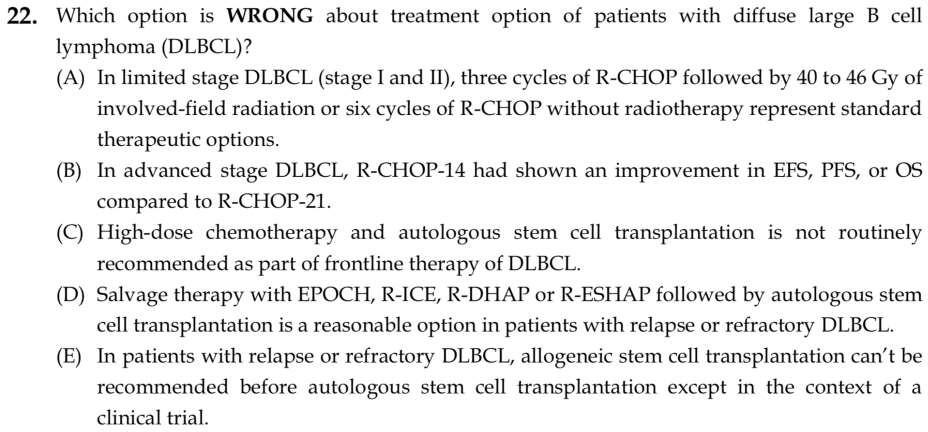
Q22. Which option is WRONG about treatment option of patients with diffuse large B cell lymphoma (DLBCL)?
- (A) In limited stage DLBCL (stage I and II), three cycles of R-CHOP followed by 40 to 46 Gy of involved-field radiation or six cycles of R-CHOP without radiotherapy represent standard therapeutic options.
- (B) In advanced stage DLBCL, R-CHOP-14 had shown an improvement in EFS, PFS, or OS compared to R-CHOP-21.
- (C) High-dose chemotherapy and autologous stem cell transplantation is not routinely recommended as part of frontline therapy of DLBCL.
- (D) Salvage therapy with EPOCH, R-ICE, R-DHAP or R-ESHAP followed by autologous stem cell transplantation is a reasonable option in patients with relapse or refractory DLBCL.
- (E) In patients with relapse or refractory DLBCL, allogeneic stem cell transplantation can't be recommended before autologous stem cell transplantation except in the context of a clinical trial.
點此顯示正解
(B) In advanced stage DLBCL, R-CHOP-14 had shown an improvement in EFS, PFS, or OS compared to R-CHOP-21.
詳解
Analysis
The stem asks for the WRONG statement about DLBCL treatment options.
1) Why (B) is the INCORRECT statement:
Option (B) states that "R-CHOP-14 had shown an improvement in EFS, PFS, or OS compared to R-CHOP-21" in advanced stage DLBCL. This is false. Multiple large randomized controlled trials have definitively demonstrated that R-CHOP-14 does NOT improve event-free survival (EFS), progression-free survival (PFS), or overall survival (OS) compared to R-CHOP-2112345.
The landmark UK NCRI R-CHOP14v21 trial (1,080 patients) found no significant difference in 2-year OS (82.7% vs 80.8%, HR 0.90, p=0.38) or 2-year PFS (75.4% vs 74.8%, HR 0.94, p=0.59) between R-CHOP-14 and R-CHOP-214. The primary endpoint of superior overall survival with R-CHOP-14 was not met1. Similar findings were reported by the French GELA study1. Real-world registry data from Germany confirmed these results, showing 3-year PFS of 75% for R-CHOP-14 versus 80% for R-CHOP-21, with similar OS rates6. Based on this evidence, R-CHOP-21 remains the standard reference regimen for advanced-stage DLBCL35[^10].
2) Why the other options are TRUE statements:
(A) is TRUE: For limited-stage DLBCL (stage I-II), both 3 cycles of R-CHOP plus involved-field radiation (40-46 Gy) and 6 cycles of R-CHOP without radiotherapy are established standard options78[^11]. Recent trials have confirmed that 4 cycles of R-CHOP alone is sufficient for low-risk patients with nonbulky disease who achieve complete metabolic response on PET-CT7. Combined modality therapy with 3-4 cycles and involved-site radiotherapy has been a predominant historical standard8[^11].
(C) is TRUE: High-dose chemotherapy with autologous stem cell transplantation (ASCT) is NOT routinely recommended as part of frontline therapy for DLBCL[^9]. Standard frontline treatment consists of R-CHOP-based regimens. ASCT is reserved for relapsed/refractory disease, not upfront consolidation in first remission.
(D) is TRUE: For relapsed/refractory DLBCL, salvage chemotherapy regimens (R-EPOCH, R-ICE, R-DHAP, R-ESHAP) followed by ASCT represent a reasonable standard approach[^9], particularly for patients with late relapse (>12 months). This has been the established paradigm for fit patients with relapsed disease, though CAR T-cell therapy has emerged as preferred for early relapse or refractory disease[^9].
(E) is TRUE: Allogeneic stem cell transplantation is generally NOT recommended before autologous transplantation except in clinical trials for relapsed/refractory DLBCL. The standard sequence is salvage chemotherapy followed by autologous (not allogeneic) transplantation. Allogeneic transplantation carries higher treatment-related mortality and is typically reserved for investigational settings or after autologous transplant failure.
詳解 · 中文翻譯
分析
題目尋求關於 DLBCL 治療選項的錯誤陳述。
1) 為什麼 (B) 是不正確的敘述:
選項 (B) 指出「在晚期 DLBCL 中,R-CHOP-14 相比 R-CHOP-21 顯示 EFS、PFS 或 OS 的改善」。這是假的。多項大型隨機對照試驗已明確證實 R-CHOP-14 相比 R-CHOP-21 在事件無進展生存 (EFS)、無進展生存 (PFS) 或總體生存 (OS) 方面不改善12345。
標誌性的英國 NCRI R-CHOP14v21 試驗(1,080 例患者)發現 R-CHOP-14 和 R-CHOP-21 在 2 年 OS(82.7% vs 80.8%,HR 0.90,p=0.38)和 2 年 PFS(75.4% vs 74.8%,HR 0.94,p=0.59)上沒有顯著差異4。R-CHOP-14 優越總生存的主要終點未達到1。法國 GELA 研究報告了類似的結果1。來自德國的真實世界登記數據證實了這些結果,顯示 R-CHOP-14 的 3 年 PFS 為 75% vs R-CHOP-21 的 80%,OS 率相似6。基於此證據,R-CHOP-21 仍為晚期 DLBCL 的標準參考方案35[^10]。
2) 為什麼其他選項是真實陳述:
(A) 為真:對於局限期 DLBCL(I-II 期),3 個周期的 R-CHOP 加靶向野照射(40-46 Gy)和 6 個周期的 R-CHOP 無放療都是已建立的標準選項78[^11]。最近的試驗證實,對於在 PET-CT 上達到完全代謝反應的非腫塊低危患者,4 個周期單獨的 R-CHOP 是充分的7。包括 3-4 個周期和靶向部位放療的聯合模式治療已是占優勢的歷史標準8[^11]。
(C) 為真:大劑量化療加自體幹細胞移植 (ASCT) 不常規推薦作為 DLBCL 一線治療的一部分[^9]。標準一線治療包括基於 R-CHOP 的方案。ASCT 保留用於復發/難治病,不用於首次緩解期的前期強化。
(D) 為真:對於復發/難治 DLBCL,救援化療方案(R-EPOCH、R-ICE、R-DHAP、R-ESHAP)後的 ASCT 代表合理的標準方法[^9],特別是對於晚期復發(>12 個月)的患者。這一直是適格患者復發病的既定典範,儘管 CAR T 細胞治療已對早期復發或難治病具有吸引力[^9]。
(E) 為真:對於復發/難治 DLBCL,除在臨床試驗背景下外,異體幹細胞移植一般不在自體移植前推薦。標準序列是救援化療後跟進自體(不是異體)移植。異體移植具有更高的治療相關死亡率,通常保留用於調查設定或自體移植失敗後。
參考文獻 (AMA)
-
Cunningham D, Hawkes EA, Jack A, et al. Rituximab Plus Cyclophosphamide, Doxorubicin, Vincristine, and Prednisolone in Patients With Newly Diagnosed Diffuse Large B-Cell Non-Hodgkin Lymphoma: A Phase 3 Comparison of Dose Intensification With 14-Day Versus 21-Day Cycles. Lancet (London, England). 2013;381(9880):1817-26. doi:10.1016/S0140-6736(13)60313-X. PMID:23615461. ↩↩↩↩↩↩
-
Kühnl A, Cunningham D, Counsell N, et al. Outcome of Elderly Patients With Diffuse Large B-Cell Lymphoma Treated With R-Chop: Results From the UK NCRI R-CHOP14v21 Trial With Combined Analysis of Molecular Characteristics With the DSHNHL RICOVER-60 Trial. Annals of Oncology : Official Journal of the European Society for Medical Oncology. 2017;28(7):1540-1546. doi:10.1093/annonc/mdx128. PMID:28398499. ↩↩
-
Tan D, Tan SY, Lim ST, et al. Management of B-Cell Non-Hodgkin Lymphoma in Asia: Resource-Stratified Guidelines. The Lancet. Oncology. 2013;14(12):e548-61. doi:10.1016/S1470-2045(13)70450-9. PMID:24176573. ↩↩↩↩
-
Knauf W, Abenhardt W, Mohm J, et al. Similar Effectiveness of R-Chop-14 and -21 in Diffuse Large B-Cell Lymphoma-Data From the Prospective German Tumour Registry Lymphatic Neoplasms. European Journal of Haematology. 2019;103(5):460-471. doi:10.1111/ejh.13295. PMID:31314918. ↩↩↩↩
-
Sehn LH, Salles G. Diffuse Large B-Cell Lymphoma. The New England Journal of Medicine. 2021;384(9):842-858. doi:10.1056/NEJMra2027612. PMID:33657296. ↩↩↩↩
-
Hawkes EA, Barraclough A, Sehn LH. Limited-Stage Diffuse Large B-Cell Lymphoma. Blood. 2022;139(6):822-834. doi:10.1182/blood.2021013998. PMID:34932795. ↩↩
-
Zhang XY, Collins GP, Cutter DJ, Eyre TA. Limited-Stage Diffuse Large B-Cell Lymphoma: Current Management and Challenges. British Journal of Haematology. 2021;194(3):508-517. doi:10.1111/bjh.17359. PMID:33618434. ↩↩↩↩
-
Falade AS, Ansell SM. Treatment of Diffuse Large B-Cell Lymphoma. Mayo Clinic Proceedings. 2026;:S0025-6196(26)17341-8. doi:10.1016/j.mayocp.2026.01.017. PMID:41961024. ↩↩↩↩
Slide annotations
Stage I, nonbulky, smIPI = 0, R-CHOP X 4 cycles or 3 cycles
Lancet Oncol. 2013;14(6):525-533.
Figures