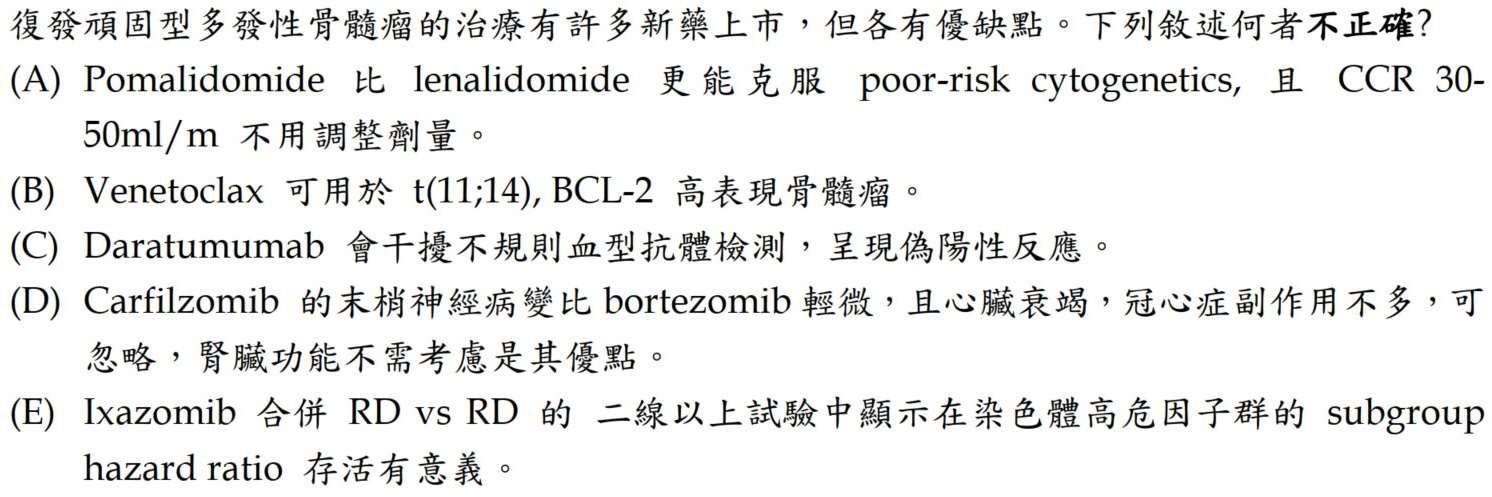
Q1. 復發頑固型多發性骨髓瘤的治療有許多新藥上市,但各有優缺點。下列敘述何者不正確?
- (A) Pomalidomide 比 lenalidomide 更能克服 poor-risk cytogenetics,且 CCR 30-50ml/m 不用調整劑量。
- (B) Venetoclax 可用於 t(11;14), BCL-2 高表現骨髓瘤。
- (C) Daratumumab 會干擾不規則血型抗體檢測,呈現偽陽性反應。
- (D) Carfilzomib 的末梢神經病變比 bortezomib 輕微,且心臟表現,冠心症副作用不多,可忽略,腎臟功能不需考慮是其優點。
- (E) Ixazomib 合併 RD vs RD 的二線以上試驗中顯示在染色體高危因子群的 subgroup hazard ratio 存活有意義。
點此顯示正解
(D) Carfilzomib 的末梢神經病變比 bortezomib 輕微,且心臟表現,冠心症副作用不多,可忽略,腎臟功能不需考慮是其優點。
詳解
Why (D) is the FALSE Statement
Carfilzomib's cardiac, pulmonary, and renal toxicities are clinically significant and cannot be ignored, making option (D) incorrect. While carfilzomib does cause less peripheral neuropathy than bortezomib, the statement that its cardiac/coronary side effects are minimal and can be ignored, and that renal function doesn't need consideration, is false12345.
Cardiovascular toxicity with carfilzomib: - All-grade cardiovascular adverse events (CVAE) occur in 18.1% of patients, with grade ≥3 events in 8.2%4 - Risk ratio for high-grade cardiac toxicities is 2.2 compared to controls1 - Common cardiac toxicities include heart failure (systolic or diastolic), cardiac chest pain, hypertension, arrhythmia, acute coronary syndrome, and pulmonary hypertension1 - Approximately 90% of cardiac toxicities occur within the first 3 months of treatment, with median time to first event of 31 days1
In the ENDEAVOR trial comparing carfilzomib to bortezomib, carfilzomib showed significantly higher rates of: - Grade 3 hypertension: 9% vs 3% - Grade 3 dyspnea: 5% vs 2%1
In the ASPIRE trial (carfilzomib-lenalidomide-dexamethasone vs lenalidomide-dexamethasone), the carfilzomib arm had higher incidences of: - Heart failure: 6.4% vs 4.1% - Ischemic heart disease: 5.9% vs 4.6% - Hypertension: 14.3% vs 6.9%23
Real-world data from SEER-Medicare showed carfilzomib users had a hazard ratio of 1.41 for all cardiovascular adverse events, with significantly increased risk of heart failure (HR 1.47), ischemic heart disease (HR 1.45), and hypertension (HR 3.33)5.
Renal and pulmonary toxicity are also significant concerns with carfilzomib, often occurring as part of a cardiorenal syndrome or vascular toxicity pattern13. These toxicities require careful monitoring and cannot be ignored.
Why the Other Statements Are Correct
(A) Pomalidomide overcomes poor-risk cytogenetics and requires no dose adjustment for CrCl 30-50 mL/min — TRUE
Pomalidomide has significant activity in relapsed/refractory multiple myeloma, even in patients failing lenalidomide, with response rates of approximately 30% in patients refractory to both lenalidomide and bortezomib9[^10]. In the ICARIA-MM trial, isatuximab-pomalidomide-dexamethasone improved median PFS in high-risk cytogenetic patients (7.5 vs 3.7 months; HR 0.66) and overall response rate (50.0% vs 16.7%)[^11]. Unlike lenalidomide, pomalidomide does not require dose adjustment for moderate renal impairment (CrCl 30-50 mL/min), making it advantageous in this population.
(B) Venetoclax can be used in t(11;14), BCL-2 high-expression myeloma — TRUE
Venetoclax, a BCL-2 inhibitor, has shown particular efficacy in multiple myeloma patients with t(11;14) translocation, which is associated with BCL-2 overexpression and dependence. The BELLINI trial evaluated venetoclax in combination with bortezomib-dexamethasone in relapsed/refractory multiple myeloma, demonstrating activity specifically in the t(11;14) subgroup.
(C) Daratumumab interferes with irregular blood group antibody testing, causing false-positive reactions — TRUE
Daratumumab, an anti-CD38 monoclonal antibody, binds to CD38 expressed on red blood cells, causing pan-reactivity in indirect antiglobulin tests (IAT) and antibody screening. This interference can mask clinically significant alloantibodies and complicate blood bank testing, requiring special techniques (such as dithiothreitol treatment) to mitigate the interference.
(E) Ixazomib + Rd vs Rd in second-line+ trial showed significant subgroup hazard ratio survival benefit in high-risk cytogenetic group — TRUE
The TOURMALINE-MM1 trial (Moreau et al., NEJM 2016) evaluated ixazomib-lenalidomide-dexamethasone versus lenalidomide-dexamethasone in relapsed/refractory multiple myeloma. Subgroup analysis demonstrated progression-free survival benefit in patients with high-risk cytogenetics, supporting the use of ixazomib-based regimens in this challenging population8.
詳解 · 中文翻譯
為什麼 (D) 是虛假敘述
Carfilzomib 的心臟、肺和腎毒性是臨床上重要的,不能被忽視,使選項 (D) 不正確。雖然 carfilzomib 確實導致比 bortezomib 更少的周邊神經病變,敘述其心臟/冠狀動脈副作用最少,可以被忽視,以及腎功能不需要考慮,是虛假的12345。
Carfilzomib 心血管毒性: - 全級心血管不良事件 (CVAE) 發生在18.1% 的患者中,3 級或更高事件在8.2%4 - 高級心臟毒性的危險比2.2 相比對照1 - 常見的心臟毒性包括心衰(收縮期或舒張期)、心臟胸痛、高血壓、心律不整、急性冠狀動脈綜合症和肺高血壓1 - 約90% 的心臟毒性發生在治療的前 3 個月內,第一個事件的中位時間為 31 天1
在比較 carfilzomib 與 bortezomib 的 ENDEAVOR 試驗中,carfilzomib 顯示明顯更高的比率: - 3 級高血壓:9% vs 3% - 3 級呼吸困難:5% vs 2%1
在 ASPIRE 試驗(carfilzomib-lenalidomide-dexamethasone vs lenalidomide-dexamethasone)中,carfilzomib 臂具有更高的發生率: - 心衰:6.4% vs 4.1% - 缺血性心臟病:5.9% vs 4.6% - 高血壓:14.3% vs 6.9%23
來自 SEER-Medicare 的真實世界數據顯示 carfilzomib 使用者對所有心血管不良事件具有危險比 1.41,心衰的風險顯著增加(HR 1.47)、缺血性心臟病(HR 1.45)和高血壓(HR 3.33)5。
腎和肺毒性也是 carfilzomib 的重要關注,經常作為心腎綜合症或血管毒性模式的一部分出現13。這些毒性需要仔細監測,不能被忽視。
為什麼其他敘述是正確的
(A) Pomalidomide 克服不良風險細胞遺傳學,CrCl 30-50 mL/min 不需要劑量調整 — 正確
Pomalidomide 在復發/難治性多發性骨髓瘤中具有顯著活性,即使在患者失敗 lenalidomide 的患者中,對 lenalidomide 和 bortezomib 均難治患者的反應率約為 30%9[^10]。在 ICARIA-MM 試驗中,isatuximab-pomalidomide-dexamethasone 改善高危細胞遺傳學患者的中位 PFS(7.5 vs 3.7 個月;HR 0.66)和整體反應率(50.0% vs 16.7%)[^11]。不像 lenalidomide,pomalidomide 不需要對中度腎功能損害調整劑量(CrCl 30-50 mL/min),使其在此人群中具有優勢。
(B) Venetoclax 可用於 t(11;14)、BCL-2 高表現骨髓瘤 — 正確
Venetoclax,BCL-2 抑制劑,在具有 t(11;14) 易位的多發性骨髓瘤患者中顯示特定療效,其與 BCL-2 過度表達和依賴相關。BELLINI 試驗在復發/難治性多發性骨髓瘤中評估 venetoclax 與 bortezomib-dexamethasone 的組合,在 t(11;14) 亞群中證明了活性。
(C) Daratumumab 干擾不規則血型抗體檢測,導致偽陽性反應 — 正確
Daratumumab,抗-CD38 單克隆抗體,結合在紅細胞表達的 CD38,導致間接抗球蛋白測試 (IAT) 和抗體篩查中的泛反應。此干擾可能掩蓋臨床上重要的同種異體抗體,並複雜化血液銀行測試,需要特殊技術(如二硫蘇糖醇治療)來緩解干擾。
(E) Ixazomib + Rd vs Rd 在二線以上試驗中顯示高危細胞遺傳學群組中顯著亞群危險比存活益處 — 正確
TOURMALINE-MM1 試驗(Moreau 等人,NEJM 2016)在復發/難治性多發性骨髓瘤中評估 ixazomib-lenalidomide-dexamethasone 與 lenalidomide-dexamethasone。亞群分析在具有高危細胞遺傳學的患者中證明了無進展生存期益處,支持在此具挑戰性人群中使用基於 ixazomib 的方案8。
參考文獻 (AMA)
-
Chakraborty R, Majhail NS. Treatment and Disease-Related Complications in Multiple Myeloma: Implications for Survivorship. American Journal of Hematology. 2020;95(6):672-690. doi:10.1002/ajh.25764. PMID:32086970. ↩↩↩↩↩↩↩↩↩↩↩↩
-
Moslehi JJ. Cardiovascular Toxic Effects of Targeted Cancer Therapies. The New England Journal of Medicine. 2016;375(15):1457-1467. doi:10.1056/NEJMra1100265. PMID:27732808. ↩↩↩↩
-
Li W, Garcia D, Cornell RF, et al. Cardiovascular and Thrombotic Complications of Novel Multiple Myeloma Therapies: A Review. JAMA Oncology. 2017;3(7):980-988. doi:10.1001/jamaoncol.2016.3350. PMID:27632640. ↩↩↩↩↩↩
-
Waxman AJ, Clasen S, Hwang WT, et al. Carfilzomib-Associated Cardiovascular Adverse Events: A Systematic Review and Meta-Analysis. JAMA Oncology. 2018;4(3):e174519. doi:10.1001/jamaoncol.2017.4519. PMID:29285538. ↩↩↩↩
-
Bishnoi R, Xie Z, Shah C, et al. Real-World Experience of Carfilzomib-Associated Cardiovascular Adverse Events: SEER-Medicare Data Set Analysis. Cancer Medicine. 2021;10(1):70-78. doi:10.1002/cam4.3568. PMID:33169938. ↩↩↩↩
-
Rajkumar SV. Multiple Myeloma: 2022 Update on Diagnosis, Risk Stratification, and Management. American Journal of Hematology. 2022;97(8):1086-1107. doi:10.1002/ajh.26590. PMID:35560063. ↩
-
Rajkumar SV. Multiple Myeloma: 2024 Update on Diagnosis, Risk-Stratification, and Management. American Journal of Hematology. 2024;99(9):1802-1824. doi:10.1002/ajh.27422. PMID:38943315. ↩
-
Harrison SJ, Perrot A, Alegre A, et al. Subgroup Analysis of ICARIA-MM Study in Relapsed/Refractory Multiple Myeloma Patients With High-Risk Cytogenetics. British Journal of Haematology. 2021;194(1):120-131. doi:10.1111/bjh.17499. PMID:34036560. ↩↩
-
Goldman-Mazur S, Kumar SK. Current Approaches to Management of High-Risk Multiple Myeloma. American Journal of Hematology. 2021;96(7):854-871. doi:10.1002/ajh.26161. PMID:33725367. ↩↩
Figures