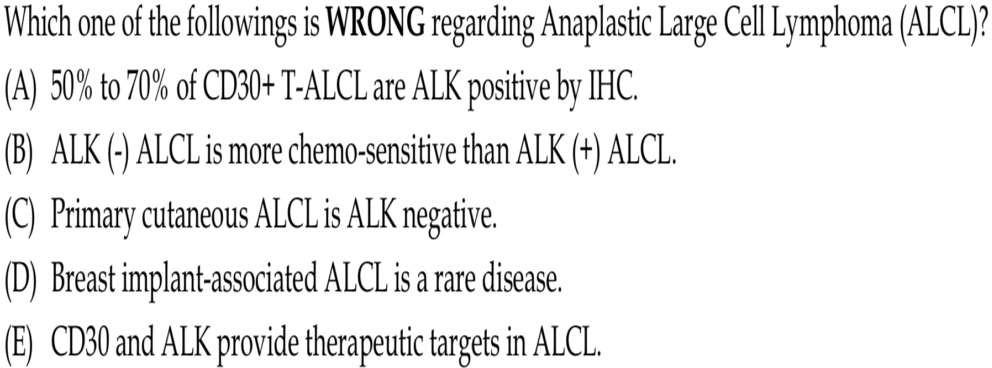
Q1. Which one of the followings is WRONG regarding Anaplastic Large Cell Lymphoma (ALCL)?
- (A) 50% to 70% of CD30+ T-ALCL are ALK positive by IHC.
- (B) ALK (-) ALCL is more chemo-sensitive than ALK (+) ALCL.
- (C) Primary cutaneous ALCL is ALK negative.
- (D) Breast implant-associated ALCL is a rare disease.
- (E) CD30 and ALK provide therapeutic targets in ALCL.
點此顯示正解
(B) ALK (-) ALCL is more chemo-sensitive than ALK (+) ALCL.
詳解
Analysis of Board Question
The stem asks for the WRONG (false) statement about ALCL.
1. Why (B) is the WRONG statement
(B) states that ALK(-) ALCL is more chemo-sensitive than ALK(+) ALCL. This is false. The evidence consistently demonstrates the opposite: ALK(+) ALCL has superior chemotherapy response rates and outcomes compared to ALK(-) ALCL1245.
In the GELA trials, complete response rates to first-line anthracycline-based chemotherapy were 86% for ALK(+) ALCL versus 68% for ALK(-) ALCL (P = 0.01), with 8-year overall survival of 82% versus 49%, respectively (P < 0.001)25. The International PTCL Project similarly showed overall response rates of 88% for ALK(+) versus 76% for ALK(-) ALCL, with 5-year overall survival of 70% versus 49%14. ALK(+) ALCL typically achieves 5-year survival rates of 70-90% compared to 40-60% for ALK(-) ALCL1.
2. Why the other options are TRUE statements
(A) TRUE: Approximately 50-70% of systemic CD30+ T-cell ALCL are ALK-positive by immunohistochemistry. In the GELA study, 46% of systemic ALCL cases were ALK-positive25, while other series report ALK positivity in the range of 50-60% of systemic ALCL cases14. The exact percentage varies by age distribution of the cohort, as ALK(+) ALCL predominates in younger patients.
(C) TRUE: Primary cutaneous ALCL is ALK-negative. This is a defining characteristic that distinguishes primary cutaneous ALCL from systemic ALK(+) ALCL789. Primary cutaneous ALCL presents as skin lesions, lacks ALK gene translocation, and carries a favorable prognosis similar to or better than ALK(+) ALCL8.
(D) TRUE: Breast implant-associated ALCL (BIA-ALCL) is a rare disease. BIA-ALCL is recognized as a rare provisional entity in the WHO classification, presenting as a seroma with a median of 8-10 years after implant placement8. It is classified as one of the four distinct ALCL entities but represents an uncommon complication of breast implants79[^11].
(E) TRUE: CD30 and ALK provide therapeutic targets in ALCL. CD30 is targeted by brentuximab vedotin, an antibody-drug conjugate that shows high response rates (86%) in relapsed/refractory ALCL1. ALK is targeted by ALK inhibitors such as crizotinib and alectinib, which have demonstrated efficacy in ALK(+) ALCL3610. These targeted therapies represent major advances in ALCL treatment beyond traditional chemotherapy.
詳解 · 中文翻譯
血液委員會試題分析
題幹尋求關於 ALCL 錯誤(虛假)敘述。
1. 為何 (B) 是錯誤敘述
(B) 敘述 ALK(-) ALCL 比 ALK(+) ALCL 更化療敏感。 這是 虛假的。證據一致證示相反:ALK(+) ALCL 相比 ALK(-) ALCL 有優越的化療應答率及預後1245。
在 GELA 試驗中,對一線蒽環類化療的完全應答率為 ALK(+) ALCL 86% versus ALK(-) ALCL 68%(P = 0.01),8 年整體存活率分別為 82% versus 49%(P < 0.001)25。國際 PTCL 計畫同樣顯示總體應答率 ALK(+) 88% versus ALK(-) ALCL 76%,5 年整體存活率 70% versus 49%14。ALK(+) ALCL 典型達到 5 年存活率 70-90% 相比 ALK(-) ALCL 的 40-60%1。
2. 為何其他選項是正確敘述
(A) 正確:約 50-70% 的全身性 CD30+ T 細胞 ALCL 按免疫組織化學為 ALK 陽性。在 GELA 研究中,46% 的全身性 ALCL 病例為 ALK 陽性25,而其他系列報告 ALK 陽性性在全身性 ALCL 病例的 50-60% 範圍內14。精確百分比因隊列年齡分佈而異,因 ALK(+) ALCL 在年輕患者中優勢。
(C) 正確:原發性皮膚 ALCL 為 ALK 陰性。這是區分原發性皮膚 ALCL 與全身性 ALK(+) ALCL 的定義特徵789。原發性皮膚 ALCL 表現為皮膚病變,缺乏 ALK 基因易位,且預後與 ALK(+) ALCL 相當或更佳8。
(D) 正確:乳房植入物相關 ALCL(BIA-ALCL)是罕見疾病。BIA-ALCL 在 WHO 分類中被認可為罕見臨時實體,表現為血清瘤,植入後中位 8-10 年8。它被分類為四個不同 ALCL 實體之一,但代表乳房植入物的不常見併發症79[^11]。
(E) 正確:CD30 和 ALK 在 ALCL 中提供治療靶點。CD30 被 brentuximab vedotin 靶點,一種顯示高應答率(86%)於復發/難治 ALCL 的抗體藥物複合體1。ALK 被 ALK 抑制劑如 crizotinib 和 alectinib 靶點,在 ALK(+) ALCL 中已證示療效3610。這些靶向治療代表超越傳統化療的 ALCL 治療重大進展。
參考文獻 (AMA)
-
Hapgood G, Savage KJ. The Biology and Management of Systemic Anaplastic Large Cell Lymphoma. Blood. 2015;126(1):17-25. doi:10.1182/blood-2014-10-567461. PMID:25869285. ↩↩↩↩↩↩↩↩↩↩
-
Sibon D, Fournier M, Brière J, et al. Long-Term Outcome of Adults With Systemic Anaplastic Large-Cell Lymphoma Treated Within the Groupe d'Etude Des Lymphomes De l'Adulte Trials. Journal of Clinical Oncology : Official Journal of the American Society of Clinical Oncology. 2012;30(32):3939-46. doi:10.1200/JCO.2012.42.2345. PMID:23045585. ↩↩↩↩↩↩
-
Eyre TA, Khan D, Hall GW, Collins GP. Anaplastic Lymphoma Kinase-Positive Anaplastic Large Cell Lymphoma: Current and Future Perspectives in Adult and Paediatric Disease. European Journal of Haematology. 2014;93(6):455-68. doi:10.1111/ejh.12360. PMID:24766435. ↩↩
-
Pichler AS, Amador C, Fujimoto A, et al. Advances in Peripheral T cell Lymphomas: Pathogenesis, Genetic Landscapes and Emerging Therapeutic Targets. Histopathology. 2025;86(1):119-133. doi:10.1111/his.15376. PMID:39679758. ↩↩↩↩↩↩
-
Irshaid L, Xu ML. ALCL by Any Other Name: The Many Facets of Anaplastic Large Cell Lymphoma. Pathology. 2020;52(1):100-110. doi:10.1016/j.pathol.2019.09.007. PMID:31706671. ↩↩↩↩↩↩
-
Wu R, Lim MS. Updates in Pathobiological Aspects of Anaplastic Large Cell Lymphoma. Frontiers in Oncology. 2023;13:1241532. doi:10.3389/fonc.2023.1241532. PMID:37810974. ↩↩
-
Zhang XR, Chien PN, Nam SY, Heo CY. Anaplastic Large Cell Lymphoma: Molecular Pathogenesis and Treatment. Cancers. 2022;14(7):1650. doi:10.3390/cancers14071650. PMID:35406421. ↩↩↩↩
-
Lowe EJ, Woessmann W. Anaplastic Large Cell Lymphoma in Children and Adolescents. British Journal of Haematology. 2025;. doi:10.1111/bjh.20154. PMID:40351161. ↩↩↩↩↩↩
-
He Y, Pei K, Zhang H, et al. Observation of Alectinib- And Crizotinib- Included Chemotherapy in Children With ALK-positive Anaplastic Large Cell Lymphoma: A Single Institutional Experience. Cancer Medicine. 2023;12(6):7182-7188. doi:10.1002/cam4.5479. PMID:36408869. ↩↩↩↩
-
Zain JM, Hanona P. Aggressive T-Cell Lymphomas: 2021 Updates on Diagnosis, Risk Stratification and Management. American Journal of Hematology. 2021;96(8):1027-1046. doi:10.1002/ajh.26270. PMID:34111312. ↩↩
Slide annotations
In most studies, about 40% to 50% of systemic ALCLs are ALK-negative. Unlike younger aged patients with ALK-positive ALCL, ALK(-) ALCL typically affects adults (40 to 65 years). Males are more commonly affected than females with a male: female ratio of 1.5:1
Figures