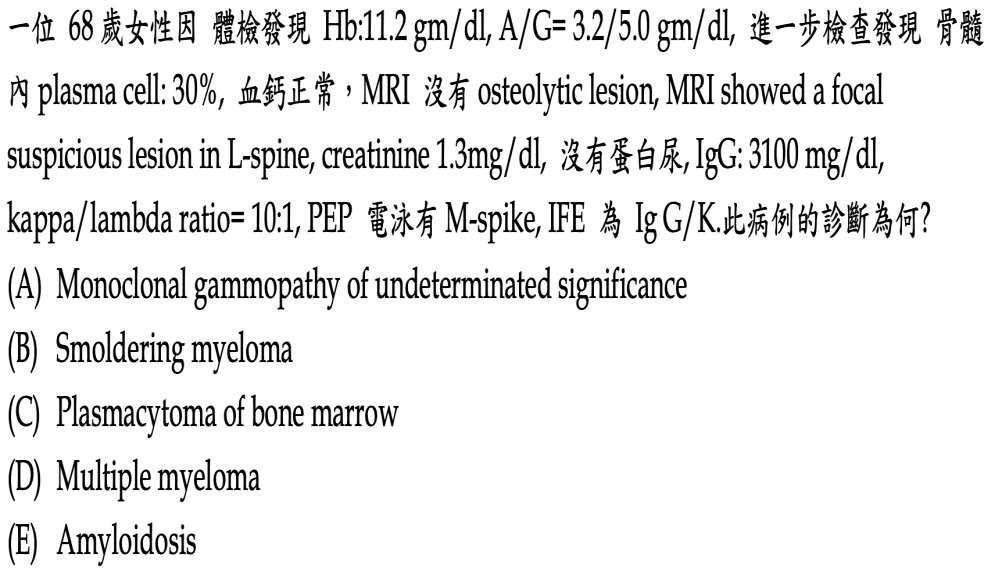
Q1. 一位 68 歲女性因體檢發現 Hb:11.2 gm/dl, A/G=3.2/5.0 gm/dl, 進一步檢查發現骨髓內 plasma cell: 30%, 血鈣正常, MRI 沒有 osteolytic lesion, MRI showed a focal suspicious lesion in L-spine, creatinine 1.3mg/dl, 沒有蛋白尿, IgG: 3100 mg/dl, kappa/lambda ratio=10:1, PEP 電泳有 M-spike, IFE 為 Ig G/K. 此病例的診斷為何?
- (A) Monoclonal gammopathy of undeterminated significance
- (B) Smoldering myeloma
- (C) Plasmacytoma of bone marrow
- (D) Multiple myeloma
- (E) Amyloidosis
點此顯示正解
(B) Smoldering myeloma
詳解
(B) Smoldering myeloma is the correct diagnosis. This patient meets the IMWG 2014 criteria for smoldering multiple myeloma (SMM) but does not meet criteria for active multiple myeloma because she lacks myeloma-defining events (MDE).
Why Smoldering Myeloma is Correct:
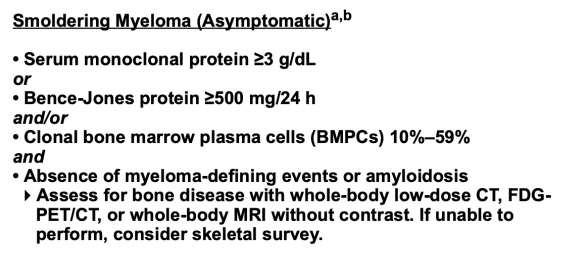
This patient fulfills both SMM diagnostic criteria245: 1. Serum M-protein ≥3 g/dL (IgG 3100 mg/dL = 3.1 g/dL) OR bone marrow plasma cells 10-60% (she has 30%) 2. Absence of myeloma-defining events or amyloidosis
Critical Analysis of MDE Criteria — Why This is NOT Active Myeloma:
The patient does not meet criteria for active multiple myeloma because she lacks both CRAB features and the SLiM biomarker-based MDE245:
CRAB features (all absent): - Calcium: Normal - Renal: Creatinine 1.3 mg/dL (not ≥2 mg/dL or CrCl <40 mL/min) - Anemia: Hemoglobin 11.2 g/dL (not <10 g/dL or >2 g/dL below normal) - Bone lesions: No osteolytic lesions on MRI
SLiM biomarker-based MDE (all absent): - Bone marrow plasma cells: 30% (not ≥60%) - Free light chain ratio: 10:1 (not ≥100; requires ratio ≥100 with involved FLC ≥100 mg/L)245 - Focal lesions on MRI: Only one focal lesion in L-spine (requires >1 focal lesion ≥5 mm to qualify as MDE)245[^6]
The single focal MRI lesion is particularly important — the IMWG criteria specifically require more than one focal lesion on MRI to constitute an MDE245. This patient has only one suspicious lesion, which does not meet the threshold.
Why Other Options are Incorrect:
(A) MGUS — Incorrect. MGUS requires all three of the following245[^6]: - Serum M-protein <3 g/dL (this patient has 3.1 g/dL, exceeds threshold) - Bone marrow plasma cells <10% (this patient has 30%, exceeds threshold) - No CRAB features (met)
This patient exceeds both the M-protein and bone marrow plasma cell thresholds for MGUS.
(C) Plasmacytoma of bone marrow — Incorrect. Solitary plasmacytoma represents a localized plasma cell tumor with <10% bone marrow plasma cells and no evidence of systemic disease2. This patient has diffuse marrow involvement with 30% clonal plasma cells and systemic M-protein production, inconsistent with solitary plasmacytoma.
(D) Multiple myeloma — Incorrect. As detailed above, the patient lacks any CRAB features and does not meet any of the three SLiM biomarker-based MDE criteria (bone marrow plasma cells <60%, FLC ratio 10 not ≥100, only 1 focal lesion not >1)245.
(E) Amyloidosis — Incorrect. There is no clinical or laboratory evidence of organ amyloid deposition (no proteinuria, no cardiac involvement, no hepatomegaly, no neuropathy). Amyloidosis requires biopsy-proven amyloid deposits with evidence of organ dysfunction[^6].
Summary:
詳解 · 中文翻譯
(B) 悶燒骨髓瘤是正確診斷。此患者符合 IMWG 2014 悶燒多發性骨髓瘤 (SMM) 標準,但因為缺乏骨髓瘤定義事件 (MDE) 不符合活躍多發性骨髓瘤的標準。
為什麼悶燒骨髓瘤是正確的:
此患者符合兩個 SMM 診斷標準245: 1. 血清 M 蛋白 ≥3 g/dL(IgG 3100 mg/dL = 3.1 g/dL)或骨髓漿細胞 10-60%(她有 30%) 2. 缺乏骨髓瘤定義事件或澱粉樣變
MDE 標準的關鍵分析 — 為什麼這不是活躍骨髓瘤:
患者不符合活躍多發性骨髓瘤的標準,因為她既缺乏 CRAB 特徵又缺乏 SLiM 生物標誌物基礎 MDE245:
CRAB 特徵(所有缺失): - 鈣:正常 - 腎:肌酐 1.3 mg/dL(不是 ≥2 mg/dL 或 CrCl <40 mL/min) - 貧血:血紅蛋白 11.2 g/dL(不是 <10 g/dL 或 >2 g/dL 低於正常) - 骨病變:MRI 無骨溶解病變
SLiM 生物標誌物基礎 MDE(所有缺失): - 骨髓漿細胞:30%(不是 ≥60%) - 遊離輕鏈比:10:1(不是 ≥100;需要比 ≥100,涉及 FLC ≥100 mg/L)245 - MRI 上的局灶病變:僅一個 L-脊柱局灶病變(需要>1 個 ≥5 mm 的局灶病變才符合 MDE)245[^6]
單個 MRI 病變特別重要 — IMWG 標準明確要求超過一個 MRI 上的局灶病變才構成 MDE245。此患者僅有一個可疑病變,不符合閾值。
為什麼其他選項是不正確的:
(A) MGUS — 不正確。MGUS 需要所有三個以下的245[^6]: - 血清 M 蛋白 <3 g/dL(此患者有 3.1 g/dL,超過閾值) - 骨髓漿細胞 <10%(此患者有 30%,超過閾值) - 無 CRAB 特徵(滿足)
此患者超過 MGUS 的 M 蛋白和骨髓漿細胞閾值。
(C) 骨髓質漿細胞瘤 — 不正確。孤立質漿細胞瘤代表具有 <10% 骨髓漿細胞和無全身疾病證據的局限性漿細胞腫瘤2。此患者有瀰漫性骨髓累及 30% 克隆漿細胞和全身 M 蛋白生產,與孤立質漿細胞瘤不符。
(D) 多發性骨髓瘤 — 不正確。如上所述,患者缺乏任何 CRAB 特徵且不符合三個 SLiM 生物標誌物基礎 MDE 標準的任何一個(骨髓漿細胞 <60%、FLC 比 10 不是 ≥100、僅 1 個局灶病變不是 >1)245。
(E) 澱粉樣變 — 不正確。沒有器官澱粉樣沉澱的臨床或實驗室證據(無蛋白尿、無心臟累及、無肝腫大、無神經病變)。澱粉樣變需要活檢證實的澱粉樣沉澱和器官功能障礙的證據[^6]。
總結:
This case illustrates the importance of precise application of the IMWG 2014 updated criteria. The patient has a substantial tumor burden (M-protein 3.1 g/dL, 30% bone marrow plasma cells) but remains asymptomatic without end-organ damage or high-risk biomarkers meeting MDE thresholds. The FLC ratio of 10:1, while abnormal, falls far short of the ≥100 threshold, and the single focal MRI lesion does not meet the >1 lesion requirement. Therefore, this is smoldering myeloma requiring close monitoring rather than active myeloma requiring immediate treatment1245[6][7].
參考文獻 (AMA)
-
Rajkumar SV. Multiple Myeloma: 2022 Update on Diagnosis, Risk Stratification, and Management. American Journal of Hematology. 2022;97(8):1086-1107. doi:10.1002/ajh.26590. PMID:35560063. ↩
-
Rajkumar SV. Multiple Myeloma: 2024 Update on Diagnosis, Risk-Stratification, and Management. American Journal of Hematology. 2024;99(9):1802-1824. doi:10.1002/ajh.27422. PMID:38943315. ↩↩↩↩↩↩↩↩↩↩↩↩↩↩↩↩↩
-
Rajkumar SV. Multiple Myeloma: 2020 Update on Diagnosis, Risk-Stratification and Management. American Journal of Hematology. 2020;95(5):548-567. doi:10.1002/ajh.25791. PMID:32212178. ↩
-
Liu Y, Parks AL. Diagnosis and Management of Monoclonal Gammopathy of Undetermined Significance: A Review. JAMA Internal Medicine. 2025;185(4):450-456. doi:10.1001/jamainternmed.2024.8124. PMID:39960681. ↩↩↩↩↩↩↩↩↩↩↩↩↩↩↩
-
Chen PH, Jhou HJ, Ho CL, Huang HL, Lee CH. Early Intervention for High-Risk Smoldering Multiple Myeloma (SMM). The Cochrane Database of Systematic Reviews. 2026;3:CD015494. doi:10.1002/14651858.CD015494.pub2. PMID:41848424. ↩↩↩↩↩↩↩↩↩↩↩↩↩↩↩
Slide annotations
Smoldering Myeloma (Asymptomatic): Serum monoclonal protein ≥3 g/dL or Bence-Jones protein ≥500 mg/24 h and/or Clonal bone marrow plasma cells (BMPCs) 10%-59% and Absence of myeloma-defining events or amyloidosis. Assess for bone disease with whole-body low-dose CT, FDG-PET/CT, or whole-body MRI without contrast. If unable to perform, consider skeletal survey.
Figures