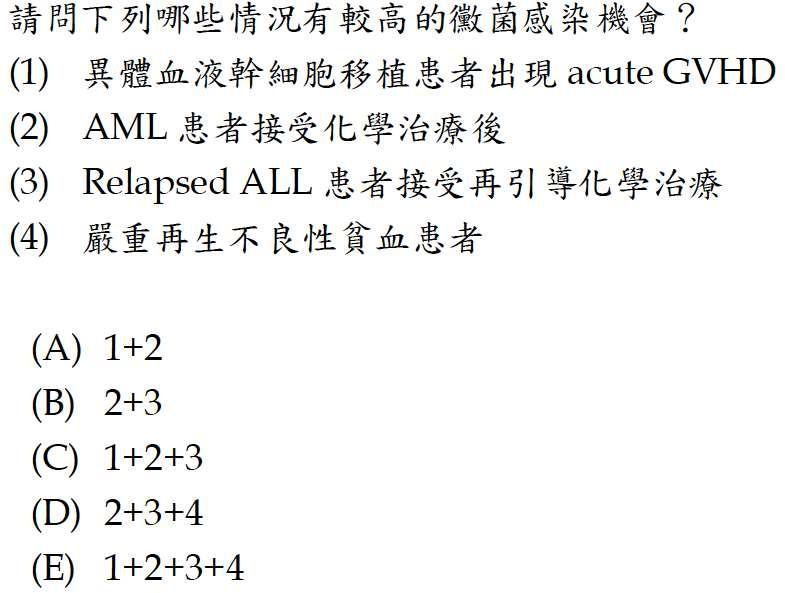
Q1. 請問下列哪些情況有較高的黴菌感染機會?
(1) 異體血液幹細胞移植患者出現 acute GVHD (2) AML 患者接受化學治療後 (3) Relapsed ALL 患者接受再引導化學治療 (4) 嚴重再生不良性貧血患者
- (A) 1+2
- (B) 2+3
- (C) 1+2+3
- (D) 2+3+4
- (E) 1+2+3+4
點此顯示正解
(E) 1+2+3+4
詳解
All four clinical scenarios represent well-established high-risk categories for invasive fungal infections, particularly invasive aspergillosis and other mold infections, making answer (E) "1+2+3+4 all correct" the appropriate choice.124
Risk factors and supporting evidence:
Allogeneic HSCT with acute GVHD: Acute GVHD ≥ grade 2 is independently associated with invasive fungal infections (pooled adjusted hazard ratio [aHR] 2.59, 95% CI 1.36-4.90), and corticosteroid use for GVHD treatment further increases risk (pooled adjusted odds ratio [aOR] 2.84, 95% CI 1.42-5.70).1 In meta-analyses focused on post-HSCT populations, acute GVHD ≥ grade II (HR 3.23, 95% CI 2.20-4.74) and high-dose glucocorticoids (HR 4.67, 95% CI 2.79-7.82) were strongly associated with invasive aspergillosis.24 The landmark posaconazole trial by Ullmann et al. (NEJM 2007) demonstrated that posaconazole prophylaxis significantly reduced invasive fungal infections in GVHD patients receiving immunosuppressive therapy compared to fluconazole or itraconazole.[^10]
AML patients after chemotherapy: Acute myeloid leukemia during remission-induction chemotherapy is a well-recognized high-risk condition due to prolonged profound neutropenia.3 Prolonged neutropenia is significantly associated with invasive aspergillosis (OR 4.85, 95% CI 2.15-10.97).4 The pivotal posaconazole trial by Cornely et al. (NEJM 2007) in AML/MDS patients undergoing intensive chemotherapy showed that posaconazole prophylaxis reduced invasive fungal infections from 8% to 2% compared to fluconazole or itraconazole, with improved survival.[^10] Recent ECIL guidelines assign posaconazole a B-I recommendation for AML patients undergoing remission induction chemotherapy.6
Relapsed ALL patients receiving re-induction chemotherapy: Relapsed/refractory hematologic malignancies are significantly associated with higher invasive mold infection risk (HR 3.43, 95% CI 1.58-7.46).4 Re-induction chemotherapy for relapsed ALL combines prolonged neutropenia with high-dose corticosteroids (particularly dexamethasone), creating a dual risk from both neutropenia and immunosuppression.35 Recent ECIL guidelines now specifically recommend antifungal prophylaxis for ALL patients with insufficient treatment response during induction therapy.6
Severe aplastic anemia patients: Severe aplastic anemia causes prolonged profound neutropenia, a major independent risk factor for invasive fungal infections.124 These patients experience extended periods of absolute neutrophil counts <500/μL, often lasting weeks to months, placing them at comparable risk to patients with acute leukemia undergoing intensive chemotherapy.3 While not always explicitly listed in prophylaxis trials, the prolonged neutropenia characteristic of severe aplastic anemia warrants antifungal prophylaxis consideration based on the same pathophysiologic principles as other prolonged neutropenic states.6
ECIL and IDSA guidance: The updated 2025 ECIL guidelines recommend mold-active prophylaxis (posaconazole B-I, or alternatives including isavuconazole, voriconazole, micafungin, caspofungin B-II) for AML/MDS patients during remission induction and for allogeneic HSCT patients with GVHD requiring augmented immunosuppression.67 The 2016 IDSA aspergillosis guidelines (Patterson et al.) similarly emphasize these populations as requiring prophylaxis.[^10]
詳解 · 中文翻譯
所有四個臨床情景都代表侵襲性黴菌感染的公認高風險類別,特別是侵襲性麴黴病和其他霉菌感染,使答案 (E)「1+2+3+4 都正確」成為適當的選擇。124
風險因素和支持證據:
伴急性 GVHD 的異體造血幹細胞移植:急性 GVHD ≥ 2 級與侵襲性黴菌感染獨立相關(彙總調整危害比 [aHR] 2.59,95% CI 1.36-4.90),類固醇用於 GVHD 治療進一步增加風險(彙總調整優勢比 [aOR] 2.84,95% CI 1.42-5.70)。1在側重於移植後人群的統合分析中,急性 GVHD ≥ 2 級(HR 3.23,95% CI 2.20-4.74)和高劑量糖皮質激素(HR 4.67,95% CI 2.79-7.82)與侵襲性麴黴病強烈相關。24 Ullmann 等人的標誌性 posaconazole 試驗(NEJM 2007)證明 posaconazole 預防明顯減少接受免疫抑制治療的 GVHD 患者中的侵襲性黴菌感染,與 fluconazole 或 itraconazole 相比。[^10]
化療後的 AML 患者:寬解誘導化療期間的急性髓性白血病是公認的高風險狀況,因為長期深度中性粒細胞減少症。3延長的中性粒細胞減少症與侵襲性麴黴病明顯相關(OR 4.85,95% CI 2.15-10.97)。4 Cornely 等人在接受密集化療的 AML/MDS 患者中進行的樞紐 posaconazole 試驗(NEJM 2007)顯示 posaconazole 預防將侵襲性黴菌感染從 8% 減少到 2%,與 fluconazole 或 itraconazole 相比,並改善存活率。[^10]最近的 ECIL 指南為接受寬解誘導化療的 AML 患者分配 posaconazole B-I 推薦。6
接受再引導化療的復發 ALL 患者:復發/難治性血液惡性腫瘤與更高的侵襲性霉菌感染風險明顯相關(HR 3.43,95% CI 1.58-7.46)。4針對復發 ALL 的再引導化療結合延長的中性粒細胞減少症與高劑量皮質類固醇(特別是地塞米松),從中性粒細胞減少症和免疫抑制建立雙重風險。35最近的 ECIL 指南現在特別推薦對歸納治療期間反應不足的 ALL 患者進行抗黴菌預防。6
嚴重再生不良性貧血患者:嚴重再生不良性貧血引起延長的深度中性粒細胞減少症,侵襲性黴菌感染的主要獨立風險因素。124這些患者經歷絕對中性粒細胞計數 <500/μL 的延長期間,通常持續數週至數月,將它們置於與接受密集化療的急性白血病患者相當的風險中。3儘管在預防試驗中不總是明確列出,嚴重再生不良性貧血特有的延長中性粒細胞減少症基於與其他延長中性粒細胞減少症狀態相同的病理生理學原則保證抗黴菌預防考慮。6
ECIL 和 IDSA 指導:更新的 2025 ECIL 指南為 AML/MDS 患者在寬解誘導期間和需要增強免疫抑制的 GVHD 異體造血幹細胞移植患者推薦霉菌活性預防(posaconazole B-I,或包括 isavuconazole、voriconazole、micafungin、caspofungin B-II 的替代方案)。672016 IDSA 麴黴病指南(Patterson 等人)類似地強調這些人群需要預防。[^10]
參考文獻 (AMA)
-
National Comprehensive Cancer Network. Prevention and Treatment of Cancer-Related Infections. https://www.nccn.org/professionals/physician_gls/pdf/infections.pdf#page=8. ↩↩↩↩↩↩
-
Gras E, Monzo-Gallo P, Azoyan L, et al. Risk Factors for Invasive Fungal Infections in Adult Patients With Hematological Malignancies and/or Stem Cell Transplant: A Systematic Review and Meta-Analysis. Scientific Reports. 2025;15(1):30724. doi:10.1038/s41598-025-16066-6. PMID:40841820. ↩↩↩↩↩↩
-
Biyun L, Yahui H, Yuanfang L, Xifeng G, Dao W. Risk Factors for Invasive Fungal Infections After Haematopoietic Stem Cell Transplantation: A Systematic Review and Meta-Analysis. Clinical Microbiology and Infection : The Official Publication of the European Society of Clinical Microbiology and Infectious Diseases. 2024;30(5):601-610. doi:10.1016/j.cmi.2024.01.005. PMID:38280518. ↩↩↩↩↩↩
-
Gras E, Azoyan L, Monzó-Gallo P, et al. Risk Factors for Invasive Mould Infections in Adult Patients With Hematological Malignancies and/or Stem Cell Transplant: A Systematic Literature Review and Meta-Analysis. The Journal of Infection. 2025;:106574. doi:10.1016/j.jinf.2025.106574. PMID:40803450. ↩↩↩↩↩↩↩↩↩↩
-
Thompson GR, Young JH. Aspergillus Infections. The New England Journal of Medicine. 2021;385(16):1496-1509. doi:10.1056/NEJMra2027424. PMID:34644473. ↩↩
-
Colombo AL, de Almeida Júnior JN, Slavin MA, Chen SC, Sorrell TC. Candida and Invasive Mould Diseases in Non-Neutropenic Critically Ill Patients and Patients With Haematological Cancer. The Lancet. Infectious Diseases. 2017;17(11):e344-e356. doi:10.1016/S1473-3099(17)30304-3. PMID:28774702. ↩↩↩↩↩↩↩↩
-
Pagano L, Maschmeyer G, Lamoth F, et al. Primary Antifungal Prophylaxis in Hematological Malignancies. Updated Clinical Practice Guidelines by the European Conference on Infections in Leukemia (ECIL). Leukemia. 2025;39(7):1547-1557. doi:10.1038/s41375-025-02586-7. PMID:40200079. ↩↩
-
Monzó-Gallo P, Teijon-Lumbreras C, Aiello TF, et al. Epidemiological Shifts of Invasive Fungal Infections in the Current Era of Haematology. Medical Mycology. 2025;:myaf070. doi:10.1093/mmy/myaf070. PMID:40720775. ↩
-
Groll AH, Castagnola E, Cesaro S, et al. Fourth European Conference on Infections in Leukaemia (ECIL-4): Guidelines for Diagnosis, Prevention, and Treatment of Invasive Fungal Diseases in Paediatric Patients With Cancer or Allogeneic Haemopoietic Stem-Cell Transplantation. The Lancet. Oncology. 2014;15(8):e327-40. doi:10.1016/S1470-2045(14)70017-8. PMID:24988936. ↩
Figures