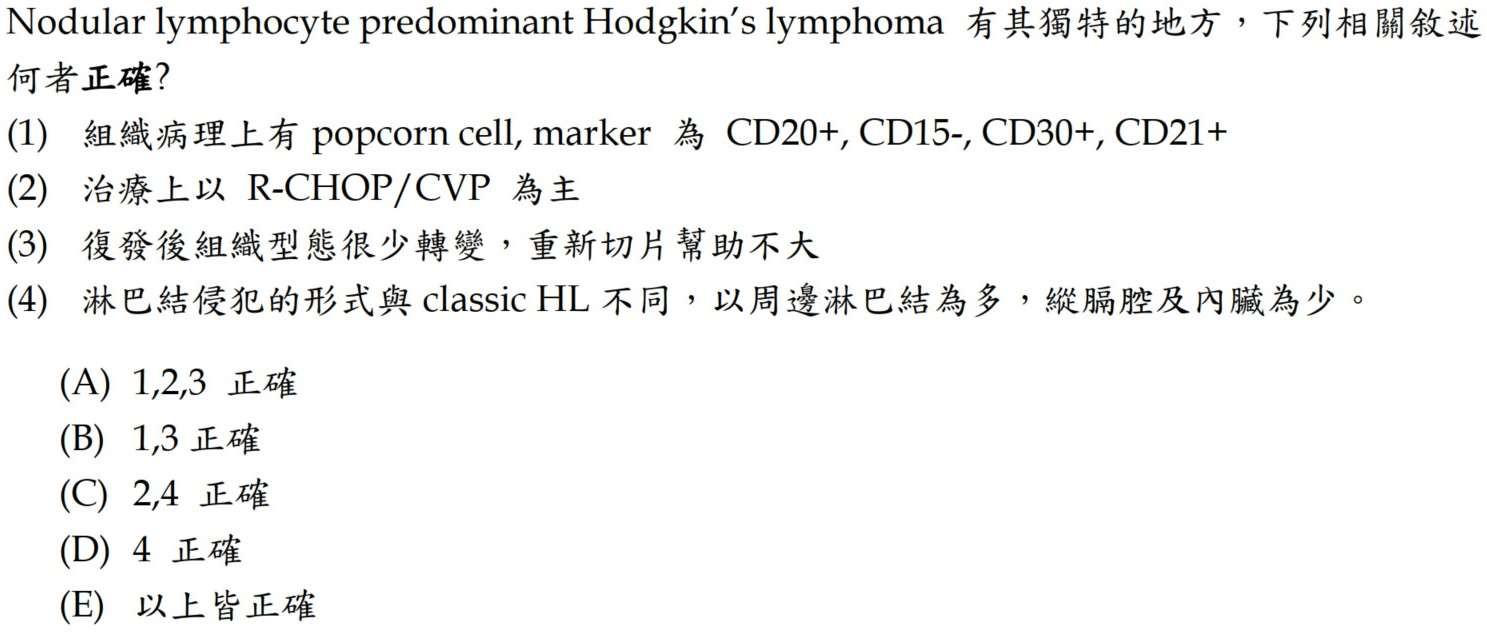
Q1. Nodular lymphocyte predominant Hodgkin's lymphoma 有其獨特的地方,下列相關敘述何者正確?
(1) 組織病理上有 popcorn cell, marker 為 CD20+, CD15-, CD30+, CD21+ (2) 治療上以 R-CHOP/CVP 為主 (3) 復發後組織型態很少轉變,重新切片幫助不大 (4) 淋巴結侵犯的形式與 classic HL 不同,以周邊淋巴結為多,縱膈腔及內臟為少。
- (A) 1,2,3 正確
- (B) 1,3 正確
- (C) 2,4 正確
- (D) 4 正確
- (E) 以上皆正確
點此顯示正解
(C) 2,4 正確
詳解
Analysis
The stem asks which descriptions are correct, so the answer should contain only TRUE statements. The marked answer is (C) (2)(4) are correct, which means statements (2) and (4) are TRUE, while statements (1) and (3) are FALSE.
Why (C) is the CORRECT answer
Statement (2) is TRUE: Treatment of nodular lymphocyte predominant Hodgkin lymphoma (NLPHL) commonly includes R-CHOP or CVP-based regimens, particularly for advanced-stage disease. While early-stage disease is often treated with radiotherapy alone, chemotherapy regimens used include ABVD (borrowed from classical HL) or less toxic regimens like CVP, and the addition of rituximab (R-CHOP, R-CVP) is increasingly employed given the CD20+ nature of the malignant cells7910[^11].
Statement (4) is TRUE: NLPHL has a distinct pattern of nodal involvement compared to classical Hodgkin lymphoma. Patients typically present with peripheral lymphadenopathy (especially cervical nodes) and characteristically spare the mediastinum. Extranodal and visceral involvement is rare23457. This contrasts sharply with classical HL, which frequently involves the mediastinum.
Why the other statements are INCORRECT
Statement (1) is FALSE: While NLPHL does feature popcorn cells (lymphocyte-predominant or L&H cells) that are CD20+ and CD15-, the critical error is that these cells are CD30-negative, not CD30-positive234579. The neoplastic cells in NLPHL "are CD20+ and commonly negative for CD30"234. This is a key distinguishing feature from classical Hodgkin lymphoma, where Reed-Sternberg cells are typically CD30+ and CD20-. CD21 positivity refers to follicular dendritic cell meshworks in the background, not the neoplastic cells themselves.
Statement (3) is FALSE: Histologic transformation in NLPHL is not rare—it occurs in approximately 8-14% of patients, typically 4-8 years after diagnosis, with the risk increasing over time9. Transformation to diffuse large B-cell lymphoma is a well-recognized complication89[11][12]. Given this significant transformation risk and the fact that NLPHL has an indolent course with late relapses, re-biopsy at relapse is clinically important to distinguish true relapse from transformation, as management differs substantially7[^11].
Summary
Option (C) correctly identifies statements (2) and (4) as true: NLPHL is treated with R-CHOP/CVP regimens (especially for advanced disease), and it characteristically involves peripheral nodes while sparing the mediastinum. Statement (1) is false because the neoplastic cells are CD30-negative, not positive. Statement (3) is false because transformation occurs in 8-14% of cases, making re-biopsy at relapse clinically valuable.
詳解 · 中文翻譯
題幹問哪些敘述是正確的,因此答案應僅包含真實敘述。標記的答案是 (C) (2)(4) 正確,意味著敘述 (2) 和 (4) 為真,而敘述 (1) 和 (3) 為假。
為什麼 (C) 是正確答案
敘述 (2) 為真:結節性淋巴細胞優勢型霍奇金淋巴瘤(NLPHL)的治療通常包括 R-CHOP 或 CVP 為主的方案,特別是對於晚期疾病。儘管早期疾病通常單獨用放射治療,但所用的化療方案包括 ABVD(借鑑自經典 HL)或較不毒性的方案如 CVP,且鑒於惡性細胞的 CD20+ 性質,rituximab 的添加(R-CHOP、R-CVP)的使用日益增多7910[^11]。
敘述 (4) 為真:與經典霍奇金淋巴瘤相比,NLPHL 有獨特的淋巴結受累形式。患者通常表現為周邊淋巴結腫大(尤其是頸部淋巴結)且特徵性地避開縱隔。淋巴結外和內臟累及罕見23457。這與經典 HL 形成鮮明對比,後者經常累及縱隔。
為什麼其他敘述不正確
敘述 (1) 為假:儘管 NLPHL 確實具有爆米花細胞(淋巴細胞優勢或 L&H 細胞),這些細胞是 CD20+ 和 CD15-,但關鍵錯誤是這些細胞是 CD30 陰性,而不是 CD30 陽性234579。NLPHL 中的腫瘤細胞「是 CD20+ 並通常 CD30 陰性」234。這是與經典霍奇金淋巴瘤的關鍵區別特徵,後者的 Reed-Sternberg 細胞通常是 CD30+ 和 CD20-。CD21 陽性指的是背景中的濾泡性樹突狀細胞網狀結構,而不是腫瘤細胞本身。
敘述 (3) 為假:NLPHL 中的組織學轉化並不罕見 — 它發生在約 8-14% 的患者中,通常在診斷後 4-8 年,風險隨時間增加9。轉化為彌漫大 B 細胞淋巴瘤是公認的並發症89[11][12]。鑒於此顯著轉化風險以及 NLPHL 有惰性病程且晚期復發,復發時重新切片在臨床上很重要以區分真實復發和轉化,因為管理差異很大7[^11]。
總結
(C) 選項正確地將敘述 (2) 和 (4) 識別為真:NLPHL 用 R-CHOP/CVP 方案治療(特別是對於晚期疾病),且特徵性地累及周邊淋巴結同時避開縱隔。敘述 (1) 為假,因為腫瘤細胞是 CD30 陰性而非陽性。敘述 (3) 為假,因為轉化發生在 8-14% 的病例中,使復發時的重新切片臨床價值。
參考文獻 (AMA)
-
Eichenauer DA, Engert A. How I Treat Nodular Lymphocyte-Predominant Hodgkin Lymphoma. Blood. 2020;136(26):2987-2993. doi:10.1182/blood.2019004044. PMID:32877522. ↩
-
Townsend W, Linch D. Hodgkin's Lymphoma in Adults. Lancet (London, England). 2012;380(9844):836-47. doi:10.1016/S0140-6736(12)60035-X. PMID:22835602. ↩↩↩↩↩↩
-
Eichenauer DA, Fuchs M. Treatment of Nodular Lymphocyte-Predominant Hodgkin Lymphoma: Where Do We Stand? Where Do We Go?. Cancers. 2023;15(13):3310. doi:10.3390/cancers15133310. PMID:37444420. ↩↩↩↩↩↩
-
Advani RH, Hoppe RT. How I Treat Nodular Lymphocyte Predominant Hodgkin Lymphoma. Blood. 2013;122(26):4182-8. doi:10.1182/blood-2013-07-453241. PMID:24215035. ↩↩↩↩↩↩
-
Ansell SM. Hodgkin Lymphoma: 2025 Update on Diagnosis, Risk-Stratification, and Management. American Journal of Hematology. 2024;99(12):2367-2378. doi:10.1002/ajh.27470. PMID:39239794. ↩↩↩↩
-
Ansell SM. Hodgkin Lymphoma: 2023 Update on Diagnosis, Risk-Stratification, and Management. American Journal of Hematology. 2022;97(11):1478-1488. doi:10.1002/ajh.26717. PMID:36215668. ↩
-
Ansell SM. Hodgkin Lymphoma: A 2020 Update on Diagnosis, Risk-Stratification, and Management. American Journal of Hematology. 2020;95(8):978-989. doi:10.1002/ajh.25856. PMID:32384177. ↩↩↩↩↩↩↩↩
-
Ansell SM. Hodgkin Lymphoma: 2018 Update on Diagnosis, Risk-Stratification, and Management. American Journal of Hematology. 2018;93(5):704-715. doi:10.1002/ajh.25071. PMID:29634090. ↩↩
-
Binkley MS, Rauf MS, Milgrom SA, et al. Stage I-Ii Nodular Lymphocyte-Predominant Hodgkin Lymphoma: A Multi-Institutional Study of Adult Patients by ILROG. Blood. 2020;135(26):2365-2374. doi:10.1182/blood.2019003877. PMID:32211877. ↩↩↩↩↩↩↩↩
-
Eyre TA, Gatter K, Collins GP, et al. Incidence, Management, and Outcome of High-Grade Transformation of Nodular Lymphocyte Predominant Hodgkin Lymphoma: Long-Term Outcomes From a 30-Year Experience. American Journal of Hematology. 2015;90(6):E103-10. doi:10.1002/ajh.23989. PMID:25715900. ↩↩
Slide annotations
Negative: CD3, CD15, CD30, and EBV
Figures