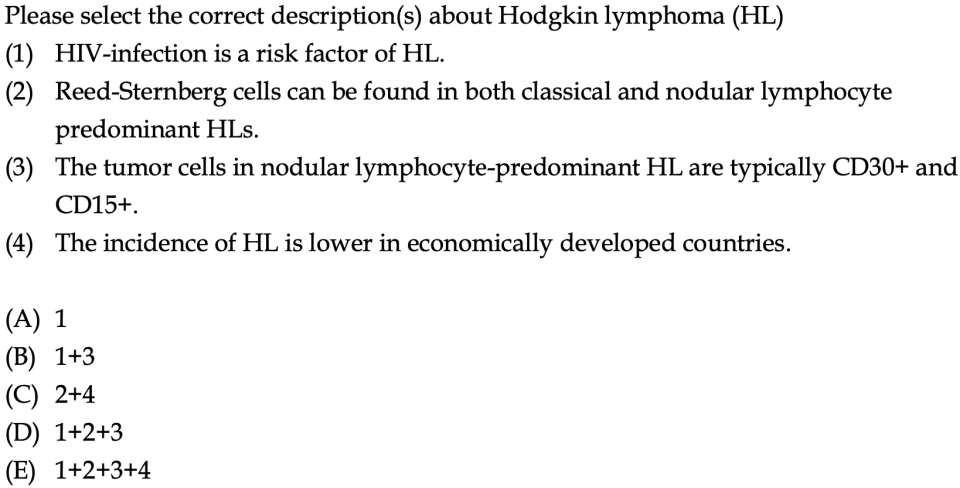
Q1. Please select the correct description(s) about Hodgkin lymphoma (HL)
(1) HIV-infection is a risk factor of HL. (2) Reed-Sternberg cells can be found in both classical and nodular lymphocyte predominant HLs. (3) The tumor cells in nodular lymphocyte-predominant HL are typically CD30+ and CD15+. (4) The incidence of HL is lower in economically developed countries.
- (A) 1
- (B) 1+3
- (C) 2+4
- (D) 1+2+3
- (E) 1+2+3+4
點此顯示正解
(A) 1
詳解
Based on the question stem asking to "select the correct description(s)," the answer should identify which statement(s) are TRUE. The slide-marked answer is (A) 1 only, meaning statement 1 is the only correct (true) statement.
Why (A) is the Correct Answer
(A) 1 only is correct because statement 1 is TRUE while statements 2, 3, and 4 are all false.
Statement 1: "HIV-infection is a risk factor of HL" — TRUE
HIV infection is an established risk factor for Hodgkin lymphoma. People living with HIV have an 11.5-fold increased risk of developing HL compared to the general population2. The standardized incidence ratio for HL in HIV-positive individuals ranges from 4-13 times higher than in HIV-negative populations13. During 2015-2019, the risk remained elevated with standardized incidence ratios of 4.04 for nodular sclerosis HL and 8.99 for other classical HL subtypes3. HIV-associated HL frequently presents with high-risk features including mixed cellularity histology, EBV co-infection (80-100% of cases), and advanced stage disease145.
Why the Other Statements Are Incorrect
Statement 2: "Reed-Sternberg cells can be found in both classical and nodular lymphocyte predominant HLs" — FALSE
Classical HL contains Hodgkin Reed-Sternberg (HRS) cells, which are CD30+ and CD15+ malignant cells7910. In contrast, nodular lymphocyte-predominant HL (NLPHL) contains lymphocyte-predominant (LP) cells (also called "L&H cells" or "popcorn cells"), which have a distinctly different morphology and immunophenotype from Reed-Sternberg cells678. These are two different types of malignant cells, not the same cell type found in both entities.
Statement 3: "The tumor cells in nodular lymphocyte-predominant HL are typically CD30+ and CD15+" — FALSE
The immunophenotype is exactly opposite. In NLPHL, the LP cells are typically CD30-negative and CD15-negative78. Instead, they are characteristically CD20-positive and express other B-cell antigens with intact immunoglobulin expression678. This contrasts sharply with classical HL, where HRS cells are CD30+ (100%) and CD15+ (75-80%)710.
Statement 4: "The incidence of HL is lower in economically developed countries" — FALSE
This statement contradicts epidemiologic data. Hodgkin lymphoma generally shows higher incidence in economically developed countries. The classic bimodal age distribution pattern (young adults and elderly) is more characteristic of developed nations, while developing countries show different patterns often related to EBV-associated disease and childhood cases.
詳解 · 中文翻譯
根據問題陳述要求「選擇正確描述」,答案應確認哪個陳述是真實的。投影片標記的答案是 (A) 僅 1,意味著陳述 1 是唯一正確(真實)陳述。
為何 (A) 是正確答案
(A) 僅 1 是正確的,因為 陳述 1 為真,而陳述 2、3 和 4 都是假。
陳述 1:「HIV 感染是 HL 的風險因素」— 真實
HIV 感染是霍奇金淋巴瘤的既定風險因素。與一般人群相比,感染 HIV 的人群患 HL 的風險增加了 11.5 倍2。HIV 陽性個體中 HL 的標準化發生率比範圍為 4-13 倍高於 HIV 陰性人群13。在 2015-2019 年期間,結節硬化型 HL 的標準化發生率比為 4.04,其他經典型 HL 亞型為 8.99,風險仍然升高3。HIV 相關 HL 常呈現高風險特徵,包括混合細胞性組織學、EBV 共感染(80-100% 的病例)和晚期疾病145。
其他陳述為何不正確
陳述 2:「Reed-Sternberg 細胞可在經典型和結節淋巴細胞主導型 HL 中發現」— 假
經典型 HL 包含 Hodgkin Reed-Sternberg(HRS)細胞,即 CD30+ 和 CD15+ 的惡性細胞7910。相反,結節淋巴細胞主導型 HL(NLPHL)包含 淋巴細胞主導(LP)細胞(也稱為「L&H 細胞」或「爆米花細胞」),其形態和免疫表型與 Reed-Sternberg 細胞明顯不同678。這是兩種不同類型的惡性細胞,而非在兩種實體中發現的同一細胞類型。
陳述 3:「結節淋巴細胞主導型 HL 中的腫瘤細胞通常為 CD30+ 和 CD15+」— 假
免疫表型恰好相反。在 NLPHL 中,LP 細胞通常為 CD30 陰性和 CD15 陰性78。相反,它們特徵上為 CD20 陽性和表達其他具有完整免疫球蛋白表達的 B 細胞抗原678。這與經典型 HL 形成鮮明對比,其中 HRS 細胞為 CD30+(100%)和 CD15+(75-80%)710。
陳述 4:「HL 在經濟發達國家的發生率較低」— 假
此陳述與流行病學資料相矛盾。霍奇金淋巴瘤通常在經濟發達國家中顯示更高的發生率。經典的雙峰年齡分佈模式(青年和老年人)更特徵於發達國家,而發展中國家常顯示與 EBV 相關疾病和兒童病例相關的不同模式。
參考文獻 (AMA)
-
Zhao J, Zhang Y, Li K, et al. Estimates of Global, Regional, and National Incidence of Hodgkin Lymphoma Attributable to Human Immunodeficiency Virus: A Population Attributable Modeling Study. International Journal of Cancer. 2025;. doi:10.1002/ijc.70115. PMID:40879655. ↩↩↩↩
-
Kimani SM, Painschab MS, Horner MJ, et al. Epidemiology of Haematological Malignancies in People Living With HIV. The Lancet. HIV. 2020;7(9):e641-e651. doi:10.1016/S2352-3018(20)30118-1. PMID:32791045. ↩↩
-
Tao J, Luo Q, Haas CB, et al. Risk of Lymphomas Among People With HIV in the United States During 2001-2019. Journal of the National Cancer Institute. 2025;:djaf244. doi:10.1093/jnci/djaf244. PMID:40857559. ↩↩↩↩
-
Yarchoan R, Uldrick TS. HIV-Associated Cancers and Related Diseases. The New England Journal of Medicine. 2018;378(11):1029-1041. doi:10.1056/NEJMra1615896. PMID:29539283. ↩↩
-
Navarro JT, Moltó J, Tapia G, Ribera JM. Hodgkin Lymphoma in People Living With HIV. Cancers. 2021;13(17):4366. doi:10.3390/cancers13174366. PMID:34503176. ↩↩
-
Yung L, Linch D. Hodgkin's Lymphoma. Lancet (London, England). 2003;361(9361):943-51. doi:10.1016/S0140-6736(03)12777-8. PMID:12648984. ↩↩↩↩
-
Gloghini A, Lorenzini D, Volpi CC, Trupia DV, Pruneri G. Hodgkin Reed-Sternberg Cells of Classic Hodgkin Lymphoma: Morphology, Phenotype, Genotype, and Cell of Origin. Cancers. 2026;18(9):1446. doi:10.3390/cancers18091446. PMID:42122242. ↩↩↩↩↩↩↩↩↩↩
-
Brice P, de Kerviler E, Friedberg JW. Classical Hodgkin Lymphoma. Lancet (London, England). 2021;398(10310):1518-1527. doi:10.1016/S0140-6736(20)32207-8. PMID:33493434. ↩↩↩↩↩↩
-
Gunawardana J, Law SC, Sabdia MB, et al. Intra-Tumoral and Peripheral Blood TIGIT and PD-1 as Immune Biomarkers in Nodular Lymphocyte Predominant Hodgkin Lymphoma. American Journal of Hematology. 2024;99(11):2096-2107. doi:10.1002/ajh.27459. PMID:39152767. ↩↩
-
Ali N, Moussa E, Khorshed E, et al. Variant Histology of Pediatric Nodular Lymphocyte-Predominant Hodgkin Lymphoma With IgD and CD30 Expression. Pediatric Blood & Cancer. 2023;70(11):e30647. doi:10.1002/pbc.30647. PMID:37638819. ↩↩↩↩
Figures