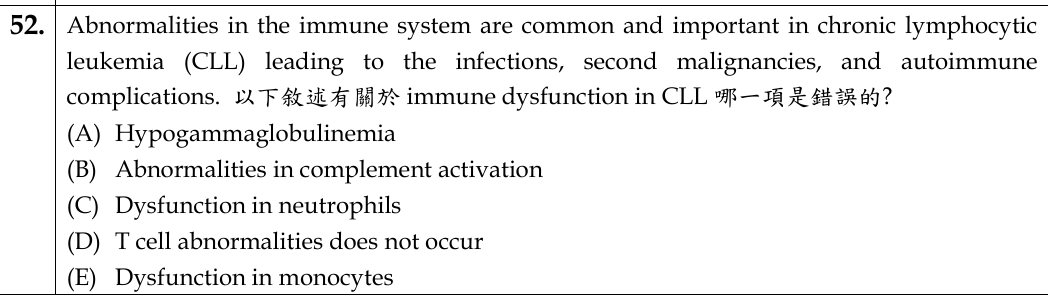
Q52. Abnormalities in the immune system are common and important in chronic lymphocytic leukemia (CLL) leading to the infections, second malignancies, and autoimmune complications. 以下敘述有關於 immune dysfunction in CLL 哪一項是錯誤的?
- (A) Hypogammaglobulinemia
- (B) Abnormalities in complement activation
- (C) Dysfunction in neutrophils
- (D) T cell abnormalities does not occur
- (E) Dysfunction in monocytes
點此顯示正解
(D) T cell abnormalities does not occur
詳解
Analysis
The stem asks for the WRONG (incorrect/false) statement about immune dysfunction in CLL.
1) Why (D) is the WRONG statement:
Option (D) states "T cell abnormalities does not occur" — this is definitively false. T cell abnormalities are a well-established hallmark of CLL immune dysfunction13457. Multiple comprehensive reviews document extensive T cell alterations including:
- Phenotypic abnormalities: Oligoclonal T cell expansions, restrictions in T cell receptor gene repertoire, and shared TCR clonotypes among patients3
- Functional defects: Impaired proliferation, reduced cytotoxicity, defective immunological synapse formation, and metabolic exhaustion5
- Exhaustion phenotype: Expression of multiple inhibitory receptors (PD-1, Tim-3, CTLA-4) with features of chronic antigenic stimulation13
- Subset imbalances: CD4+ T cell depletion, expansion of exhausted CD8+ subsets, increased regulatory T cells (Tregs), and dysregulation of cytokine signaling47
The literature emphasizes that T cell dysfunction is present even in untreated patients, indicating it is intrinsic to CLL pathophysiology13. These T cell abnormalities contribute to impaired anti-tumor immunity, increased viral infections (HSV, CMV, VZV), and poor responses to immunotherapies including CAR T-cell therapy134.

2) Why the other options are TRUE (and therefore not the answer):
(A) Hypogammaglobulinemia — TRUE and well-documented. Hypogammaglobulinemia is a hallmark of CLL, occurring in the majority of patients and associated with worse survival outcomes7[^8]. It results from displacement of normal B lymphocytes by neoplastic cells, defective B-cell maturation due to abnormal T-cell function, and suppression of bone marrow plasma cells[8][9]. This leads to recurrent bacterial infections and poor vaccine responses7[8][10].
(B) Abnormalities in complement activation — TRUE. Complement system abnormalities, particularly classical pathway deficiencies, are well-established in CLL7[9][10][^11]. These defects diminish opsonization and impair clearance of encapsulated bacteria, contributing to increased risk of pneumonia and invasive bacterial infections[^10]. Both quantitative and functional complement deficiencies are documented7.
(C) Dysfunction in neutrophils — TRUE. Neutrophil abnormalities are part of the innate immune defects in CLL7[9][10]. Documented defects include reduced chemotaxis and impaired oxidative burst, leading to poor bacterial clearance and increased susceptibility to fungal infections[^10]. These neutrophil dysfunctions contribute to the overall impaired pathogen defense seen in CLL patients[^9].
(E) Dysfunction in monocytes — TRUE. Monocyte abnormalities are explicitly documented as part of the innate immune dysfunction in CLL7[^9]. The literature describes impaired monocyte function alongside neutrophil defects, contributing to reduced microbial clearance and poor opsonization7. Monocytes can differentiate into nurse-like cells in the CLL microenvironment, which support leukemic cell survival[^9].
Summary: Option (D) is the only false statement. T cell abnormalities are extensively documented and represent a critical component of CLL-associated immune dysfunction, affecting both disease progression and susceptibility to infections.
詳解 · 中文翻譯
分析
題幹要求找出錯誤的(不正確/虛假的)關於 CLL 免疫功能障礙的敘述。
1) 為什麼 (D) 是錯誤的敘述:
選項 (D) 陳述「T 細胞異常不會發生」— 這是絕對虛假的。T 細胞異常是 CLL 免疫功能障礙的公認特徵13457。多項全面的文獻記錄了廣泛的 T 細胞改變,包括:
- 表型異常:寡克隆 T 細胞擴張、T 細胞受體基因庫存限制,以及患者間的共享 TCR 克隆型3
- 功能缺陷:增生能力受損、細胞毒性降低、免疫突觸形成缺陷,以及代謝耗盡5
- 耗盡表型:多種抑制受體(PD-1、Tim-3、CTLA-4)的表達具有慢性抗原刺激特徵13
- 亞群失衡:CD4+ T 細胞耗盡、耗盡 CD8+ 亞群的擴張、調節性 T 細胞(Tregs)增加,以及細胞因子信號轉導失調47
文獻強調 T 細胞功能障礙即使在未經治療的患者中也存在,表明它對 CLL 病理生理學是內在的13。這些 T 細胞異常導致抗腫瘤免疫力受損、病毒感染增加(HSV、CMV、VZV),以及對包括 CAR T 細胞治療在內的免疫療法反應不佳134。
2) 為什麼其他選項是正確的(因此不是答案):
(A) 低免疫球蛋白血症 — 正確且文獻充分記載。低免疫球蛋白血症是 CLL 的特徵,發生於大多數患者且與更差的存活結果相關7[^8]。它源於正常 B 淋巴細胞被腫瘤細胞替代、T 細胞功能異常導致的 B 細胞成熟缺陷,以及骨髓漿細胞的抑制[8][9]。這導致反覆性細菌感染和疫苗反應不佳7[8][10]。
(B) 補體激活異常 — 正確。補體系統異常,特別是經典途徑缺陷,在 CLL 中是公認的7[9][10][11]。這些缺陷減少了調理作用並損害了被膜細菌的清除,導致肺炎和侵襲性細菌感染風險增加[10]。定量和功能性補體缺陷均已被記錄7。
(C) 中性粒細胞功能障礙 — 正確。中性粒細胞異常是 CLL 中先天免疫缺陷的一部分7[9][10]。已記載的缺陷包括化學趨向性降低和氧化爆發受損,導致細菌清除不佳和真菌感染易感性增加[^10]。這些中性粒細胞功能障礙導致 CLL 患者整體病原體防禦受損[^9]。
(E) 單核細胞功能障礙 — 正確。單核細胞異常被明確記載為 CLL 先天免疫功能障礙的一部分7[^9]。文獻描述了單核細胞功能受損與中性粒細胞缺陷並行,導致微生物清除減少和調理作用不佳7。單核細胞可在 CLL 微環境中分化為護理樣細胞,支持白血病細胞存活[^9]。
總結:選項 (D) 是唯一虛假的敘述。T 細胞異常已得到廣泛記載,代表 CLL 相關免疫功能障礙的關鍵成分,影響疾病進展和感染易感性。
參考文獻 (AMA)
-
Roessner PM, Seiffert M. T-Cells in Chronic Lymphocytic Leukemia: Guardians or Drivers of Disease?. Leukemia. 2020;34(8):2012-2024. doi:10.1038/s41375-020-0873-2. PMID:32457353. ↩↩↩↩↩↩↩↩
-
Vlachonikola E, Stamatopoulos K, Chatzidimitriou A. T Cells in Chronic Lymphocytic Leukemia: A Two-Edged Sword. Frontiers in Immunology. 2020;11:612244. doi:10.3389/fimmu.2020.612244. PMID:33552073. ↩
-
Martino EA, Caserta S, Vigna E, et al. Infections in Chronic Lymphocytic Leukemia: Evolving Risks and Prevention Strategies. European Journal of Haematology. 2026;116(3):204-214. doi:10.1111/ejh.70065. PMID:41292288. ↩↩↩↩↩↩↩↩↩↩
-
Lopez-Sanchez C, van Bruggen JAC, Kater AP. Tumor-Associated Disruption of T Cell Receptor Signaling: Lessons Across Cancers With Implications for CLL. Leukemia & Lymphoma. 2025;:1-9. doi:10.1080/10428194.2025.2587786. PMID:41236817. ↩↩↩↩↩↩
-
Taghiloo S, Asgarian-Omran H. Cross-Talk Between Leukemic and Immune Cells at the Tumor Microenvironment in Chronic Lymphocytic Leukemia: An Update Review. European Journal of Haematology. 2024;113(1):4-15. doi:10.1111/ejh.14224. PMID:38698678. ↩↩↩↩
-
Otani IM, Lehman HK, Jongco AM, et al. Practical Guidance for the Diagnosis and Management of Secondary Hypogammaglobulinemia: A Work Group Report of the AAAAI Primary Immunodeficiency and Altered Immune Response Committees. The Journal of Allergy and Clinical Immunology. 2022;149(5):1525-1560. doi:10.1016/j.jaci.2022.01.025. PMID:35176351. ↩
-
Vitale C, Boccellato E, Comba L, et al. Impact of Immune Parameters and Immune Dysfunctions on the Prognosis of Patients With Chronic Lymphocytic Leukemia. Cancers. 2021;13(15):3856. doi:10.3390/cancers13153856. PMID:34359757. ↩↩↩↩↩↩↩↩↩↩↩↩↩↩↩↩↩↩
Figures