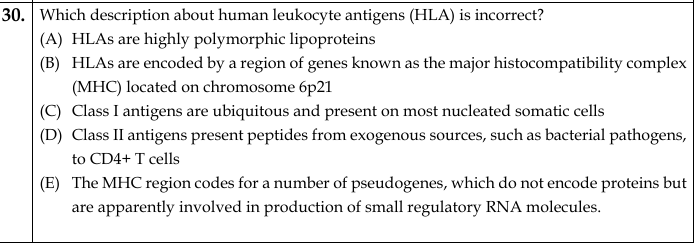
Q30. Which description about human leukocyte antigens (HLA) is incorrect?
- (A) HLAs are highly polymorphic lipoproteins
- (B) HLAs are encoded by a region of genes known as the major histocompatibility complex (MHC) located on chromosome 6p21
- (C) Class I antigens are ubiquitous and present on most nucleated somatic cells
- (D) Class II antigens present peptides from exogenous sources, such as bacterial pathogens, to CD4+ T cells
- (E) The MHC region codes for a number of pseudogenes, which do not encode proteins but are apparently involved in production of small regulatory RNA molecules.
點此顯示正解
(A) HLAs are highly polymorphic lipoproteins
詳解
Statement (A) is incorrect because HLAs are highly polymorphic glycoproteins, not lipoproteins. HLA class I and class II molecules are transmembrane glycoproteins with complex carbohydrate modifications that are essential for their structure and function123. The molecular structure consists of polypeptide chains with extracellular immunoglobulin-like domains that form the peptide-binding groove, transmembrane regions, and cytoplasmic tails—all characteristic of glycoproteins, not lipoproteins124.

Why the other statements are correct:
(B) is correct: HLA genes are indeed encoded in the major histocompatibility complex (MHC) region located on chromosome 6p21.315[^14]. The MHC spans approximately 4-5 megabases and contains over 200 genes, including the classical HLA class I genes (HLA-A, -B, -C) and class II genes (HLA-DR, -DQ, -DP)[10][11][^12].
(C) is correct: Class I HLA molecules (HLA-A, -B, -C) are expressed on the surface of virtually all nucleated cells125[^14]. This ubiquitous expression allows class I molecules to present endogenous peptides (8-10 amino acids) to CD8+ T cells, enabling immune surveillance for intracellular pathogens and transformed cells15.
(D) is correct: Class II HLA molecules (HLA-DR, -DP, -DQ) are expressed on antigen-presenting cells (dendritic cells, macrophages, B cells) and present peptides derived from exogenous sources to CD4+ T helper cells125. These exogenous antigens include bacterial pathogens and other extracellular proteins that are internalized through the endocytic pathway35.
(E) is correct: The MHC region contains numerous pseudogenes and noncoding regulatory elements[10][11][^12]. The complete MHC sequence revealed 224 identified gene loci, with many pseudogenes and noncoding RNAs that may function in gene regulation[^12]. Recent evidence suggests that variants in noncoding regions can affect transcription, translation, and splicing of HLA genes[^14].
詳解 · 中文翻譯
敘述 (A) 是不正確的,因為 HLA 是高度多態的糖蛋白,而不是脂蛋白。 HLA 1 類和 2 類分子是具有複雜碳水化合物修飾的跨膜糖蛋白,這對其結構和功能至關重要123。分子結構包括具有形成肽結合凹槽的細胞外免疫球蛋白樣域、跨膜區域和細胞質尾部的多肽鏈 - 所有這些都是糖蛋白的特徵,而不是脂蛋白124。
為什麼其他敘述是正確的:
(B) 是正確的:HLA 基因確實在位於染色體 6p21.3 的主要組織相容性複合體 (MHC) 區域中進行編碼15[^14]。MHC 跨越約 4-5 兆鹼基,包含超過 200 個基因,包括經典 HLA 1 類基因(HLA-A、-B、-C)和 2 類基因(HLA-DR、-DQ、-DP)[10][11][^12]。
(C) 是正確的:1 類 HLA 分子(HLA-A、-B、-C)在幾乎所有核有細胞的表面表達125[^14]。這種無處不在的表達允許 1 類分子將內源性肽(8-10 個胺基酸)呈遞給 CD8+ T 細胞,使免疫監視細胞內病原體和轉化細胞成為可能15。
(D) 是正確的:2 類 HLA 分子(HLA-DR、-DP、-DQ)在抗原呈遞細胞(樹狀細胞、巨噬細胞、B 細胞)上表達,並將來自外源性來源的肽呈遞給 CD4+ T 輔助細胞125。這些外源性抗原包括通過內吞途徑內化的細菌病原體和其他細胞外蛋白35。
(E) 是正確的:MHC 區域包含許多偽基因和非編碼調控元件[10][11][^12]。完整的 MHC 序列揭示了 224 個已鑑定的基因位點,許多偽基因和非編碼 RNA 可能在基因調控中起作用[^12]。最近的證據表明非編碼區域中的變體可以影響 HLA 基因的轉錄、翻譯和剪接[^14]。
參考文獻 (AMA)
-
Medhasi S, Chantratita N. Human Leukocyte Antigen (HLA) System: Genetics and Association With Bacterial and Viral Infections. Journal of Immunology Research. 2022;2022:9710376. doi:10.1155/2022/9710376. PMID:35664353. ↩↩↩↩↩↩↩↩↩↩↩↩
-
Mestre-Ferrer A, Scholz E, Humet-Alsius J, Alvarez I. PRBAM: A New Tool to Analyze the MHC Class I and HLA-DR Anchor Motifs. Immunology. 2019;156(2):187-198. doi:10.1111/imm.13020. PMID:30408168. ↩↩↩↩↩↩↩↩
-
Afridi S, Hoessli DC, Hameed MW. Mechanistic Understanding and Significance of Small Peptides Interaction With MHC Class II Molecules for Therapeutic Applications. Immunological Reviews. 2016;272(1):151-68. doi:10.1111/imr.12435. PMID:27319349. ↩↩↩↩
-
Sanchez-Mazas A, Fernandez-Viña M, Middleton D, et al. Immunogenetics as a Tool in Anthropological Studies. Immunology. 2011;133(2):143-64. doi:10.1111/j.1365-2567.2011.03438.x. PMID:21480890. ↩↩
-
Klein J, Sato A. The HLA System. First of Two Parts. The New England Journal of Medicine. 2000;343(10):702-9. doi:10.1056/NEJM200009073431006. PMID:10974135. ↩↩↩↩↩↩↩↩↩↩
-
Martin MP, Carrington M. Immunogenetics of HIV Disease. Immunological Reviews. 2013;254(1):245-64. doi:10.1111/imr.12071. PMID:23772624. ↩
-
Houwaart T, Scholz S, Pollock NR, et al. Complete Sequences of Six Major Histocompatibility Complex Haplotypes, Including All the Major MHC Class II Structures. Hla. 2023;102(1):28-43. doi:10.1111/tan.15020. PMID:36932816. ↩
-
Shiina T, Blancher A, Inoko H, Kulski JK. Comparative Genomics of the Human, Macaque and Mouse Major Histocompatibility Complex. Immunology. 2017;150(2):127-138. doi:10.1111/imm.12624. PMID:27395034. ↩
-
No authors listed. Complete Sequence and Gene Map of a Human Major Histocompatibility Complex. The MHC Sequencing Consortium. Nature. 1999;401(6756):921-3. doi:10.1038/44853. PMID:10553908. ↩
Slide correction
Glycoprotein
Figures