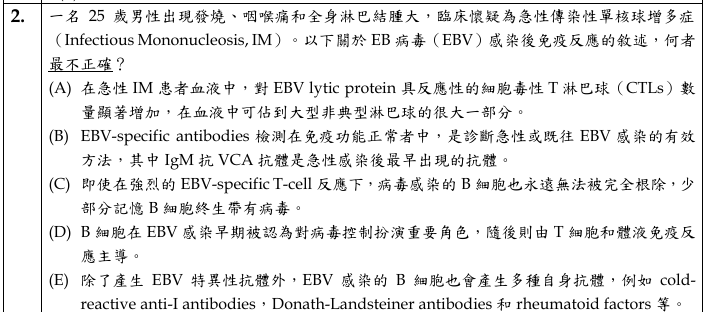
Q2. 一名25歲男性出現發燒、咽喉痛和全身淋巴結腫大,臨床懷疑為急性傳染性單核球增多症(Infectious Mononucleosis, IM)。以下關於EB病毒(EBV)感染後免疫反應的敘述,何者最不正確?
- (A) 在急性IM患者血液中,對EBV lytic protein具反應性的細胞毒性T淋巴球(CTLs)數量顯著增加,在血液中可佔到大型異型淋巴球的很大一部分。
- (B) EBV-specific antibodies檢測在免疫功能正常者中,是診斷急性感染EBV的有效方法,其中IgM抗VCA抗體是最早出現的指標。
- (C) 即使在強烈的EBV-specific T-cell反應下,病毒感染的B細胞也永遠無法被完全根除,少部分記憶B細胞終生帶有病毒。
- (D) TB細胞在EBV感染早期被認為對病毒控制扮演重要角色,隨後則由T細胞和體液免疫反應主導。
- (E) 除了產生EBV特異性抗體外,EBV感染的B細胞也會產生多種自身抗體,例如cold-reactive anti-I antibodies、Donath-Landsteiner antibodies和rheumatoid factors等。
點此顯示正解
(D) TB細胞在EBV感染早期被認為對病毒控制扮演重要角色,隨後則由T細胞和體液免疫反應主導。
詳解
Why Option (D) is the LEAST ACCURATE
Option (D) is incorrect because "TB cells" do not exist as a recognized lymphocyte subset. The statement claims "TB cells play a key role in early EBV control, then T-cell and humoral responses take over," but this fundamentally misrepresents the actual immune response to EBV infection.
In reality, NK (natural killer) cells—not "TB cells"—are the critical innate immune effectors that control early EBV infection13. NK cells act rapidly before the adaptive immune response develops, with specific NK cell subsets (CD16+NKG2A+KIR− NK cells) eliminating lytically infected B cells prior to CD8+ T cell activation1. Studies demonstrate that NK cell numbers are significantly elevated at diagnosis of infectious mononucleosis, and higher NK cell counts correlate with lower viral loads in peripheral blood3. NK cells eliminate infected B cells through direct cytotoxicity and antibody-dependent cellular cytotoxicity (ADCC), while also augmenting the antigen-specific T cell response through release of immunomodulatory cytokines35.
Following the early NK cell response, EBV-specific cytotoxic CD8+ T cells undergo massive expansion to control both the lytic cycle and the proliferation of latently infected B cells2. The term "TB cells" appears to be either a fabrication or a misunderstanding—there is no such cell type in immunology literature.
Why Options (A), (B), (C), and (E) are ACCURATE
(A) is accurate: During acute infectious mononucleosis, there is a rapid, massive expansion of cytotoxic CD8+ T cells that are predominantly specific for EBV lytic antigens2[^11]. These EBV-specific CD8+ T cells constitute the majority of atypical lymphocytes (Downey cells) seen on peripheral blood smears[^9]. MHC class I tetramer studies confirm that EBV-specific CD8+ T cells predominantly target immediate-early and early lytic antigen epitopes, with clonal expansion correlating positively with viral load[^11].
(B) is accurate: VCA-IgM is the earliest serologic marker of acute primary EBV infection and is the standard for serologic diagnosis in immunocompetent hosts78. The presence of VCA-IgM (with or without VCA-IgG) in the absence of EBNA-IgG antibodies indicates recent primary infection7. More than 90% of patients with primary acute EBV infection develop VCA-IgM within 10 days of symptom onset8.  demonstrates that infectious mononucleosis shows extremely high VCA-IgM positivity but very low EBNA-IgG positivity, distinguishing acute primary infection from past or reactivated infection.
(C) is accurate: Despite robust EBV-specific T cell responses, the virus is never fully eradicated and establishes lifelong latency in a small pool of memory B cells2[^11]. EBV episomal DNA persists in a few B cells for life in the truly latent "stage 0"2. Approximately 90% of adults worldwide harbor lifelong latent EBV infection[^11]. The EBV-specific T cell pool contracts after primary infection is controlled, but memory T cells remain vigilant—accounting for up to 2.5% of circulating memory T cells and over 20% of T cells in the tonsils—ready to respond upon viral reactivation2.
(E) is accurate: EBV-driven polyclonal B cell activation produces multiple autoantibodies beyond EBV-specific antibodies[^9]. Activation of B cells by EBV results in production of polyclonal antibodies, causing elevated titers of heterophile antibodies and occasionally increases in cold agglutinins (anti-I), cryoglobulins, antinuclear antibodies, and rheumatoid factor[^9]. The Donath-Landsteiner antibody (a biphasic hemolysin) can also be produced during EBV infection as part of this polyclonal B cell activation.
詳解 · 中文翻譯
為何選項 (D) 最不精確
選項 (D) 錯誤,因為「TB 細胞」不存在作為公認的淋巴細胞亞群。 敘述聲稱「TB 細胞在 EBV 感染早期被認為對病毒控制扮演重要角色,隨後由 T 細胞和體液免疫反應主導」,但這基礎上錯誤地呈現對 EBV 感染的實際免疫反應。
實際上,NK(自然殺傷)細胞—不是「TB 細胞」—是控制早期 EBV 感染的關鍵先天免疫效應細胞13。NK 細胞在適應免疫反應發展之前迅速作用,特定 NK 細胞亞群(CD16+NKG2A+KIR− NK 細胞)在 CD8+ T 細胞激活前消除溶解感染的 B 細胞1。研究證示在傳染性單核球增多症診斷時 NK 細胞數量明顯升高,且更高 NK 細胞計數與周邊血液中較低病毒負荷相關聯3。NK 細胞通過直接細胞毒性和抗體依賴細胞毒性(ADCC)消除感染細胞,同時透過釋放免疫調節細胞因子增強抗原特異性 T 細胞反應35。
隨著早期 NK 細胞反應,EBV 特異性細胞毒性 CD8+ T 細胞發生大規模擴展以控制溶解週期和潛伏感染 B 細胞的增殖2。術語「TB 細胞」似乎是製造或誤解—在免疫學文獻中不存在此類細胞類型。
為何選項 (A)、(B)、(C) 及 (E) 精確
(A) 精確:在急性傳染性單核球增多症期間,存在 迅速、大規模細胞毒性 CD8+ T 細胞擴展,主要特異於 EBV 溶解抗原2[^11]。這些 EBV 特異性 CD8+ T 細胞構成在周邊血液塗片上見到的異型淋巴球(Downey 細胞)的多數[^9]。MHC I 類四聚體研究確認 EBV 特異性 CD8+ T 細胞主要靶向立即早期及早期溶解抗原表位,克隆擴展與病毒負荷正相關[^11]。
(B) 精確:VCA-IgM 是急性原發 EBV 感染最早血清學標誌且是免疫能力強者中血清學診斷的標準78。VCA-IgM 的存在(伴或不伴 VCA-IgG)在沒有 EBNA-IgG 抗體情況下表示最近原發感染7。超過 90% 的患者伴原發急性 EBV 感染在症狀開始後 10 天內發展 VCA-IgM8。 證示傳染性單核球增多症表現極高 VCA-IgM 陽性但非常低 EBNA-IgG 陽性,區分急性原發感染與過去或重新活躍感染。
(C) 精確:儘管強大 EBV 特異性 T 細胞反應,病毒從不被完全根除且在少量記憶 B 細胞中建立終身潛伏2[^11]。EBV 外圈狀 DNA 在真正潛伏「階段 0」中幾個 B 細胞終身持續2。全球約 90% 的成人帶有終身潛伏 EBV 感染[^11]。EBV 特異性 T 細胞池在原發感染控制後收縮,但記憶 T 細胞保持警覺—說明循環記憶 T 細胞的 2.5% 及扁桃腺中 T 細胞的超過 20%—對病毒重新活躍的反應準備就緒2。
(E) 精確:EBV 驅動多克隆 B 細胞激活產生除 EBV 特異性抗體外的多種自身抗體[^9]。EBV 對 B 細胞的激活導致多克隆抗體的產生,導致異嗜性抗體的提升滴度,且偶爾增加 冷凝集素(anti-I)、冷球蛋白、抗核抗體及類風濕因子[^9]。Donath-Landsteiner 抗體(雙相溶血素)也可在 EBV 感染期間作為此多克隆 B 細胞激活的一部分產生。
參考文獻 (AMA)
-
Liang D, Wang H, Jin Y, et al. Unveiling the Immune Landscape: Single-Cell Sequencing of Infectious Mononucleosis Patients. Journal of Medical Virology. 2025;97(7):e70491. doi:10.1002/jmv.70491. PMID:40673701. ↩↩↩↩
-
Williams H, McAulay K, Macsween KF, et al. The Immune Response to Primary EBV Infection: A Role for Natural Killer Cells. British Journal of Haematology. 2005;129(2):266-74. doi:10.1111/j.1365-2141.2005.05452.x. PMID:15813855. ↩↩↩↩↩↩↩↩↩↩
-
Alari-Pahissa E, Ataya M, Moraitis I, et al. NK Cells Eliminate Epstein-Barr Virus Bound to B Cells Through a Specific Antibody-Mediated Uptake. PLoS Pathogens. 2021;17(8):e1009868. doi:10.1371/journal.ppat.1009868. PMID:34415956. ↩↩↩↩↩↩
-
Latour S, Fischer A. Signaling Pathways Involved in the T-Cell-Mediated Immunity Against Epstein-Barr Virus: Lessons From Genetic Diseases. Immunological Reviews. 2019;291(1):174-189. doi:10.1111/imr.12791. PMID:31402499. ↩
-
Cohen JI. Epstein-Barr Virus Infection. The New England Journal of Medicine. 2000;343(7):481-92. doi:10.1056/NEJM200008173430707. PMID:10944566. ↩↩
-
Miller JM, Binnicker MJ, Campbell S, et al. Guide to Utilization of the Microbiology Laboratory for Diagnosis of Infectious Diseases: 2024 Update by the Infectious Diseases Society of America (IDSA) and the American Society for Microbiology (ASM). Clinical Infectious Diseases : An Official Publication of the Infectious Diseases Society of America. 2024;:ciae104. doi:10.1093/cid/ciae104. PMID:38442248. ↩
-
Lu Q, Fu W, Ouyang G, Xu Q, Huang D. A Case of Infectious Mononucleosis Complicated With Spontaneous Atraumatic Splenic Rapture Caused by Epstein-Barr Virus Infection. Journal of Medical Virology. 2022;94(12):6127-6132. doi:10.1002/jmv.28083. PMID:35996203. ↩↩↩↩
-
Li J, Hou H, Song J, et al. Development of a Diagnostic Algorithm for Epstein-Barr Virus-Related Diseases: A Retrospective Observational Study. Journal of Medical Virology. 2025;97(6):e70421. doi:10.1002/jmv.70421. PMID:40432357. ↩↩↩↩
Figures