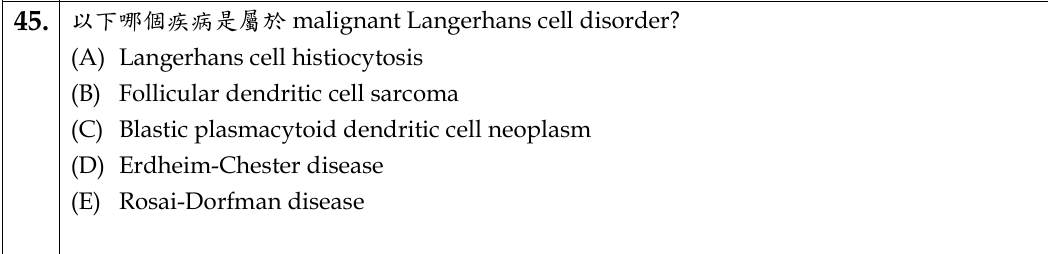
Q45. 以下哪個疾病是屬於 malignant Langerhans cell disorder?
- (A) Langerhans cell histiocytosis
- (B) Follicular dendritic cell sarcoma
- (C) Blastic plasmacytoid dendritic cell neoplasm
- (D) Erdheim-Chester disease
- (E) Rosai-Dorfman disease
點此顯示正解
(A) Langerhans cell histiocytosis
詳解
(A) Langerhans cell histiocytosis is the correct answer because it is the only option that represents a Langerhans cell disorder according to the WHO classification. LCH is characterized by a clonal proliferation of CD1a+/CD207 (langerin)+ Langerhans-like cells with constitutive activation of the MAPK pathway, most commonly through BRAF V600E mutations (present in approximately 50% of cases)12345. While historically debated as reactive versus neoplastic, LCH is now definitively classified as a myeloid neoplastic disorder based on clonality, somatic activating mutations, and shared mutations with hematopoietic precursors14.
Why the other options are NOT Langerhans cell disorders:
(B) Follicular dendritic cell sarcoma is derived from follicular dendritic cells (mesenchymal stromal cells of lymphoid follicles), not Langerhans cells. These tumors express follicular dendritic cell markers including CD21, CD23, and CD35, and are negative for CD1a and langerin[^10]. Recent studies show recurrent alterations in NF-κB pathway genes[^10].
(C) Blastic plasmacytoid dendritic cell neoplasm (BPDCN) arises from plasmacytoid dendritic cells, a distinct dendritic cell lineage. BPDCN characteristically expresses CD4, CD56, CD123, and TCL1, and is negative for CD1a and langerin8[^10]. This is an aggressive neoplasm with poor prognosis.
(D) Erdheim-Chester disease is a non-Langerhans histiocytosis characterized by foamy (xanthomatous) histiocytes that express CD68, CD163, fascin, and factor XIIIa but are negative for CD1a and langerin (may be dim S100+)79[^11]. Like LCH, ECD harbors MAPK pathway mutations (BRAF V600E in ~50%), but the cell of origin and immunophenotype are distinct from Langerhans cells79.
(E) Rosai-Dorfman disease is another non-Langerhans histiocytosis featuring large histiocytes that are S100+, CD68+, CD163+ but CD1a- and langerin-79[^11]. The hallmark finding is emperipolesis (engulfment of intact inflammatory cells within histiocyte cytoplasm)7. A subset harbors MAPK pathway mutations (NRAS, KRAS, MAP2K1/2, rarely BRAF)7.
Key distinguishing feature: Only LCH expresses the Langerhans cell markers CD1a and CD207 (langerin), which define it as a Langerhans cell disorder124[^11].
詳解 · 中文翻譯
(A) Langerhans 細胞組織細胞增多症是正確答案,因為它是唯一代表按 WHO 分類的 Langerhans 細胞障礙的選項。LCH 以 CD1a+/CD207(langerin)+ Langerhans 類細胞的隆克隆增殖特徵,伴 MAPK 途徑的構成激活,最常見通過 BRAF V600E 突變(存在於約 50% 的病例)12345。雖然歷史上關於反應性 vs 腫瘤性有爭論,LCH 現在基於克隆性、體細胞激活突變及與造血幹細胞前體的共有突變被明確分類為 髓系腫瘤病症14。
為何其他選項不是 Langerhans 細胞障礙:
(B) 濾泡樹突狀細胞肉瘤源自 濾泡樹突狀細胞(淋巴濾泡的間質基質細胞),不是 Langerhans 細胞。這些腫瘤表達濾泡樹突狀細胞標誌物,包括 CD21、CD23 及 CD35,並對 CD1a 及 langerin 陰性[^10]。最近研究顯示 NF-κB 途徑基因中的經常改變[^10]。
(C) 爆炸性漿細胞樣樹突狀細胞腫瘤(BPDCN)源自 漿細胞樣樹突狀細胞,一種不同樹突狀細胞譜系。BPDCN 特徵性表達 CD4、CD56、CD123 及 TCL1,並對 CD1a 及 langerin 陰性8[^10]。這是預後差的侵襲性腫瘤。
(D) Erdheim-Chester 病是一個 非 Langerhans 組織細胞增多症,特徵為泡沫(黃瘤樣)組織細胞,表達 CD68、CD163、fascin 及因子 XIIIa,但對 CD1a 及 langerin 陰性(可能為暗 S100+)79[^11]。如同 LCH,ECD 含有 MAPK 途徑突變(BRAF V600E 在約 50%),但細胞起源及免疫表型與 Langerhans 細胞不同79。
(E) Rosai-Dorfman 病是另一個 非 Langerhans 組織細胞增多症,具大組織細胞為 S100+、CD68+、CD163+,但 CD1a- 及 langerin-79[^11]。標誌性發現是 嵌入(組織細胞細胞質內完整發炎細胞的吞沒)7。一個亞群含有 MAPK 途徑突變(NRAS、KRAS、MAP2K1/2、罕見 BRAF)7。
關鍵區別特徵:僅 LCH 表達 Langerhans 細胞標誌物 CD1a 及 CD207(langerin),其定義它為 Langerhans 細胞障礙124[^11]。
參考文獻 (AMA)
-
Bielamowicz K, Dimitrion P, Abla O, et al. Langerhans Cell Histiocytosis: NACHO Update on Progress, Chaos, and Opportunity on the Path to Rational Cures. Cancer. 2024;130(14):2416-2439. doi:10.1002/cncr.35301. PMID:38687639. ↩↩↩↩↩↩
-
National Comprehensive Cancer Network. Histiocytic Neoplasms. https://www.nccn.org/professionals/physician_gls/pdf/histiocytic_neoplasms.pdf#page=38. ↩↩↩↩
-
Rodriguez-Galindo C, Allen CE. Langerhans Cell Histiocytosis. Blood. 2020;135(16):1319-1331. doi:10.1182/blood.2019000934. PMID:32106306. ↩↩
-
Allen CE, Merad M, McClain KL. Langerhans-Cell Histiocytosis. The New England Journal of Medicine. 2018;379(9):856-868. doi:10.1056/NEJMra1607548. PMID:30157397. ↩↩↩↩↩↩
-
Rodriguez-Galindo C. Clinical Features and Treatment of Langerhans Cell Histiocytosis. Acta Paediatrica (Oslo, Norway : 1992). 2021;110(11):2892-2902. doi:10.1111/apa.16014. PMID:34192374. ↩↩
-
Egan C, Song S, Liu WP, et al. Plasmacytoid Dendritic Cell Proliferations, Malignant Histiocytic (Macrophage/Dendritic Cell) Neoplasms and Follicular Dendritic Cell Neoplasms: Report From the 2024 Joint CSHP/EA4HP/SH Workshop. Virchows Archiv : An International Journal of Pathology. 2025;:10.1007/s00428-025-04114-5. doi:10.1007/s00428-025-04114-5. PMID:40550890. ↩
-
Valent P, Wojta J, Kovanen PT, et al. Tissue-Resident Myeloid and Histiocytic Cells in Health and Disease: Novel Emerging Concepts. American Journal of Hematology. 2025;100(12):2305-2319. doi:10.1002/ajh.70062. PMID:40938275. ↩↩↩↩↩↩↩↩↩↩
-
Emile JF, Cohen-Aubart F, Collin M, et al. Histiocytosis. Lancet (London, England). 2021;398(10295):157-170. doi:10.1016/S0140-6736(21)00311-1. PMID:33901419. ↩↩
-
Rech KL, He R. Challenges in the Histopathologic Diagnosis of Histiocytic Neoplasms. Journal of the National Comprehensive Cancer Network : JNCCN. 2021;19(11):1305-1311. doi:10.6004/jnccn.2021.7098. PMID:34781270. ↩↩↩↩↩↩
Figures