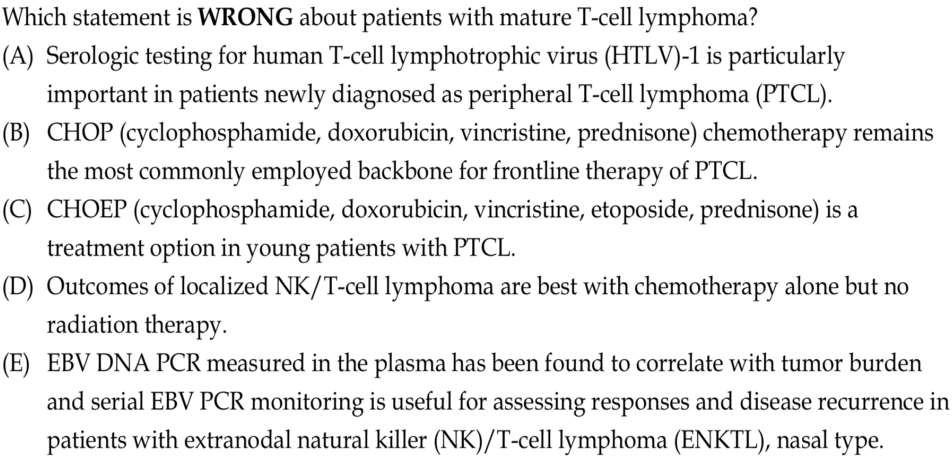
Q1. Which statement is WRONG about patients with mature T-cell lymphoma?
- (A) Serologic testing for human T-cell lymphotrophic virus (HTLV)-1 is particularly important in patients newly diagnosed as peripheral T-cell lymphoma (PTCL).
- (B) CHOP (cyclophosphamide, doxorubicin, vincristine, prednisone) chemotherapy remains the most commonly employed backbone for frontline therapy of PTCL.
- (C) CHOEP (cyclophosphamide, doxorubicin, vincristine, etoposide, prednisone) is a treatment option in young patients with PTCL.
- (D) Outcomes of localized NK/T-cell lymphoma are best with chemotherapy alone but no radiation therapy.
- (E) EBV DNA PCR measured in the plasma has been found to correlate with tumor burden and serial EBV PCR monitoring is useful for assessing responses and disease recurrence in patients with extranodal natural killer (NK)/T-cell lymphoma (ENKTL), nasal type.
點此顯示正解
(D) Outcomes of localized NK/T-cell lymphoma are best with chemotherapy alone but no radiation therapy.
詳解
Analysis of Board Exam Question
1. Why (D) is FALSE:
Statement (D) is false because outcomes of localized (stage I-II) NK/T-cell lymphoma are best with combined-modality therapy (chemotherapy plus radiotherapy), not chemotherapy alone. Radiotherapy is a core component of first-line treatment for early-stage extranodal NK/T-cell lymphoma (ENKTL)12. Multiple studies demonstrate that radiotherapy with or without chemotherapy is superior to chemotherapy alone for localized disease. In a large multicenter study of 1,273 early-stage patients, radiotherapy alone and radiotherapy with or without chemotherapy achieved 5-year overall survival of 69.6% and 67.7%, respectively, compared to only 33.9% with chemotherapy alone (P < .001)3. The current standard approach involves non-anthracycline-based chemotherapy combined with radiotherapy using concurrent, sequential, or sandwich approaches124. Radiotherapy administered at 50-54 Gy is associated with improved locoregional control and efficacy2. Even in the modern era with improved non-anthracycline regimens containing L-asparaginase and platinum agents, radiotherapy remains an essential component of first-line therapy for early-stage patients5.
2. Why the other statements are TRUE:
(A) TRUE: HTLV-1 serologic testing is particularly important in newly diagnosed PTCL because it identifies adult T-cell leukemia/lymphoma (ATLL), a distinct entity caused by HTLV-1 infection that requires different management. The NCCN T-Cell Lymphoma Guidelines recommend that "assessment of HTLV-1/2 by serology or other methods is encouraged, if not previously done, as results can impact therapy"8[^9]. While HTLV-1 is endemic in certain geographic regions (Japan, Caribbean, parts of Africa and South America), it has been described in patients in non-endemic areas as well78[^9].
(B) TRUE: CHOP (cyclophosphamide, doxorubicin, vincristine, prednisone) remains the most commonly employed backbone for frontline therapy of PTCL, despite its limitations. While CHOP is not effective for NK/T-cell lymphoma due to the multidrug resistance phenotype[^11], it continues to be widely used for other PTCL subtypes including PTCL-NOS, angioimmunoblastic T-cell lymphoma (AITL), and ALK-negative anaplastic large cell lymphoma (ALCL)8. The NCCN guidelines list CHOP as a primary treatment option for these entities, though outcomes remain suboptimal compared to B-cell lymphomas.
(C) TRUE: CHOEP (CHOP plus etoposide) is a treatment option in young patients with PTCL. The addition of etoposide to CHOP has been evaluated in younger patients with aggressive PTCL subtypes, with some studies suggesting improved outcomes in fit patients who can tolerate the increased toxicity. This intensified regimen is considered particularly for younger patients with good performance status.
(E) TRUE: EBV DNA PCR measured in plasma correlates with tumor burden in ENKTL and is useful for monitoring. The NCCN guidelines specifically state that "EBV viral load is important in diagnosis and possibly in monitoring of disease" and that "lack of normalization of EBV viremia should be considered indirect evidence of persistent disease"7. Plasma EBV DNA quantification serves as a surrogate marker for lymphoma load and should be performed for prognostication and treatment response assessment[10][11]. Serial monitoring helps assess responses and detect disease recurrence, with therapeutic goals including achieving undetectable plasma EBV DNA[^11].
詳解 · 中文翻譯
血液委員會試題分析
1. 為何 (D) 錯誤:
敘述 (D) 錯誤,因為侷限性(第 I-II 期)NK/T 細胞淋巴瘤的預後最佳採用合併模式治療(化療加放射治療),非單獨化療。放射治療是早期細胞外結節 NK/T 細胞淋巴瘤(ENKTL)的一線治療核心成分12。多項研究證示放射治療伴或不伴化療優於單獨化療在侷限疾病中。在一項涵蓋 1,273 名早期患者的大型多中心研究中,單獨放射治療及放射治療伴或不伴化療達到 5 年整體存活率分別為 69.6% 和 67.7%,相比之下單獨化療僅 33.9%(P < .001)3。當今標準方法涉及非蒽環類化療合併放射治療,使用同步、序列或夾心方法124。以 50-54 Gy 給予的放射治療與改善局部區域控制及療效相關2。即使在含有左旋天冬醯酶及鉑類藥物的改善非蒽環類方案的現代時代,放射治療仍為早期患者一線治療的必要成分5。
2. 為何其他敘述正確:
(A) 正確:HTLV-1 血清學檢測在新診斷 PTCL 中特別重要,因為它識別成人 T 細胞白血病/淋巴瘤(ATLL),一種由 HTLV-1 感染引起的不同實體,需要不同的管理。NCCN T 細胞淋巴瘤指南建議「評估 HTLV-1/2 透過血清學或其他方法是鼓勵的,如先前未進行,因為結果可影響治療」8[^9]。雖然 HTLV-1 在特定地理區域(日本、加勒比海、非洲和南美洲部分)為風土病,它也被描述在非風土性區域患者中78[^9]。
(B) 正確:CHOP(環磷醯胺、阿黴素、長春新鹼、類固醇)仍為 PTCL 一線治療最常採用的骨幹,儘管其局限。雖然 CHOP 對 NK/T 細胞淋巴瘤無效因多藥耐藥型態[^11],它繼續被廣泛用於其他 PTCL 亞型,包括 PTCL-NOS、血管免疫母細胞淋巴瘤(AITL)及 ALK 陰性非霍奇金淋巴瘤(ALCL)8。NCCN 指南列舉 CHOP 為這些實體的初級治療選擇,雖然預後仍低於 B 細胞淋巴瘤。
(C) 正確:CHOEP(CHOP 加依託博苷)是年輕 PTCL 患者的治療選擇。將依託博苷加入 CHOP 已在年輕患者伴侵襲性 PTCL 亞型中評估,某些研究提示在能耐受增加毒性的健康患者中改善預後。此強化方案被認為特別適用於年輕且狀態良好的患者。
(E) 正確:血漿中測得的 EBV DNA PCR 與 ENKTL 的腫瘤負荷相關聯且對監測有用。NCCN 指南明確指出「EBV 病毒負荷在診斷及可能的疾病監測中很重要」及「EBV 病毒血症缺乏正常化應被認為持續疾病的間接證據」7。血漿 EBV DNA 定量作為淋巴瘤負荷的替代標誌物並應進行預後判定及治療應答評估[10][11]。序列監測幫助評估應答及偵測疾病復發,治療目標包括達到無法檢測的血漿 EBV DNA[^11]。
參考文獻 (AMA)
-
Kim SJ, Yoon SE, Kim WS. Treatment of Localized Extranodal NK/T Cell Lymphoma, Nasal Type: A Systematic Review. Journal of Hematology & Oncology. 2018;11(1):140. doi:10.1186/s13045-018-0687-0. PMID:30567593. ↩↩↩↩
-
Yamaguchi M, Suzuki R, Oguchi M. Advances in the Treatment of Extranodal NK/T-cell Lymphoma, Nasal Type. Blood. 2018;131(23):2528-2540. doi:10.1182/blood-2017-12-791418. PMID:29602763. ↩↩↩↩↩↩
-
Yang Y, Zhu Y, Cao JZ, et al. Risk-Adapted Therapy for Early-Stage Extranodal Nasal-Type NK/T-cell Lymphoma: Analysis From a Multicenter Study. Blood. 2015;126(12):1424-32; quiz 1517. doi:10.1182/blood-2015-04-639336. PMID:26109206. ↩↩
-
Kwong YL, Anderson BO, Advani R, et al. Management of T-Cell and Natural-Killer-Cell Neoplasms in Asia: Consensus Statement From the Asian Oncology Summit 2009. The Lancet. Oncology. 2009;10(11):1093-101. doi:10.1016/S1470-2045(09)70265-7. PMID:19880063. ↩↩
-
Qi SN, Yang Y, Zhang YJ, et al. Risk-Based, Response-Adapted Therapy for Early-Stage Extranodal Nasal-Type NK/T-cell Lymphoma in the Modern Chemotherapy Era: A China Lymphoma Collaborative Group Study. American Journal of Hematology. 2020;95(9):1047-1056. doi:10.1002/ajh.25878. PMID:32449800. ↩↩
-
National Comprehensive Cancer Network. T-Cell Lymphomas. https://www.nccn.org/professionals/physician_gls/pdf/t-cell.pdf#page=10. ↩
-
Tse E, Zhao WL, Xiong J, Kwong YL. How We Treat NK/T-cell Lymphomas. Journal of Hematology & Oncology. 2022;15(1):74. doi:10.1186/s13045-022-01293-5. PMID:35659326. ↩↩↩↩
-
Tse E, Fox CP, Glover A, et al. Extranodal Natural Killer/T-Cell Lymphoma: An Overview on Pathology and Clinical Management. Seminars in Hematology. 2022;59(4):198-209. doi:10.1053/j.seminhematol.2022.10.002. PMID:36805888. ↩↩↩↩↩↩
Figures