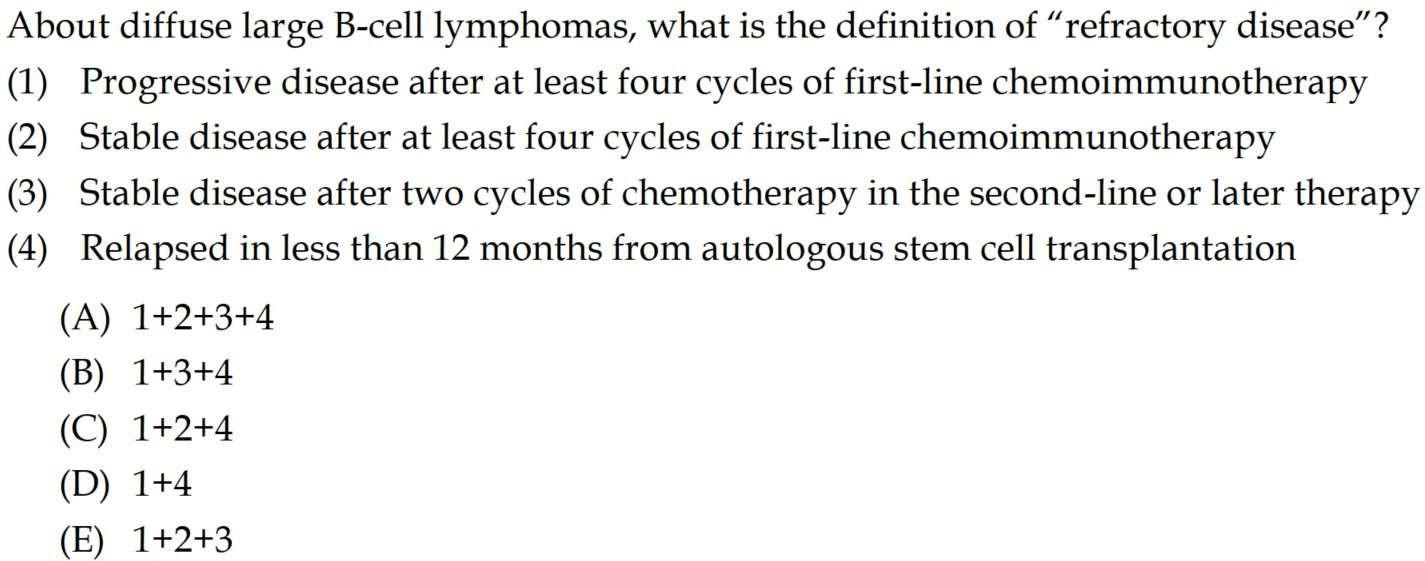
Q1. About diffuse large B-cell lymphomas, what is the definition of “refractory disease”?
- (A) 1+2+3+4
- (B) 1+3+4
- (C) 1+2+4
- (D) 1+4
- (E) 1+2+3
點此顯示正解
(A) 1+2+3+4
詳解
Based on the SCHOLAR-1 study definition, option (A) is incorrect because it includes criterion (3), which is not part of the actual SCHOLAR-1 refractory disease definition.
1. Why (A) is the INCORRECT statement
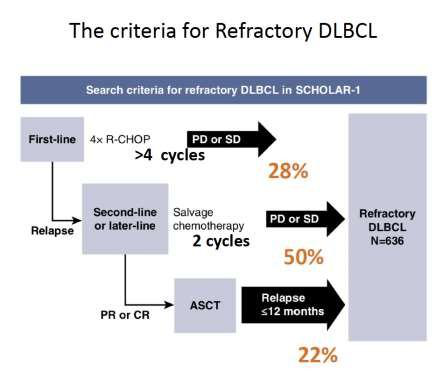
The SCHOLAR-1 study defined refractory DLBCL as meeting any of the following criteria1[3][8]:
- Progressive disease as best response at any point during chemotherapy (>4 cycles of first-line or ≥2 cycles of later-line therapy)
- Stable disease as best response at any point during chemotherapy (>4 cycles of first-line or ≥2 cycles of later-line therapy)
- Relapse ≤12 months from autologous stem cell transplantation
Criterion (3) in the question stem—"Partial response (PR) of ≤6 months duration as best response, with biopsy-proven residual disease or progression within 12 months of autologous stem-cell transplant"—is not part of the SCHOLAR-1 definition. The SCHOLAR-1 criteria do not include any provision for partial response with short duration or biopsy-proven residual disease. Option (A) incorrectly includes this criterion.
2. Why the other options are TRUE statements
Option (B): 1+3+4 — Incorrect because it includes criterion (3), which is not part of SCHOLAR-1.
Option (C): 1+2+4 — This is correct and matches the actual SCHOLAR-1 definition: progressive disease (1), stable disease (2), and relapse within 12 months of auto-SCT (4)1[3][8].
Option (D): 1+4 — This is a subset of the SCHOLAR-1 criteria (progressive disease and early relapse post-transplant) but omits stable disease (2), so it is incomplete but not incorrect.
Option (E): 1+2+3 — Incorrect because it includes criterion (3), which is not part of SCHOLAR-1.
The correct SCHOLAR-1 definition comprises criteria 1, 2, and 4 only—making option (C) the accurate representation of the study's refractory disease definition1[3][8].
詳解 · 中文翻譯
根據 SCHOLAR-1 研究定義,選項 (A) 不正確,因為它包含標準 (3),而這不是 SCHOLAR-1 難治性疾病定義的實際內容。
1. 為何 (A) 是錯誤陳述
SCHOLAR-1 研究定義難治性 DLBCL 為符合任何以下標準1[3][8]:
- 進行性疾病作為在化療期間任何時間點的最佳反應(>4 個化療週期的一線治療或 ≥2 個後續治療週期)
- 穩定疾病作為在化療期間任何時間點的最佳反應(>4 個化療週期的一線治療或 ≥2 個後續治療週期)
- 在自體造血幹細胞移植後 ≤12 個月內復發
題目中的標準 (3)——「完全反應(CR)持續 ≤6 個月作為最佳反應,伴隨活檢證實殘存疾病或自體幹細胞移植後 12 個月內進行性疾病」——不是 SCHOLAR-1 定義的一部分。SCHOLAR-1 標準不包括任何關於短期部分反應或活檢證實殘存疾病的條款。選項 (A) 錯誤地包含了此標準。
2. 其他選項為何都是正確陳述
選項 (B):1+3+4 — 不正確,因為它包含標準 (3),而這不是 SCHOLAR-1 的一部分。
選項 (C):1+2+4 — 這是正確的,與實際的 SCHOLAR-1 定義相符:進行性疾病 (1)、穩定疾病 (2) 和自體造血幹細胞移植後 12 個月內復發 (4)1[3][8]。
選項 (D):1+4 — 這是 SCHOLAR-1 標準的子集(進行性疾病和移植後早期復發),但遺漏了穩定疾病 (2),因此不完整但並非不正確。
選項 (E):1+2+3 — 不正確,因為它包含標準 (3),而這不是 SCHOLAR-1 的一部分。
SCHOLAR-1 的正確定義僅包括標準 1、2 和 4——使選項 (C) 成為對該研究難治性疾病定義的準確表述1[3][8]。
參考文獻 (AMA)
-
Crump M, Neelapu SS, Farooq U, et al. Outcomes in Refractory Diffuse Large B-Cell Lymphoma: Results From the International SCHOLAR-1 Study. Blood. 2017;130(16):1800-1808. doi:10.1182/blood-2017-03-769620. PMID:28774879. ↩↩↩↩↩↩
-
Bastos-Oreiro M, Gutierrez A, Iacoboni G, et al. Impact of SCHOLAR-1 Criteria on Chimeric Antigen Receptor T Cell Therapy Efficacy in Aggressive B Lymphoma: A Real-World GELTAMO/GETH Study. Transplantation and Cellular Therapy. 2023;29(12):747.e1-747.e10. doi:10.1016/j.jtct.2023.08.026. PMID:37659694. ↩
Slide annotations
SCHOLAR-1
Figures