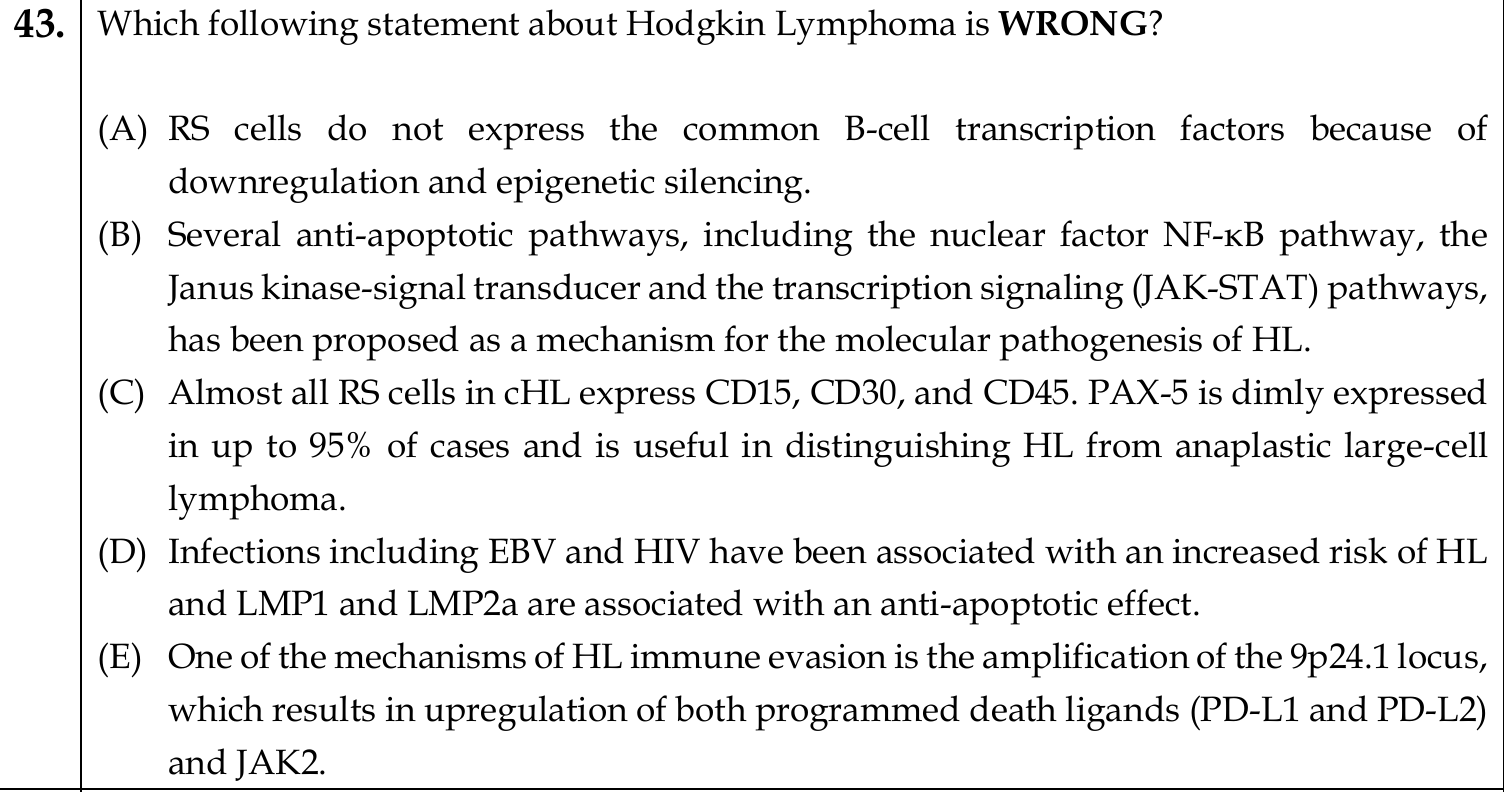
Q43. Which following statement about Hodgkin Lymphoma is WRONG?
- (A) RS cells do not express the common B-cell transcription factors because of downregulation and epigenetic silencing.
- (B) Several anti-apoptotic pathways, including the nuclear factor NF-κB pathway, the Janus kinase-signal transducer and the transcription signaling (JAK-STAT) pathways, has been proposed as a mechanism for the molecular pathogenesis of HL.
- (C) Almost all RS cells in cHL express CD15, CD30, and CD45. PAX-5 is dimly expressed in up to 95% of cases and is useful in distinguishing HL from anaplastic large-cell lymphoma.
- (D) Infections including EBV and HIV have been associated with an increased risk of HL and LMP1 and LMP2a are associated with an anti-apoptotic effect.
- (E) One of the mechanisms of HL immune evasion is the amplification of the 9p24.1 locus, which results in upregulation of both programmed death ligands (PD-L1 and PD-L2) and JAK2.
點此顯示正解
(C) Almost all RS cells in cHL express CD15, CD30, and CD45. PAX-5 is dimly expressed in up to 95% of cases and is useful in distinguishing HL from anaplastic large-cell lymphoma.
詳解
Option (C) is incorrect because Reed-Sternberg cells in classical Hodgkin lymphoma are characteristically CD45-negative, not CD45-positive as stated in the option. The claim that "almost all RS cells express CD15, CD30, and CD45" is false specifically regarding CD45 expression.
Why CD45 negativity is characteristic:
Reed-Sternberg (RS) cells consistently lack CD45 (leukocyte common antigen) expression, which is a defining immunophenotypic feature that helps distinguish classical HL from other lymphomas13. In a study of 55 patients with Hodgkin disease, all cases showed CD45-negative HRS cells3. This CD45 negativity reflects the profound lineage dysregulation and loss of typical B-cell markers that characterizes classical HL1. The correct immunophenotype is: - CD30: positive in 100% of cases2 - CD15: positive in 75-80% of cases2 - CD45: negative in classical HL13 - PAX5: dimly positive in up to 95-97% of cases, which helps confirm B-cell origin and distinguish HL from anaplastic large-cell lymphoma (ALCL)24
Why the other options are correct:
(A) is correct: RS cells lose expression of common B-cell transcription factors through downregulation and epigenetic silencing. Despite their germinal center B-cell origin, HRS cells undergo profound lineage dysregulation with reduced expression of B-cell markers (CD20, CD79A/B) and only partial retention of PAX51. Epigenetic phenomena such as promoter hypermethylation lead to downregulation of B-lineage-specific genes[^11].
(B) is correct: Anti-apoptotic pathways including NF-κB and JAK-STAT are central to HL pathogenesis. Persistent NF-κB activation is a hallmark of HRS cells, driven by genomic lesions, EBV infection, and microenvironmental interactions79. JAK/STAT signaling is permanently activated due to pervasive mutations in pathway genes, promoting tumor growth and preventing apoptosis9[10][11].
(D) is correct: EBV infection is observed in 30-50% of adult classical HL cases and drives pathogenesis through latent viral proteins. LMP1 and LMP2A mimic constitutive CD40 and B-cell receptor signaling respectively, thereby activating NF-κB and JAK/STAT pathways, inducing anti-apoptotic gene expression, and upregulating immune checkpoint ligands including PD-L189. HIV infection is also associated with increased HL risk2.
(E) is correct: 9p24.1 amplification is a recurrent genetic alteration in classical HL that leads to coordinate upregulation of PD-L1, PD-L2, and JAK2. This chromosomal region contains the genes encoding PD-1 ligands (PD-L1 and PD-L2) as well as JAK2, and copy-number alterations at this locus represent a key mechanism of immune evasion in HRS cells2[10][11].
詳解 · 中文翻譯
(C) 選項不正確,因為經典霍奇金淋巴瘤中的 Reed-Sternberg 細胞特徵性為 CD45 陰性,而不是選項中所述的 CD45 陽性。「幾乎所有 RS 細胞表達 CD15、CD30 和 CD45」的聲稱對於 CD45 表達而言是假的。
為什麼 CD45 陰性是特徵性的:
Reed-Sternberg (RS) 細胞一致地缺乏 CD45(白細胞共同抗原)表達,這是幫助區分經典 HL 與其他淋巴瘤的定義性免疫表型特徵13。在 55 名霍奇金病患者的研究中,所有病例都顯示 CD45 陰性 HRS 細胞3。此 CD45 陰性反映了經典 HL 特徵的深度系列失調和典型 B 細胞標誌物的喪失1。正確的免疫表型是: - CD30:在 100% 的病例中陽性2 - CD15:在 75-80% 的病例中陽性2 - CD45:在經典 HL 中陰性13 - PAX5:在達 95-97% 的病例中弱陽性,有助於確認 B 細胞來源並將 HL 與間變大細胞淋巴瘤(ALCL)區分24
為什麼其他選項正確:
(A) 正確: RS 細胞通過下調和表觀遺傳學沉寂喪失常見 B 細胞轉錄因子的表達。儘管來自生殖中心 B 細胞,HRS 細胞經歷深度系列失調,B 細胞標誌物表達減少(CD20、CD79A/B)且僅部分保留 PAX51。促進子高甲基化等表觀遺傳現象導致 B 系列特異性基因的下調[^11]。
(B) 正確: 包括 NF-κB 和 JAK-STAT 的抗凋亡途徑是 HL 發病機制的中樞。持續的 NF-κB 活化是 HRS 細胞的標誌,由基因組損傷、EBV 感染和微環境相互作用驅動79。由於通路基因中的普遍突變,JAK/STAT 信號傳導被永久激活,促進腫瘤生長並防止凋亡9[10][11]。
(D) 正確: EBV 感染在 30-50% 的成人經典 HL 病例中觀察到,通過潛伏病毒蛋白驅動發病機制。LMP1 和 LMP2A 分別模擬構成型 CD40 和 B 細胞受體信號,從而激活 NF-κB 和 JAK/STAT 途徑、引發抗凋亡基因表達並上調免疫檢查點配體包括 PD-L189。HIV 感染也與 HL 風險增加相關2。
(E) 正確: 9p24.1 擴增是經典 HL 的復發性遺傳改變,導致 PD-L1、PD-L2 和 JAK2 的協調上調。此染色體區域含有編碼 PD-1 配體(PD-L1 和 PD-L2)以及 JAK2 的基因,此位點的拷貝數改變代表 HRS 細胞免疫逃逸的關鍵機制2[10][11]。
參考文獻 (AMA)
-
Gloghini A, Lorenzini D, Volpi CC, Trupia DV, Pruneri G. Hodgkin Reed-Sternberg Cells of Classic Hodgkin Lymphoma: Morphology, Phenotype, Genotype, and Cell of Origin. Cancers. 2026;18(9):1446. doi:10.3390/cancers18091446. PMID:42122242. ↩↩↩↩↩↩↩↩
-
Schmid C, Pan L, Diss T, Isaacson PG. Expression of B-Cell Antigens by Hodgkin's and Reed-Sternberg Cells. The American Journal of Pathology. 1991;139(4):701-7. PMID:1656757. https://pubmed.ncbi.nlm.nih.gov/1656757. ↩↩↩↩↩↩↩↩↩↩
-
Brice P, de Kerviler E, Friedberg JW. Classical Hodgkin Lymphoma. Lancet (London, England). 2021;398(10310):1518-1527. doi:10.1016/S0140-6736(20)32207-8. PMID:33493434. ↩↩↩↩↩↩
-
Cozzolino I, Vitagliano G, Caputo A, et al. CD15, CD30, and PAX5 Evaluation in Hodgkin's Lymphoma on Fine-Needle Aspiration Cytology Samples. Diagnostic Cytopathology. 2020;48(3):211-216. doi:10.1002/dc.24366. PMID:31825183. ↩↩
-
Brune MM, Juskevicius D, Haslbauer J, Dirnhofer S, Tzankov A. Genomic Landscape of Hodgkin Lymphoma. Cancers. 2021;13(4):682. doi:10.3390/cancers13040682. PMID:33567641. ↩
-
von Hoff L, Kärgel E, Franke V, et al. Autocrine LTA Signaling Drives NF-κB and JAK-STAT Activity and Myeloid Gene Expression in Hodgkin Lymphoma. Blood. 2019;133(13):1489-1494. doi:10.1182/blood-2018-08-871293. PMID:30696620. ↩
-
Weniger MA, Küppers R. Molecular Biology of Hodgkin Lymphoma. Leukemia. 2021;35(4):968-981. doi:10.1038/s41375-021-01204-6. PMID:33686198. ↩↩
-
Satou A, Takahara T, Nakamura S. An Update on the Pathology and Molecular Features of Hodgkin Lymphoma. Cancers. 2022;14(11):2647. doi:10.3390/cancers14112647. PMID:35681627. ↩↩
-
Caserta S, Martino EA, Skafi M, et al. Beyond PD-1: Mechanisms of Resistance to Checkpoint Blockade in Classical Hodgkin Lymphoma and Next-Generation Immune Strategies. European Journal of Haematology. 2026;116(4):357-367. doi:10.1111/ejh.70101. PMID:41449642. ↩↩↩↩↩↩
Slide annotations
Class HL: CD3-/CD20-/CD45-/CD79a- CD15+/CD30+/PAX-5 weak
Figures