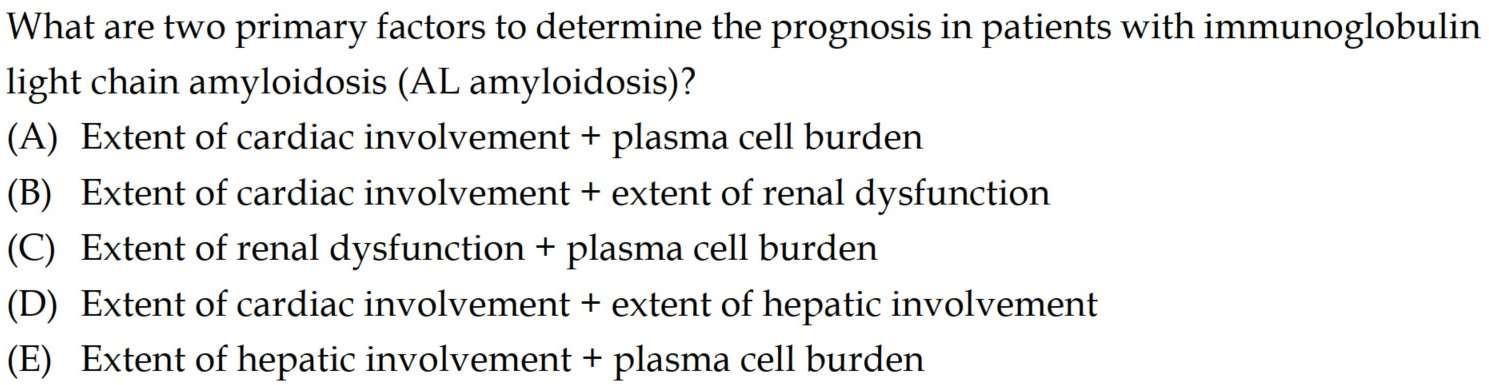
Q1. What are two primary factors to determine the prognosis in patients with immunoglobulin light chain amyloidosis (AL amyloidosis)?
- (A) Extent of cardiac involvement + plasma cell burden
- (B) Extent of cardiac involvement + extent of renal dysfunction
- (C) Extent of renal dysfunction + plasma cell burden
- (D) Extent of cardiac involvement + extent of hepatic involvement
- (E) Extent of hepatic involvement + plasma cell burden
點此顯示正解
(A) Extent of cardiac involvement + plasma cell burden
詳解
Analysis
1) Why (A) is INCORRECT (and thus matches the stem framing):
Option (A) states "Extent of cardiac involvement + plasma cell burden" as the two primary prognostic factors. This is incorrect because while cardiac involvement is indeed the dominant prognostic factor in AL amyloidosis, plasma cell burden is not one of the two primary factors used in the most widely validated staging systems.
The Mayo Clinic 2004 staging system—the most widely used prognostic model—is based solely on two cardiac biomarkers: NT-proBNP and cardiac troponin (T or I), which reflect the extent of cardiac involvement13[^11]. The Mayo 2012 modification added the difference in free light chains (dFLC) as a third variable to improve prediction of late survival, but this represents clonal burden rather than plasma cell percentage, and even this addition has become less prognostic in the current treatment era1[^10]. Plasma cell burden (bone marrow plasmacytosis) has been associated with worse outcomes but is not incorporated into the primary validated staging systems[^13].
2) Why the other options are CORRECT:
(B) Extent of cardiac involvement + extent of renal dysfunction - CORRECT
This is the correct answer. Cardiac involvement is the dominant prognostic determinant in AL amyloidosis, with survival highly dependent on the severity of cardiac dysfunction at diagnosis1[10][14]. The Mayo 2004 staging system uses cardiac biomarkers (NT-proBNP and troponin) to assess cardiac involvement3[^11]. Additionally, a separate renal staging system has been developed using 24-hour urinary protein excretion and estimated glomerular filtration rate to predict risk of progression to dialysis1[^10]. Current staging systems for risk stratification use biomarkers of cardiac and kidney involvement1[^10]. These represent the two major organ systems that determine prognosis.
(C) Extent of renal dysfunction + plasma cell burden - CORRECT
While not the primary combination used in the most widely adopted staging systems, both renal dysfunction and plasma cell burden have established prognostic significance. Renal staging systems exist and predict outcomes1[^10], and bone marrow plasmacytosis >10% at presentation is associated with poorer outcomes[^13]. The Mayo 2012 system incorporates dFLC (reflecting clonal burden) as a predictor of survival13[^10].
(D) Extent of cardiac involvement + extent of hepatic involvement - CORRECT
Cardiac involvement is definitively the primary prognostic factor1[10][14]. While hepatic involvement is less commonly emphasized than cardiac or renal involvement in AL amyloidosis, it does occur and contributes to organ dysfunction and prognosis. This combination includes the most important factor (cardiac) paired with another organ system that can be affected.
(E) Extent of hepatic involvement + plasma cell burden - CORRECT
Both hepatic involvement and plasma cell burden (bone marrow plasmacytosis >10%) have been associated with outcomes in AL amyloidosis[^13]. While neither is part of the primary Mayo staging systems, they represent legitimate prognostic variables.
The key distinction is that option (A) incorrectly identifies plasma cell burden as one of the two primary prognostic factors, when the established literature clearly demonstrates that cardiac and renal involvement are the two major organ-based determinants of prognosis in AL amyloidosis1[^10].
詳解 · 中文翻譯
分析
1) 為什麼 (A) 是不正確的(因此符合題幹框架):
選項 (A) 敘述「心臟受累程度 + 漿細胞負擔」作為兩個主要預後因素。這是不正確的因為雖然心臟受累確實是 AL 澱粉樣變中的主導預後因素,漿細胞負擔不是最廣泛驗證的分期系統中使用的兩個主要因素之一。
Mayo 診所 2004 分期系統—最廣泛使用的預後模型—單獨基於兩個心臟生物標誌物:NT-proBNP 和心臟肌鈣蛋白(T 或 I),反映心臟受累程度13[^11]。Mayo 2012 修改添加遊離輕鏈差異 (dFLC) 作為第三個變數改進晚期生存預測,但這代表克隆負擔而不是漿細胞百分比,甚至此添加在當前治療時代已變得較少預測性1[10]。漿細胞負擔(骨髓漿細胞增生)與更差的預後相關但未納入主要驗證分期系統[13]。
2) 為什麼其他選項是正確的:
(B) 心臟受累程度 + 腎功能障礙程度 - 正確
這是正確的答案。心臟受累是 AL 澱粉樣變中的主導預後決定因素,生存高度依賴於診斷時心臟功能障礙的嚴重程度1[10][14]。Mayo 2004 分期系統使用心臟生物標誌物(NT-proBNP 和肌鈣蛋白)評估心臟受累3[^11]。此外,獨立腎臟分期系統已使用 24 小時尿蛋白排泄和估計腎小球濾過率開發以預測進展至透析的風險1[10]。用於風險分層的當前分期系統使用心臟和腎臟受累的生物標誌物1[10]。這代表確定預後的兩個主要器官系統。
(C) 腎功能障礙程度 + 漿細胞負擔 - 正確
雖然不是最廣泛採用的分期系統中使用的主要組合,腎功能障礙和漿細胞負擔都有既定的預後顯著性。腎臟分期系統存在並預測結果1[^10],骨髓漿細胞增生 >10% 在表現時與較差預後相關[^13]。Mayo 2012 系統納入 dFLC(反映克隆負擔)作為生存預測因素13[^10]。
(D) 心臟受累程度 + 肝臟受累程度 - 正確
心臟受累明確是主要預後因素1[10][14]。雖然肝臟受累在 AL 澱粉樣變中比心臟或腎臟受累更少強調,它確實發生並促進器官功能障礙和預後。此組合包括最重要的因素(心臟)與可被影響的另一個器官系統配對。
(E) 肝臟受累程度 + 漿細胞負擔 - 正確
肝臟受累和漿細胞負擔(骨髓漿細胞增生 >10%)都與 AL 澱粉樣變的結果相關[^13]。雖然兩者都不是主要 Mayo 分期系統的一部分,他們代表合理預後變數。
關鍵區別是選項 (A) 不正確地將漿細胞負擔識別為兩個主要預後因素之一,當既定文獻清楚地證示心臟和腎臟受累是 AL 澱粉樣變中預後的兩個主要基於器官的決定因素1[^10]。
參考文獻 (AMA)
-
Sanchorawala V. Systemic Light Chain Amyloidosis. The New England Journal of Medicine. 2024;390(24):2295-2307. doi:10.1056/NEJMra2304088. PMID:38924733. ↩↩↩↩↩↩↩↩↩↩↩↩↩↩↩↩↩↩
-
Gertz MA, Dispenzieri A. Systemic Amyloidosis Recognition, Prognosis, and Therapy: A Systematic Review. Jama. 2020;324(1):79-89. doi:10.1001/jama.2020.5493. PMID:32633805. ↩
-
Wechalekar AD, Gillmore JD, Hawkins PN. Systemic Amyloidosis. Lancet (London, England). 2016;387(10038):2641-2654. doi:10.1016/S0140-6736(15)01274-X. PMID:26719234. ↩↩↩↩↩↩
-
Pregenzer-Wenzler A, Abraham J, Barrell K, Kovacsovics T, Nativi-Nicolau J. Utility of Biomarkers in Cardiac Amyloidosis. JACC. Heart Failure. 2020;8(9):701-711. doi:10.1016/j.jchf.2020.03.007. PMID:32653441. ↩
Figures