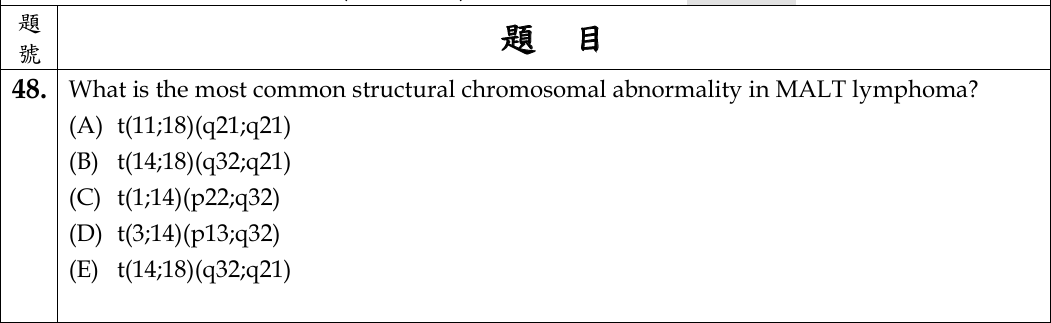
Q48. What is the most common structural chromosomal abnormality in MALT lymphoma?
- (A) t(11;18)(q21;q21)
- (B) t(14;18)(q32;q21)
- (C) t(1;14)(p22;q32)
- (D) t(3;14)(p13;q32)
- (E) t(14;18)(q32;q21)
點此顯示正解
(A) t(11;18)(q21;q21)
詳解
1. Why t(11;18)(q21;q21) is the MOST COMMON structural chromosomal abnormality in MALT lymphoma
The t(11;18)(q21;q21) translocation is the most frequent chromosomal translocation in extranodal marginal zone lymphomas (MALT lymphomas), accounting for 15-50% of cases overall, with the highest frequencies observed in gastric (24%) and pulmonary (38%) MALT lymphomas13. This translocation generates the API2-MALT1 (also called BIRC3-MALT1) fusion protein, which results from fusion of the amino-terminal region of the API2 gene (containing three BIR domains) to the carboxyl-terminal region of the MALT1 gene (containing the paracaspase domain)37[^10].
The API2-MALT1 fusion protein is oncogenic through constitutive activation of both canonical and non-canonical NF-κB signaling pathways[9][10]. The BIR domains from API2 promote oligomerization of the fusion protein, which recruits and activates TRAF6 E3 ligase activity, leading to polyubiquitination and activation of the IKK complex[^10]. This results in sustained NF-κB activation independent of antigen stimulation7[^8].
Clinically, t(11;18)-positive MALT lymphomas demonstrate resistance to Helicobacter pylori eradication therapy (in gastric cases), tendency toward disseminated disease, and reduced likelihood of transformation to diffuse large B-cell lymphoma45. The translocation is significantly associated with CagA-positive H. pylori strains in gastric MALT lymphoma3.
2. Why the other options are LESS COMMON or ABSENT
Option B and E: t(14;18)(q32;q21) — This is the second most common translocation, occurring in 15-20% of nongastrointestinal extranodal MALT lymphomas16. This translocation involves the IGH-MALT1 fusion (not BCL2, which distinguishes it from the t(14;18) in follicular lymphoma), leading to overexpression of MALT1 through juxtaposition with the immunoglobulin heavy-chain enhancer7[^9]. While recurrent, it is less frequent than t(11;18).
Option C: t(1;14)(p22;q32) — This BCL10-IGH translocation is rare, occurring in only 1-2% of MALT lymphomas16. It has been reported in gastric, pulmonary, and cutaneous MALT lymphomas1. The translocation leads to BCL10 overexpression through IGH enhancer activity7[^9].
Option D: t(3;14)(p13;q32) — This FOXP1-IGH translocation occurs in approximately 10% of extranodal MALT lymphomas, predominantly in thyroid, ocular adnexa, and cutaneous sites16. It juxtaposes the FOXP1 transcription factor gene next to the IGH locus, resulting in FOXP1 overexpression1.
All four translocations converge on NF-κB pathway activation, but t(11;18) is distinguished by its higher overall frequency, particularly in the most common MALT lymphoma sites (stomach and lung), and its unique mechanism involving a fusion protein rather than simple gene overexpression17[^9].
詳解 · 中文翻譯
1. 為什麼 t(11;18)(q21;q21) 是 MALT 淋巴瘤最常見的結構性染色體異常
t(11;18)(q21;q21) 易位是淋巴結外邊緣區淋巴瘤(MALT 淋巴瘤)中最頻繁的染色體易位,佔所有病例的 15-50%,最高頻率在胃部(24%)和肺部(38%)MALT 淋巴瘤中觀察到13。此易位生成 API2-MALT1(也稱為 BIRC3-MALT1)融合蛋白,源自 API2 基因的胺基端區域(含三個 BIR 結構域)與 MALT1 基因的羧基端區域(含類胰蛋白酶結構域)的融合37[^10]。
API2-MALT1 融合蛋白通過典型和非典型 NF-κB 信號通路的構成性激活發揮癌基因作用[9][10]。來自 API2 的 BIR 結構域促進融合蛋白的寡聚化,招募並激活 TRAF6 E3 連接酶活性,導致 IKK 複合體的聚泛素化和激活[^10]。這導致獨立於抗原刺激的持續 NF-κB 激活7[^8]。
臨床上,t(11;18) 陽性 MALT 淋巴瘤表現出對幽門螺桿菌根除治療的耐受(胃部病例)、傾向於播散性疾病 及轉化為彌漫大 B 細胞淋巴瘤的可能性降低45。易位與胃部 MALT 淋巴瘤中的 CagA 陽性幽門螺桿菌菌株明顯相關3。
2. 為什麼其他選項較不常見或不存在
選項 B 和 E: t(14;18)(q32;q21) — 這是第二最常見的易位,發生在15-20% 的腸外淋巴結外 MALT 淋巴瘤中16。此易位涉及 IGH-MALT1 融合(不是 BCL2,區別於濾泡性淋巴瘤中的 t(14;18)),通過與免疫球蛋白重鏈增強子並置導致 MALT1 過度表達7[^9]。儘管復發,它比 t(11;18) 較不頻繁。
選項 C: t(1;14)(p22;q32) — 此 BCL10-IGH 易位罕見,僅發生在 1-2% 的 MALT 淋巴瘤中16。已在胃部、肺部及皮膚 MALT 淋巴瘤中報告1。易位導致 BCL10 過度表達,通過 IGH 增強子活性7[^9]。
選項 D: t(3;14)(p13;q32) — 此 FOXP1-IGH 易位發生在約 10% 的淋巴結外 MALT 淋巴瘤中,主要在甲狀腺、眼眶周圍及皮膚部位16。它並置 FOXP1 轉錄因子基因相鄰於 IGH 位點,導致 FOXP1 過度表達1。
所有四個易位聚焦在 NF-κB 通路激活,但 t(11;18) 因其更高的整體頻率而傑出,特別是在最常見的 MALT 淋巴瘤部位(胃和肺),及其涉及融合蛋白而不是簡單基因過度表達的獨特機制17[^9]。
參考文獻 (AMA)
-
Rossi D, Bertoni F, Zucca E. Marginal-Zone Lymphomas. The New England Journal of Medicine. 2022;386(6):568-581. doi:10.1056/NEJMra2102568. PMID:35139275. ↩↩↩↩↩↩↩↩↩↩↩↩↩↩
-
Ye H, Liu H, Attygalle A, et al. Variable Frequencies of T(11;18)(q21;q21) in MALT Lymphomas of Different Sites: Significant Association With CagA Strains of H Pylori in Gastric MALT Lymphoma. Blood. 2003;102(3):1012-8. doi:10.1182/blood-2002-11-3502. PMID:12676782. ↩
-
Lim KH, Yang Y, Staudt LM. Pathogenetic Importance and Therapeutic Implications of NF-κB in Lymphoid Malignancies. Immunological Reviews. 2012;246(1):359-78. doi:10.1111/j.1600-065X.2012.01105.x. PMID:22435566. ↩↩↩↩↩↩
-
Du MQ. MALT Lymphoma: Genetic Abnormalities, Immunological Stimulation and Molecular Mechanism. Best Practice & Research. Clinical Haematology. 2017 Mar - Jun;30(1-2):13-23. doi:10.1016/j.beha.2016.09.002. PMID:28288707. ↩↩
-
Nie Z, Du MQ, McAllister-Lucas LM, et al. Conversion of the LIMA1 Tumour Suppressor Into an Oncogenic LMO-like Protein by API2-MALT1 in MALT Lymphoma. Nature Communications. 2015;6:5908. doi:10.1038/ncomms6908. PMID:25569716. ↩↩
-
Toyoda K, Maeshima AM, Nomoto J, et al. Mucosa-Associated Lymphoid Tissue Lymphoma With T(11;18)(q21;q21) Translocation: Long-Term Follow-Up Results. Annals of Hematology. 2019;98(7):1675-1687. doi:10.1007/s00277-019-03671-5. PMID:30923996. ↩↩↩↩↩↩
-
Foukas PG, Bisig B, de Leval L. Recent Advances Upper Gastrointestinal Lymphomas: Molecular Updates and Diagnostic Implications. Histopathology. 2021;78(1):187-214. doi:10.1111/his.14289. PMID:33382495. ↩↩↩↩↩↩↩↩↩↩
Figures