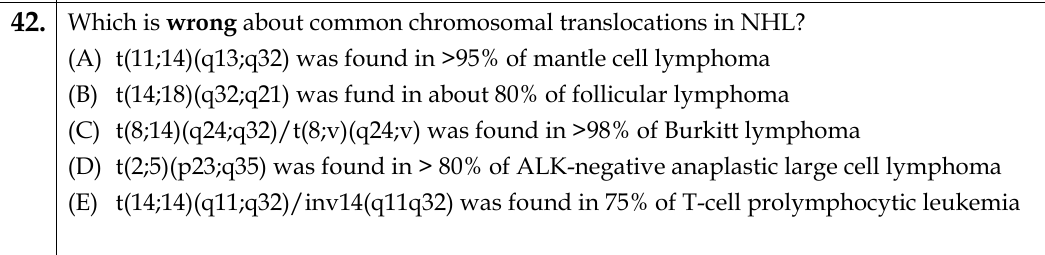
Q42. Which is wrong about common chromosomal translocations in NHL?
- (A) t(11;14)(q13;q32) was found in >95% of mantle cell lymphoma
- (B) t(14;18)(q32;q21) was fund in about 80% of follicular lymphoma
- (C) t(8;14)(q24;q32)/t(8;v)(q24;v) was found in >98% of Burkitt lymphoma
- (D) t(2;5)(p23;q35) was found in > 80% of ALK-negative anaplastic large cell lymphoma
- (E) t(14;14)(q11;q32)/inv(14)(q11q32) was found in 75% of T-cell prolymphocytic leukemia
點此顯示正解
(D) t(2;5)(p23;q35) was found in > 80% of ALK-negative anaplastic large cell lymphoma
詳解
Why (D) is FALSE
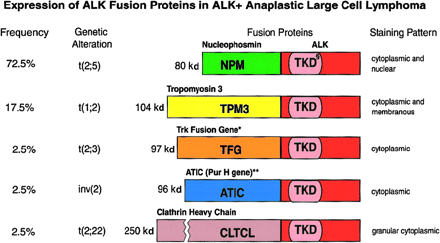
Option (D) is false because t(2;5)(p23;q35) creating the NPM-ALK fusion is the hallmark of ALK-positive anaplastic large cell lymphoma (ALCL), not ALK-negative ALCL. By definition, ALK-negative ALCL lacks ALK gene rearrangements1. The t(2;5)(p23;q35) translocation juxtaposes the ALK gene on chromosome 2p23 with the NPM (nucleophosmin) gene on chromosome 5q35, resulting in constitutive ALK expression. This translocation is found in the majority of ALK-positive ALCL cases, but is absent in ALK-negative ALCL, which represents a distinct entity with different molecular characteristics and prognosis.
Why the Other Options are TRUE
(A) TRUE: t(11;14)(q13;q32) in >95% of mantle cell lymphoma
The t(11;14)(q13;q32) translocation is the genetic hallmark of mantle cell lymphoma, present in the vast majority of cases235. This translocation juxtaposes the CCND1 gene (cyclin D1) on chromosome 11q13 to the immunoglobulin heavy chain (IGH) locus on chromosome 14q32, resulting in constitutive overexpression of cyclin D1 and subsequent cell cycle deregulation35. This translocation is considered a defining feature of mantle cell lymphoma.
(B) TRUE: t(14;18)(q32;q21) in ~80% of follicular lymphoma
The t(14;18)(q32;q21) translocation is the genetic hallmark of follicular lymphoma, detected in 80-90% of cases23. This translocation places the BCL2 gene on chromosome 18q21 under control of the IGH enhancer on chromosome 14q32, leading to constitutive BCL2 expression23. The resulting overexpression of the anti-apoptotic protein BCL-2 blocks the normal germinal center apoptotic program and represents a defining pathogenic feature of follicular lymphoma3.
(C) TRUE: t(8;14)(q24;q32) or variants in >98% of Burkitt lymphoma
Burkitt lymphoma is genetically characterized by MYC translocations, most commonly t(8;14)(q24;q32), which places the MYC gene on chromosome 8q24 under control of the IGH locus on chromosome 14q32124. Variant translocations involving MYC and other immunoglobulin loci also occur. These translocations lead to constitutive MYC activation and are present in the vast majority of Burkitt lymphoma cases4.
(E) TRUE: t(14;14)(q11;q32)/inv(14)(q11q32) in ~75% of T-cell prolymphocytic leukemia
Chromosome 14 abnormalities, specifically inv(14)(q11q32) and t(14;14)(q11;q32), are the genetic hallmarks of T-cell prolymphocytic leukemia (T-PLL), present in up to 80% of cases69. These rearrangements juxtapose the TCL1 locus at 14q32 with the T-cell receptor alpha/delta chain locus at 14q11, resulting in constitutive dysregulation of TCL16. The inversion is more common than the translocation79. Studies show that conventional cytogenetics detects these abnormalities in approximately 43-75% of cases, while FISH analysis reveals TCL1 rearrangement in up to 85% of cases, including many with normal karyotypes8[^10].
詳解 · 中文翻譯
為什麼 (D) 是虛假的
選項 (D) 是虛假的,因為 t(2;5)(p23;q35) 創建 NPM-ALK 融合是 ALK 陽性間變大細胞淋巴瘤 (ALCL) 的特徵,而不是 ALK 陰性 ALCL。 根據定義,ALK 陰性 ALCL 缺乏 ALK 基因重排1。t(2;5)(p23;q35) 易位使染色體 2p23 上的 ALK 基因與染色體 5q35 上的 NPM(核磷蛋白)基因相鄰近,導致組成型 ALK 表達。此易位在大多數 ALK 陽性 ALCL 病例中發現,但在 ALK 陰性 ALCL 中缺失,後者代表具有不同分子特徵和預後的不同實體。
為什麼其他選項是真實的
(A) 真實:t(11;14)(q13;q32) 在 >95% 套細胞淋巴瘤中
t(11;14)(q13;q32) 易位是套細胞淋巴瘤的遺傳特徵,存在於絕大多數病例中235。此易位使染色體 11q13 上的 CCND1 基因(循環蛋白 D1)與染色體 14q32 上的免疫球蛋白重鏈 (IGH) 位點相鄰近,導致循環蛋白 D1 的組成型過度表達和隨後的細胞週期失調35。此易位被認為是套細胞淋巴瘤的定義特徵。
(B) 真實:t(14;18)(q32;q21) 在 ~80% 濾泡淋巴瘤中
t(14;18)(q32;q21) 易位是濾泡淋巴瘤的遺傳特徵,在 80-90% 的病例中檢測到23。此易位將染色體 18q21 上的 BCL2 基因置於染色體 14q32 上的 IGH 增強子的控制下,導致組成型 BCL2 表達23。所得抗凋亡蛋白 BCL-2 的過度表達阻滯正常生發中心凋亡程序,代表濾泡淋巴瘤的定義病原特徵3。
(C) 真實:t(8;14)(q24;q32) 或變體在 >98% Burkitt 淋巴瘤中
Burkitt 淋巴瘤的遺傳特徵是 MYC 易位,最常見 t(8;14)(q24;q32),將染色體 8q24 上的 MYC 基因置於染色體 14q32 上的 IGH 位點的控制下124。涉及 MYC 和其他免疫球蛋白位點的變體易位也發生。這些易位導致組成型 MYC 激活,存在於絕大多數 Burkitt 淋巴瘤病例中4。
(E) 真實:t(14;14)(q11;q32)/inv(14)(q11q32) 在 ~75% T 細胞前淋巴細胞白血病中
染色體 14 異常,特別是 inv(14)(q11q32) 和 t(14;14)(q11;q32),是 T 細胞前淋巴細胞白血病 (T-PLL) 的遺傳特徵,存在於高達 80% 的病例中69。這些重排使 14q32 上的 TCL1 位點與 14q11 上的 T 細胞受體 alpha/delta 鏈位點相鄰近,導致 TCL1 的組成型失調6。反演比易位更常見79。研究顯示常規細胞遺傳學在約 43-75% 的病例中檢測這些異常,而 FISH 分析在高達 85% 的病例中揭示 TCL1 重排,包括許多具有正常核型的病例8[^10]。
參考文獻 (AMA)
-
Ma ES. Recurrent Cytogenetic Abnormalities in Non-Hodgkin's Lymphoma and Chronic Lymphocytic Leukemia. Methods in Molecular Biology (Clifton, N.J.). 2017;1541:279-293. doi:10.1007/978-1-4939-6703-2_22. PMID:27910030. ↩↩↩↩
-
Shankland KR, Armitage JO, Hancock BW. Non-Hodgkin Lymphoma. Lancet (London, England). 2012;380(9844):848-57. doi:10.1016/S0140-6736(12)60605-9. PMID:22835603. ↩↩↩↩↩↩↩↩
-
Armitage JO, Gascoyne RD, Lunning MA, Cavalli F. Non-Hodgkin Lymphoma. Lancet (London, England). 2017;390(10091):298-310. doi:10.1016/S0140-6736(16)32407-2. PMID:28153383. ↩↩↩↩↩↩↩↩↩↩
-
Lenz G, Staudt LM. Aggressive Lymphomas. The New England Journal of Medicine. 2010;362(15):1417-29. doi:10.1056/NEJMra0807082. PMID:20393178. ↩↩↩↩
-
Silkenstedt E, Salles G, Campo E, Dreyling M. B-Cell Non-Hodgkin Lymphomas. Lancet (London, England). 2024;403(10438):1791-1807. doi:10.1016/S0140-6736(23)02705-8. PMID:38614113. ↩↩↩↩
-
Hu Z, Medeiros LJ, Fang L, et al. Prognostic Significance of Cytogenetic Abnormalities in T-Cell Prolymphocytic Leukemia. American Journal of Hematology. 2017;92(5):441-447. doi:10.1002/ajh.24679. PMID:28194886. ↩↩↩↩
-
Rashidi A, Fisher SI. T-Cell Chronic Lymphocytic Leukemia or Small-Cell Variant of T-Cell Prolymphocytic Leukemia: A Historical Perspective and Search for Consensus. European Journal of Haematology. 2015;95(3):199-210. doi:10.1111/ejh.12560. PMID:25846234. ↩↩
-
Brito-Babapulle V, Pomfret M, Matutes E, Catovsky D. Cytogenetic Studies on Prolymphocytic Leukemia. II. T Cell Prolymphocytic Leukemia. Blood. 1987;70(4):926-31. PMID:3115337. https://pubmed.ncbi.nlm.nih.gov/3115337. ↩↩
-
Sun Y, Tang G, Hu Z, et al. Comparison of Karyotyping, Fluorescence in Situ Hybridisation and TCL1 Immunohistochemistry in T Cell Prolymphocytic Leukaemia. Journal of Clinical Pathology. 2018;71(4):309-315. doi:10.1136/jclinpath-2017-204616. PMID:28821581. ↩↩↩↩
Slide correction
ALCL-ALK(+)
Figures