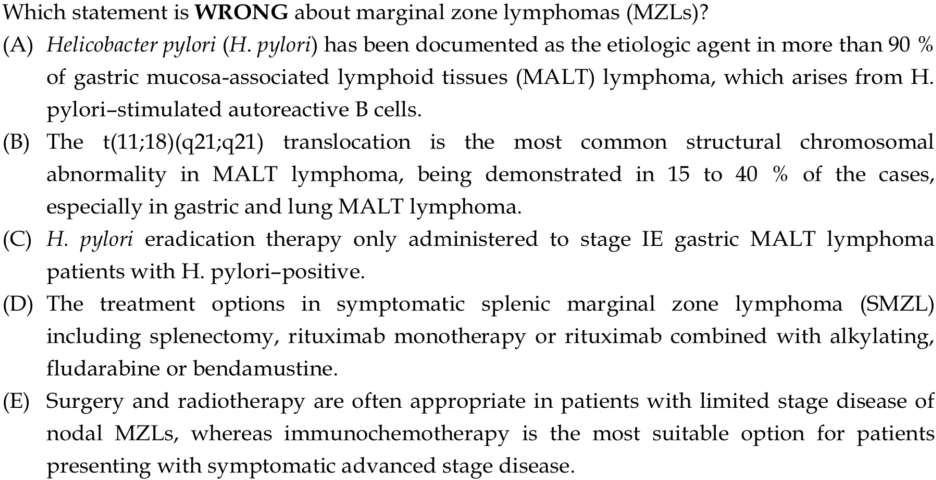
Q1. Which statement is WRONG about marginal zone lymphomas (MZLs)?
- (A) Helicobacter pylori (H. pylori) has been documented as the etiologic agent in more than 90% of gastric mucosa-associated lymphoid tissues (MALT) lymphoma, which arises from H. pylori-stimulated autoreactive B cells.
- (B) The t(11;18)(q21;q21) translocation is the most common structural chromosomal abnormality in MALT lymphoma, being demonstrated in 15 to 40% of the cases, especially in gastric and lung MALT lymphoma.
- (C) H. pylori eradication therapy only administered to stage IE gastric MALT lymphoma patients with H. pylori-positive.
- (D) The treatment options in symptomatic splenic marginal zone lymphoma (SMZL) including splenectomy, rituximab monotherapy or rituximab combined with alkylating, fludarabine or bendamustine.
- (E) Surgery and radiotherapy are often appropriate in patients with limited stage disease of nodal MZLs, whereas immunochemotherapy is the most suitable option for patients presenting with symptomatic advanced stage disease.
點此顯示正解
(C) H. pylori eradication therapy only administered to stage IE gastric MALT lymphoma patients with H. pylori-positive.
詳解
Why (C) is the WRONG Statement
Statement (C) is false because H. pylori eradication therapy should be administered to ALL patients with gastric MALT lymphoma who have confirmed H. pylori infection, irrespective of stage—not restricted to stage IE disease only17[^10]. Furthermore, eradication therapy should even be considered in H. pylori-negative gastric MALT lymphoma, as approximately 15% of such patients achieve complete remission with antibiotic therapy236.
The evidence supporting this broader approach includes:
All stages, H. pylori-positive: Current guidelines from multiple societies recommend H. pylori eradication as initial treatment for all H. pylori-positive gastric MALT lymphoma patients regardless of stage157[^10]. Even in advanced-stage disease, successful H. pylori eradication leads to lymphoma regression in approximately 75% of cases145. The NEJM review explicitly states: "H. pylori should be eradicated in all patients with gastric MZL and H. pylori infection, irrespective of the stage"1.
H. pylori-negative cases: Recent evidence demonstrates that empiric eradication therapy can induce complete remission in 15-15.5% of H. pylori-negative gastric MALT lymphoma patients23. A prospective study showed that H. pylori-negative patients treated with frontline antibiotics had similar progression-free survival and overall survival compared to H. pylori-positive patients6.  Current guidelines now suggest administering eradication therapy as initial treatment regardless of H. pylori status, particularly in minimally symptomatic patients who wish to avoid radiation exposure23.
Biological rationale: The response in H. pylori-negative cases may reflect false-negative microbiologic testing or infection by other microorganisms that respond to broad-spectrum antibiotics[^9]. Given the negligible risk and potential benefit, empiric eradication therapy is reasonable even when H. pylori is not detected35.
Why the Other Statements are CORRECT
(A) is correct: H. pylori is documented in more than 90% of gastric MALT lymphoma cases and arises from H. pylori-stimulated autoreactive B cells1[^11]. The pathogenesis involves chronic H. pylori gastritis generating immune responses that expand B-cell clones with reactive B-cell receptors, eventually leading to malignant transformation through acquisition of genetic lesions[11][12].
(B) is correct: The t(11;18)(q21;q21) translocation is indeed the most common structural chromosomal abnormality in MALT lymphoma, occurring in 15-40% of cases (with approximately 25% in gastric MALT lymphoma specifically), and is particularly frequent in gastric and pulmonary MALT lymphoma7[9][10][^11]. This translocation generates a BIRC3/MALT1 fusion protein that constitutively activates NF-κB signaling, rendering the lymphoma independent of antigenic stimulation and resistant to antibiotic therapy17[9][11].
(D) is correct: Treatment options for symptomatic splenic marginal zone lymphoma include all the listed modalities78[^9]. While splenectomy was historically first-line, rituximab monotherapy has largely replaced splenectomy and leads to prolonged responses7[^9]. For patients requiring more intensive therapy, rituximab combined with alkylating agents (chlorambucil), fludarabine, or bendamustine has shown convincing efficacy7[^9].
(E) is correct: For nodal MZL, the treatment approach is stage-dependent78[^9]. Localized disease (stage I-II) is appropriately managed with surgery or involved-site radiotherapy (24 Gy), achieving excellent long-term disease control[^9]. For symptomatic advanced-stage disease, systemic therapy with immunochemotherapy (rituximab plus chemotherapy) is the preferred approach, following principles similar to follicular lymphoma management78[^9]. Asymptomatic advanced-stage patients may be observed with watchful waiting1[^9].
詳解 · 中文翻譯
為何 (C) 是錯誤陳述
陳述 (C) 是假的,因為 H. pylori 根除治療應給予所有具有確認 H. pylori 感染的胃 MALT 淋巴瘤患者,無論分期——不限於僅第 IE 期疾病17[^10]。此外,根除治療甚至應 在 H. pylori 陰性胃 MALT 淋巴瘤中考慮,因為約 15% 的此類患者通過抗生素治療獲得完全緩解236。
支持此更廣泛方法的證據包括:
所有分期,H. pylori 陽性: 來自多個學會的當前指南建議 H. pylori 根除作為所有 H. pylori 陽性胃 MALT 淋巴瘤患者的初始治療,無論分期157[^10]。即使在晚期疾病中,成功的 H. pylori 根除導致約 75% 的病例淋巴瘤退縮145。NEJM 評論明確指出:「應在所有患有胃 MZL 和 H. pylori 感染的患者中根除 H. pylori,無論分期」1。
H. pylori 陰性病例: 最近的證據顯示實驗性根除治療可在 15-15.5% 的 H. pylori 陰性胃 MALT 淋巴瘤患者中誘導完全緩解23。一項前瞻性研究顯示用一線抗生素治療的 H. pylori 陰性患者與 H. pylori 陽性患者相比有相似的無進展生存期和整體生存6。當前指南現在建議無論 H. pylori 狀態如何投與根除治療作為初始治療,特別是在希望避免放射線暴露的極小症狀患者中23。
生物學基礎: H. pylori 陰性病例的反應可能反映假陰性微生物學檢測或對廣譜抗生素有反應的其他微生物的感染[^9]。鑑於風險可忽略不計和潛在益處,即使未檢測到 H. pylori,實驗性根除治療也是合理的35。
其他陳述為何正確
(A) 正確: H. pylori 記載於 >90% 的胃 MALT 淋巴瘤病例,源於 H. pylori 刺激的自反應 B 細胞1[^11]。病理生成涉及慢性 H. pylori 胃炎產生免疫反應,擴展具有反應性 B 細胞受體的 B 細胞克隆,最終通過獲得遺傳病變導致惡性轉變[11][12]。
(B) 正確: t(11;18)(q21;q21) 易位確實是 MALT 淋巴瘤中最常見的結構性染色體異常,發生在 15-40% 的病例中(在胃 MALT 淋巴瘤中具體為約 25%),在胃和肺 MALT 淋巴瘤中特別頻繁7[9][10][^11]。此易位產生 BIRC3/MALT1 融合蛋白,組成激活 NF-κB 信號轉導,使淋巴瘤獨立於抗原刺激,對抗生素治療耐藥17[9][11]。
(D) 正確: 有症狀脾邊緣帶淋巴瘤的治療選項包括所有列出的方式78[^9]。雖然脾切除術在歷史上是一線,但 rituximab 單藥療法已在很大程度上取代脾切除術,導致延長的反應7[^9]。對於需要更強化治療的患者,rituximab 與烷化劑(氯苯芥)、fludarabine 或 bendamustine 組合已顯示令人信服的療效7[^9]。
(E) 正確: 對於 結點 MZL,治療方法取決於分期78[^9]。局限性疾病(第 I-II 期) 適當地用 手術或浸潤部位放療(24 Gy)管理,達到優異的長期疾病控制[^9]。對於 有症狀晚期疾病,用 免疫化療(rituximab 加化療)的全身治療是首選方法,遵循與濾泡淋巴瘤管理類似的原則78[9]。無症狀晚期患者可能被觀察密切監測1[9]。
參考文獻 (AMA)
-
Rossi D, Bertoni F, Zucca E. Marginal-Zone Lymphomas. The New England Journal of Medicine. 2022;386(6):568-581. doi:10.1056/NEJMra2102568. PMID:35139275. ↩↩↩↩↩↩↩↩↩↩↩↩↩↩
-
Silkenstedt E, Salles G, Campo E, Dreyling M. B-Cell Non-Hodgkin Lymphomas. Lancet (London, England). 2024;403(10438):1791-1807. doi:10.1016/S0140-6736(23)02705-8. PMID:38614113. ↩↩↩↩↩↩
-
Jung K, Kim DH, Seo HI, Gong EJ, Bang CS. Efficacy of Eradication Therapy in Helicobacter Pylori-Negative Gastric Mucosa-Associated Lymphoid Tissue Lymphoma: A Meta-Analysis. Helicobacter. 2021;26(2):e12774. doi:10.1111/hel.12774. PMID:33400830. ↩↩↩↩↩↩↩↩
-
Cheah CY, Seymour JF. Marginal Zone Lymphoma: 2023 Update on Diagnosis and Management. American Journal of Hematology. 2023;98(10):1645-1657. doi:10.1002/ajh.27058. PMID:37605344. ↩↩
-
Strati P, Lee ST, Teegavarupu P, et al. Frontline Antibiotic Therapy for Early-Stage Helicobacter Pylori-Negative Gastric MALT Lymphoma. American Journal of Hematology. 2019;94(6):E150-E153. doi:10.1002/ajh.25447. PMID:30785215. ↩↩↩↩↩↩
-
Chey WD, Howden CW, Moss SF, et al. ACG Clinical Guideline: Treatment of Helicobacter Pylori Infection. The American Journal of Gastroenterology. 2024;119(9):1730-1753. doi:10.14309/ajg.0000000000002968. PMID:39626064. ↩↩↩↩
-
Lemos FFB, de Castro CT, Calmon MS, et al. Effectiveness of Helicobacter Pylori Eradication in the Treatment of Early-Stage Gastric Mucosa-Associated Lymphoid Tissue Lymphoma: An Up-to-Date Meta-Analysis. World Journal of Gastroenterology. 2023;29(14):2202-2221. doi:10.3748/wjg.v29.i14.2202. PMID:37122607. ↩↩↩↩↩↩↩↩↩↩↩↩↩↩↩↩↩↩
-
Armitage JO, Gascoyne RD, Lunning MA, Cavalli F. Non-Hodgkin Lymphoma. Lancet (London, England). 2017;390(10091):298-310. doi:10.1016/S0140-6736(16)32407-2. PMID:28153383. ↩↩↩↩↩↩
Figures