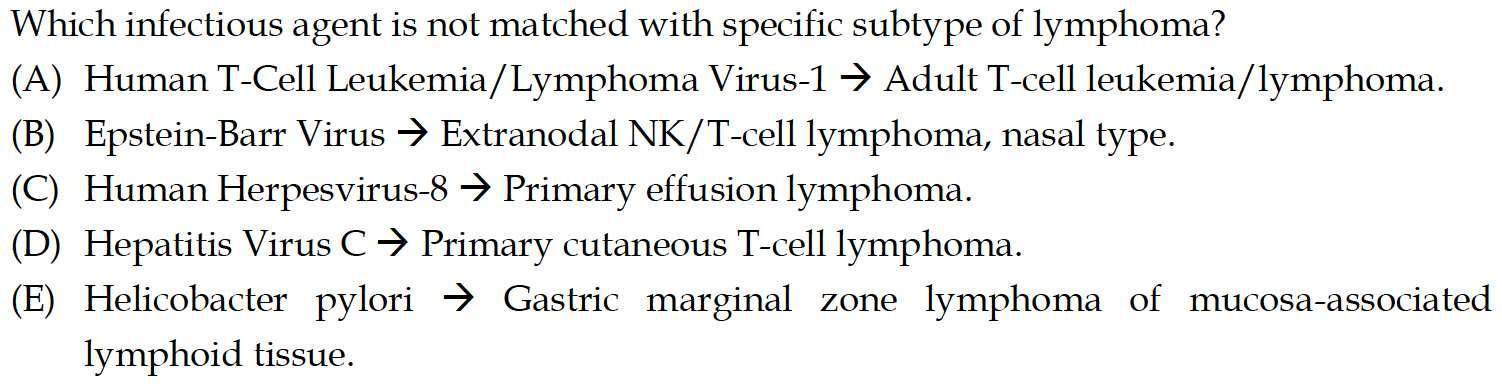
Q1. Which infectious agent is not matched with specific subtype of lymphoma?
- (A) Human T-Cell Leukemia/Lymphoma Virus-1 → Adult T-cell leukemia/lymphoma.
- (B) Epstein-Barr Virus → Extranodal NK/T-cell lymphoma, nasal type.
- (C) Human Herpesvirus-8 → Primary effusion lymphoma.
- (D) Hepatitis Virus C → Primary cutaneous T-cell lymphoma.
- (E) Helicobacter pylori → Gastric marginal zone lymphoma of mucosa-associated lymphoid tissue.
點此顯示正解
(D) Hepatitis Virus C → Primary cutaneous T-cell lymphoma.
詳解
Option (D) is the mismatched pair because hepatitis C virus (HCV) is not associated with primary cutaneous T-cell lymphoma. HCV is strongly linked to B-cell non-Hodgkin lymphomas, particularly splenic marginal zone lymphoma, diffuse large B-cell lymphoma, and lymphoplasmacytic lymphoma123. Primary cutaneous T-cell lymphomas (mycosis fungoides and Sézary syndrome) have no established association with HCV infection. The question deliberately pairs HCV with a T-cell lymphoma entity to create the mismatch.
Why the other options are correct pairings:
(A) HTLV-1 → Adult T-cell leukemia/lymphoma (ATLL): This is a classic, well-established association. HTLV-1 directly transforms T lymphocytes and causes ATLL, particularly in endemic regions such as Japan, the Caribbean, and parts of Africa8[^9]. HTLV-1 viral genes (Tax and HBZ) contribute to immune evasion and oncogenic signaling pathways leading to ATLL development8.
(B) EBV → Extranodal NK/T-cell lymphoma, nasal type: This association is nearly universal—extranodal NK/T-cell lymphoma is EBV-positive in approximately 92% of cases in HIV-negative patients7. EBV directly transforms lymphocytes through viral proteins such as LMP1 and BART microRNAs8[^9].
(C) HHV-8 → Primary effusion lymphoma (PEL): HHV-8 (also known as Kaposi sarcoma-associated herpesvirus) is the defining etiologic agent of primary effusion lymphoma, a rare B-cell lymphoma that typically occurs in immunosuppressed patients[9][10].
(E) H. pylori → Gastric MALT lymphoma: H. pylori causes chronic immune stimulation leading to most cases of gastric mucosa-associated lymphoid tissue (MALT) lymphoma[9][10][^11]. H. pylori eradication is first-line therapy for localized gastric MALT lymphoma, with regression observed in many cases.
詳解 · 中文翻譯
選項 (D) 是不匹配的配對因為丙肝病毒 (HCV) 不是與原發性皮膚 T 細胞淋巴瘤相關的。HCV 與 B 細胞非 Hodgkin 淋巴瘤密切相關,特別是脾邊緣區淋巴瘤、瀰漫性大 B 細胞淋巴瘤和淋巴漿細胞淋巴瘤123。原發性皮膚 T 細胞淋巴瘤(蕈樣肉芽腫和 Sézary 綜合症)與 HCV 感染沒有既定關聯。問題故意將 HCV 與 T 細胞淋巴瘤實體配對以造成不匹配。
為什麼其他選項是正確的配對:
(A) HTLV-1 → 成人 T 細胞白血病/淋巴瘤 (ATLL): 這是一個經典、眾所周知的關聯。HTLV-1 直接轉化 T 淋巴細胞並導致 ATLL,特別是在如日本、加勒比海和非洲部分等流行地區8[^9]。HTLV-1 病毒基因(Tax 和 HBZ)導致免疫逃避和致癌信號傳導途徑,導致 ATLL 發展8。
(B) EBV → 結外 NK/T 細胞淋巴瘤、鼻型: 此關聯幾乎是普遍的——結外 NK/T 細胞淋巴瘤在 HIV 陰性患者中約 92% 病例為 EBV 陽性7。EBV 通過病毒蛋白如 LMP1 和 BART microRNA 直接轉化淋巴細胞8[^9]。
(C) HHV-8 → 原發性積液淋巴瘤 (PEL): HHV-8(也稱為 Kaposi 肉瘤相關皰疹病毒)是原發性積液淋巴瘤的定義病因病原體,這是罕見 B 細胞淋巴瘤通常發生於免疫抑制患者中[9][10]。
(E) 幽門螺桿菌 → 胃 MALT 淋巴瘤: 幽門螺桿菌導致慢性免疫刺激導致大多數胃粘膜相關淋巴組織 (MALT) 淋巴瘤病例[9][10][^11]。幽門螺桿菌根除是侷部胃 MALT 淋巴瘤的一線療法,許多病例中觀察到退行。
參考文獻 (AMA)
-
Cacoub P, Saadoun D. Extrahepatic Manifestations of Chronic HCV Infection. The New England Journal of Medicine. 2021;384(11):1038-1052. doi:10.1056/NEJMra2033539. PMID:33730456. ↩↩
-
Couronné L, Bachy E, Roulland S, et al. From Hepatitis C Virus Infection to B-Cell Lymphoma. Annals of Oncology : Official Journal of the European Society for Medical Oncology. 2018;29(1):92-100. doi:10.1093/annonc/mdx635. PMID:29045541. ↩↩
-
Peveling-Oberhag J, Arcaini L, Hansmann ML, Zeuzem S. Hepatitis C-Associated B-Cell Non-Hodgkin Lymphomas. Epidemiology, Molecular Signature and Clinical Management. Journal of Hepatology. 2013;59(1):169-77. doi:10.1016/j.jhep.2013.03.018. PMID:23542089. ↩↩
-
Shichijo T, Yasunaga JI. Viral-Driven Oncogenesis in T/NK-cell Lymphomas: Parallels and Divergences Between HTLV-1 and EBV. International Journal of Hematology. 2026;123(4):476-486. doi:10.1007/s12185-025-04156-0. PMID:41498998. ↩
-
Engels EA. Infectious Agents as Causes of Non-Hodgkin Lymphoma. Cancer Epidemiology, Biomarkers & Prevention : A Publication of the American Association for Cancer Research, Cosponsored by the American Society of Preventive Oncology. 2007;16(3):401-4. doi:10.1158/1055-9965.EPI-06-1056. PMID:17337646. ↩
-
Hirabayashi M, Georges D, Combes JD, Clifford GM. Attributable Fraction of Epstein-Barr Virus in Subtypes of Lymphoma: A Systematic Review and Global Meta-Analysis. International Journal of Cancer. 2026;. doi:10.1002/ijc.70468. PMID:41947331. ↩
-
Hjalgrim H, Engels EA. Infectious Aetiology of Hodgkin and Non-Hodgkin Lymphomas: A Review of the Epidemiological Evidence. Journal of Internal Medicine. 2008;264(6):537-48. doi:10.1111/j.1365-2796.2008.02031.x. PMID:19017178. ↩↩
-
Armitage JO, Gascoyne RD, Lunning MA, Cavalli F. Non-Hodgkin Lymphoma. Lancet (London, England). 2017;390(10091):298-310. doi:10.1016/S0140-6736(16)32407-2. PMID:28153383. ↩↩↩↩↩↩
Slide annotations
Unknown
Figures