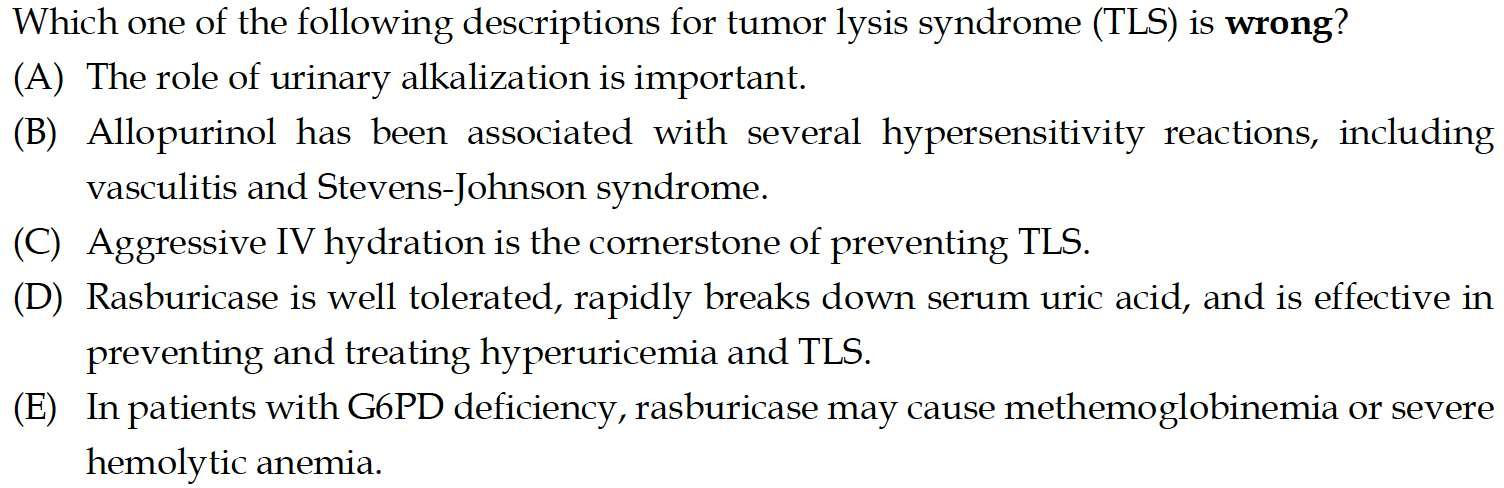
Q1. Which one of the following descriptions for tumor lysis syndrome (TLS) is wrong?
- (A) The role of urinary alkalization is important.
- (B) Allopurinol has been associated with several hypersensitivity reactions, including vasculitis and Stevens-Johnson syndrome.
- (C) Aggressive IV hydration is the cornerstone of preventing TLS.
- (D) Rasburicase is well tolerated, rapidly breaks down serum uric acid, and is effective in preventing and treating hyperuricemia and TLS.
- (E) In patients with G6PD deficiency, rasburicase may cause methemoglobinemia or severe hemolytic anemia.
點此顯示正解
(A) The role of urinary alkalization is important.
詳解
Analysis of TLS Board Question
1. Why (A) is WRONG: Urinary alkalinization is NOT important in modern TLS management
Urinary alkalinization is no longer recommended in TLS prevention or management1234[^5]. While alkalinization increases uric acid solubility (from ~15 mg/dL at pH 5.0 to ~200 mg/dL at pH 7.0), it decreases calcium phosphate solubility, promoting calcium phosphate crystal precipitation in renal tubules2[^5]. This exacerbates hyperphosphatemia and increases the risk of nephrocalcinosis, hypocalcemia with attendant risks of tetany, seizures, and arrhythmias2.
Additionally, alkalinization does not substantially increase xanthine and hypoxanthine solubility, potentially leading to xanthine crystal nephropathy when allopurinol is used1. Animal models demonstrated that increasing urine flow rate was the most effective strategy for preventing urate-induced obstructive uropathy, while increasing urinary pH >7.0 without increased urine output was ineffective1. Given these potential complications and lack of clear evidence of benefit, current guidelines state that alkalinization is not recommended14[^5]. The 2008 ASCO guidelines explicitly state "alkalinization is currently not recommended, because there is no unequivocal evidence of efficacy"4.
2. Why the other statements are CORRECT:
(B) Allopurinol hypersensitivity reactions - Allopurinol has been associated with several hypersensitivity reactions including vasculitis and Stevens-Johnson syndrome[^10]. This is why febuxostat is reserved for patients with allopurinol hypersensitivity[^10].
(C) Aggressive IV hydration as cornerstone - Aggressive intravenous hydration (normal saline) is the cornerstone of TLS prevention, maintaining adequate glomerular filtration rate and high urine flow rates to allow rapid clearance of uric acid, potassium, and phosphorus3[^8]. This is consistently emphasized across all guidelines14[^5].
(D) Rasburicase efficacy and tolerability - Rasburicase is well tolerated, rapidly breaks down serum uric acid to the more soluble allantoin, and is effective in preventing and treating hyperuricemia and TLS3[5][10]. It decreases uric acid levels more rapidly than xanthine oxidase inhibitors[^10]. Single doses of 1.5-7.5 mg abrogate hyperuricemia within 24-36 hours in most patients[^10].
(E) Rasburicase contraindication in G6PD deficiency - Rasburicase produces hydrogen peroxide as a by-product, which causes methemoglobinemia and severe hemolytic anemia in patients with G6PD deficiency3[5][6][^8]. Rasburicase is contraindicated in patients with known G6PD deficiency[6][9]. The associated complications are usually mild but can be severe after a single dose[^6]. Screening is recommended for high-risk patients (Mediterranean, African, or Southeast Asian ancestry) before administration[6][9].
詳解 · 中文翻譯
TLS 板考分析
1. 為什麼 (A) 是錯誤的:尿液鹼化在現代 TLS 管理中不重要
尿液鹼化在 TLS 預防或管理中不再被推薦1234[^5]。雖然鹼化增加尿酸溶解度(從 pH 5.0 時的 ~15 mg/dL 到 pH 7.0 時的 ~200 mg/dL),它降低磷酸鈣溶解度,促進磷酸鈣晶體在腎小管中沉澱2[^5]。這加劇了高磷血症,並增加了腎結石沉著症的風險,低鈣血症伴隨的風險包括肌肉強直、癲癇發作和心律不整2。
此外,鹼化不會實質上增加黃嘌呤和次黃嘌呤的溶解度,當使用別嘌呤醇時可能導致黃嘌呤晶體腎病1。動物模型證明增加尿流量是預防尿酸誘導的阻塞性尿路病的最有效策略,而增加尿 pH >7.0 而未增加尿量是無效的1。鑑於這些潛在並發症和缺乏明確的療效證據,目前指南指出鹼化是不推薦的14[^5]。2008 ASCO 指南明確指出「不推薦鹼化,因為沒有明確的療效證據」4。
2. 為什麼其他敘述是正確的:
(B) 別嘌呤醇過敏反應 - 別嘌呤醇已與包括血管炎和史蒂文斯-強森症候群在內的多種過敏反應相關[^10]。這就是為什麼 febuxostat 被保留用於別嘌呤醇過敏患者[^10]。
(C) 積極的靜脈補液作為基礎 - 積極的靜脈補液(生理食鹽水)是 TLS 預防的基礎,維持足夠的腎絲球濾過率和高尿流量,以允許尿酸、鉀和磷的快速清除3[8]。這在所有指南中都得到一致強調14[5]。
(D) Rasburicase 療效和耐受性 - Rasburicase 耐受性良好,迅速分解血清尿酸成更易溶的異丙酸,在預防和治療高尿酸血症和 TLS 方面有效3[5][10]。它比黃嘌呤氧化酶抑制劑更迅速地降低尿酸水平[^10]。在大多數患者中,1.5-7.5 mg 的單次劑量在 24-36 小時內廢除高尿酸血症[^10]。
(E) Rasburicase 在 G6PD 缺陷患者中的禁忌 - Rasburicase 產生過氧化氫作為副產品,在 G6PD 缺陷患者中引起甲血紅蛋白症和嚴重溶血性貧血3[5][6][^8]。Rasburicase 禁忌用於已知 G6PD 缺陷的患者[6][9]。相關並發症通常輕微,但在單次劑量後可能嚴重[6]。建議對高危患者(地中海、非洲或東南亞血統)進行篩查後再進行管理[6][^9]。
參考文獻 (AMA)
-
Coiffier B, Altman A, Pui CH, Younes A, Cairo MS. Guidelines for the Management of Pediatric and Adult Tumor Lysis Syndrome: An Evidence-Based Review. Journal of Clinical Oncology : Official Journal of the American Society of Clinical Oncology. 2008;26(16):2767-78. doi:10.1200/JCO.2007.15.0177. PMID:18509186. ↩↩↩↩↩↩↩↩↩↩
-
Bociek RG, Lunning M. Tumor Lysis Syndrome. The New England Journal of Medicine. 2025;393(11):1104-1116. doi:10.1056/NEJMra2300923. PMID:40961427. ↩↩↩↩↩↩
-
Rosner MH, Perazella MA. Acute Kidney Injury in Patients With Cancer. The New England Journal of Medicine. 2017;376(18):1770-1781. doi:10.1056/NEJMra1613984. PMID:28467867. ↩↩↩↩↩↩↩↩
-
Howard SC, Jones DP, Pui CH. The Tumor Lysis Syndrome. The New England Journal of Medicine. 2011;364(19):1844-54. doi:10.1056/NEJMra0904569. PMID:21561350. ↩↩↩↩↩↩↩↩
Slide annotations
Urinary alkalinization increases uric acid solubility but decreases calcium phosphate solubility. Because it is more difficult to correct hyperphosphatemia than hyperuricemia, urinary alkalinization should be avoided in patients with the tumor lysis syndrome, especially when rasburicase is available. NEnglJ Med. 2011 May 12; 364(19): 1844–1854.
Figures