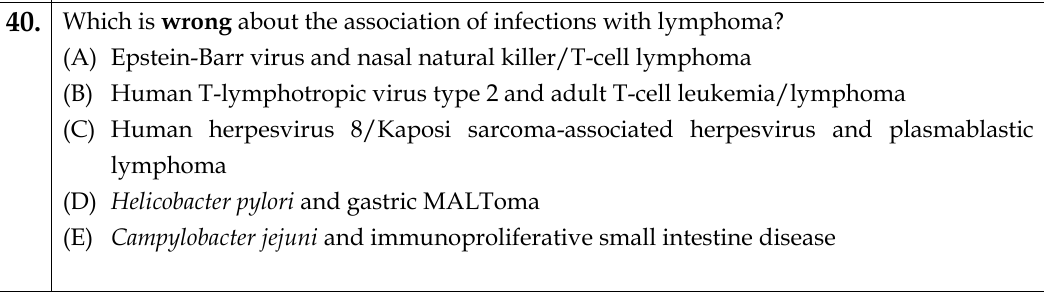
Q40. Which is wrong about the association of infections with lymphoma?
- (A) Epstein-Barr virus and nasal natural killer/T-cell lymphoma
- (B) Human T-lymphotropic virus type 2 and adult T-cell leukemia/lymphoma
- (C) Human herpesvirus 8/Kaposi sarcoma-associated herpesvirus and plasmablastic lymphoma
- (D) Helicobacter pylori and gastric MALToma
- (E) Campylobacter jejuni and immunoproliferative small intestine disease
點此顯示正解
(B) Human T-lymphotropic virus type 2 and adult T-cell leukemia/lymphoma
詳解
Why Option (B) is FALSE
Adult T-cell leukemia/lymphoma (ATLL) is caused by HTLV-1, not HTLV-2. HTLV-1 was identified as the etiologic agent of ATLL shortly after its discovery in the early 1980s, with a lifetime risk of developing ATLL estimated at 2-7% in infected individuals25. In contrast, HTLV-2 has not been definitively associated with any lymphoproliferative disease14. While HTLV-2 was initially isolated from a patient with hairy cell leukemia, subsequent epidemiological studies have failed to establish a convincing causal relationship between HTLV-2 and any specific malignancy14. The limited number of individuals harboring HTLV-2 in association with specific diseases has precluded convincing epidemiological demonstration of a definitive etiologic role in human disease4.
Why the Other Options are TRUE
(A) Epstein-Barr virus (EBV) and nasal natural killer/T-cell lymphoma is a well-established association. EBV is invariably associated with extranodal NK/T-cell lymphoma, nasal type, and the virus directly infects and transforms lymphocytes7[^10]. EBV is also linked to multiple other lymphomas including Burkitt lymphoma, classic Hodgkin lymphoma, and plasmablastic lymphoma8[^10].
(C) Human herpesvirus 8 (HHV-8)/Kaposi sarcoma-associated herpesvirus (KSHV) and plasmablastic lymphoma is a recognized association. HHV-8/KSHV is implicated in several lymphoproliferative disorders including primary effusion lymphoma, multicentric Castleman disease, KSHV-positive diffuse large B-cell lymphoma, and plasmablastic lymphoma[^10]. As a gammaherpesvirus, HHV-8 has oncogenic properties and can infect lymphocytes causing various plasmacytic/plasmablastic neoplasms[^10].
(D) Helicobacter pylori and gastric MALToma represents one of the best-established infection-lymphoma associations. H. pylori infection increases the risk of gastric mucosa-associated lymphoid tissue (MALT) extranodal marginal zone lymphoma approximately sixfold8. This was the first convincing evidence for a causal relationship between bacterial infection and lymphomagenesis[^9]. Chronic H. pylori gastritis leads to continuous antigenic stimulation that drives lymphoma development, and eradication of the infection can result in sustained lymphoma regression[^9].
(E) Campylobacter jejuni and immunoproliferative small intestine disease (IPSID) is an established association. C. jejuni has been linked to specific extranodal lymphoma sites, particularly IPSID (also known as Mediterranean lymphoma or alpha heavy chain disease)[^9]. Like other bacterial infection-driven lymphomas, the pathogenesis involves chronic antigenic stimulation from persistent infection[^9].
詳解 · 中文翻譯
為什麼選項 (B) 是假的
成人 T 細胞白血病/淋巴瘤 (ATLL) 由 HTLV-1 引起,而不是 HTLV-2。 HTLV-1 被識別為 ATLL 的病因病原體在其在早期 1980 年代發現後不久,在被感染個體中開發 ATLL 的終身風險估計為 2-7%25。相比之下,HTLV-2 沒有明確與任何淋巴增生性病相關14。雖然 HTLV-2 最初從患有毛細胞白血病的患者分離,後續流行病學研究未能建立 HTLV-2 與任何具體惡性腫瘤之間的令人信服的因果關係14。攜帶 HTLV-2 與具體病相關的個體數量有限,阻止了令人信服的流行病學證明在人類病中的明確病因作用4。
為什麼其他選項是真實的
(A) Epstein-Barr 病毒(EBV)和鼻結外自然殺傷/T 細胞淋巴瘤是眾所周知的關聯。EBV 不可避免地與結外 NK/T 細胞淋巴瘤、鼻型相關,病毒直接感染和轉化淋巴細胞7[^10]。EBV 也與多個其他淋巴瘤相關,包括 Burkitt 淋巴瘤、經典 Hodgkin 淋巴瘤和母細胞性淋巴瘤8[^10]。
(C) Human 皰疹病毒 8(HHV-8)/Kaposi 肉瘤相關皰疹病毒(KSHV)和母細胞性淋巴瘤是公認的關聯。HHV-8/KSHV 暗示在多個淋巴增生性疾病中,包括原發性積液淋巴瘤、多中心 Castleman 病、KSHV 陽性瀰漫性大 B 細胞淋巴瘤和母細胞性淋巴瘤[^10]。作為 gammaherpesvirus,HHV-8 有致癌性質並可感染淋巴細胞造成各種漿細胞/母細胞性腫瘤[^10]。
(D) 幽門螺桿菌和胃 MALToma 代表最眾所周知的感染-淋巴瘤關聯之一。幽門螺桿菌感染增加胃粘膜相關淋巴組織(MALT)結外邊緣區淋巴瘤的風險約六倍8。這是細菌感染和淋巴瘤發生之間因果關係的第一個令人信服的證據[9]。慢性幽門螺桿菌胃炎導致持續的抗原刺激驅動淋巴瘤發展,根除感染可導致持續的淋巴瘤退行[9]。
(E) 彎曲桿菌 jejuni 和免疫增殖性小腸病(IPSID)是既定的關聯。C. jejuni 已與具體結外淋巴瘤位點相關,特別是 IPSID(也稱為地中海淋巴瘤或 alpha 重鏈病)[9]。像其他細菌感染驅動的淋巴瘤,病發生涉及來自持續感染的慢性抗原刺激[9]。
參考文獻 (AMA)
-
Schierhout G, McGregor S, Gessain A, et al. Association Between HTLV-1 Infection and Adverse Health Outcomes: A Systematic Review and Meta-Analysis of Epidemiological Studies. The Lancet. Infectious Diseases. 2020;20(1):133-143. doi:10.1016/S1473-3099(19)30402-5. PMID:31648940. ↩↩↩↩
-
Ishitsuka K, Tamura K. Human T-Cell Leukaemia Virus Type I and Adult T-Cell Leukaemia-Lymphoma. The Lancet. Oncology. 2014;15(11):e517-26. doi:10.1016/S1470-2045(14)70202-5. PMID:25281470. ↩↩
-
Martinez MP, Al-Saleem J, Green PL. Comparative Virology of HTLV-1 and HTLV-2. Retrovirology. 2019;16(1):21. doi:10.1186/s12977-019-0483-0. PMID:31391116. ↩
-
Feuer G, Green PL. Comparative Biology of Human T-Cell Lymphotropic Virus Type 1 (HTLV-1) and HTLV-2. Oncogene. 2005;24(39):5996-6004. doi:10.1038/sj.onc.1208971. PMID:16155606. ↩↩↩↩↩↩
-
Hjalgrim H, Engels EA. Infectious Aetiology of Hodgkin and Non-Hodgkin Lymphomas: A Review of the Epidemiological Evidence. Journal of Internal Medicine. 2008;264(6):537-48. doi:10.1111/j.1365-2796.2008.02031.x. PMID:19017178. ↩↩
-
Wen KW, Wang L, Menke JR, Damania B. Cancers Associated With Human Gammaherpesviruses. The FEBS Journal. 2022;289(24):7631-7669. doi:10.1111/febs.16206. PMID:34536980. ↩
-
Roman E, Smith AG. Epidemiology of Lymphomas. Histopathology. 2011;58(1):4-14. doi:10.1111/j.1365-2559.2010.03696.x. PMID:21261679. ↩↩
-
Vannata B, Pirosa MC, Bertoni F, Rossi D, Zucca E. Bacterial Infection-Driven Lymphomagenesis. Current Opinion in Oncology. 2022;34(5):454-463. doi:10.1097/CCO.0000000000000886. PMID:35880463. ↩↩↩↩
Slide correction
HTLV-1
Figures