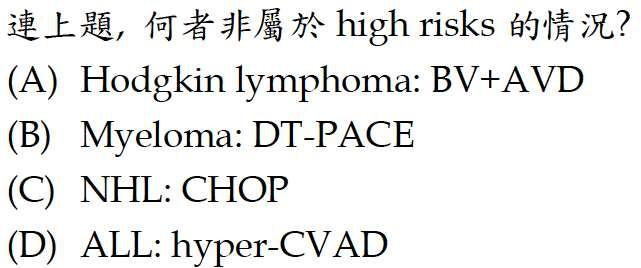
Q2. 連上題,何者非屬於 high risks 的情況?
- (A) Hodgkin lymphoma: BV+AVD
- (B) Myeloma: DT-PACE
- (C) NHL: CHOP
- (D) ALL: hyper-CVAD
點此顯示正解
(C) NHL: CHOP
詳解
CHOP (without rituximab) for NHL is classified as intermediate-risk (10-20% febrile neutropenia risk) in NCCN guidelines, not high-risk (>20%). R-CHOP-21 is borderline at approximately 16-20% FN risk without primary G-CSF prophylaxis, while dose-dense R-CHOP-14 approaches 20% despite higher G-CSF use1345. Modern NCCN Hematopoietic Growth Factors guidelines place standard CHOP/R-CHOP in the intermediate-risk category, reserving high-risk classification for intensified variants like CHOEP or R-DA-EPOCH.
Why the other options ARE high-risk (>20% FN) regimens:
(A) BV+AVD (Brentuximab vedotin + AVD) for Hodgkin lymphoma: This regimen carries high FN risk requiring mandatory primary G-CSF prophylaxis. In the pivotal ECHELON-1 trial, among patients who did not receive primary G-CSF prophylaxis, 21% developed febrile neutropenia (14% grade 3, 6% grade 4), with 96% experiencing neutropenia overall[7][8]. The trial protocol was amended mid-study to mandate primary G-CSF prophylaxis for all subsequent patients due to dose-limiting febrile neutropenia[8][10]. Among patients who received primary G-CSF prophylaxis from cycle 1, FN incidence decreased to 11%[7][10]. The FDA label explicitly recommends prophylactic G-CSF with BV+AVD based on these observed rates[^7].
(B) DT-PACE for myeloma: This is a high-intensity regimen (dexamethasone, thalidomide, cisplatin, doxorubicin, cyclophosphamide, etoposide) used for relapsed/refractory multiple myeloma. The regimen's dose-intensive nature and multi-agent cytotoxic backbone place it in the high-risk category for FN, typically requiring G-CSF support.
(D) Hyper-CVAD for ALL: This dose-intensive alternating regimen (hyperfractionated cyclophosphamide, vincristine, doxorubicin, dexamethasone alternating with high-dose methotrexate and cytarabine) for acute lymphoblastic leukemia carries very high FN risk due to profound myelosuppression. Primary G-CSF prophylaxis is standard practice with hyper-CVAD given the expected >20% FN risk and the need to maintain dose intensity for curative intent.
Summary: Standard CHOP/R-CHOP remains in the intermediate-risk category (10-20%), making it the correct answer for a regimen that is NOT high-risk. The other three options—BV+AVD, DT-PACE, and hyper-CVAD—all exceed the 20% FN threshold and require primary G-CSF prophylaxis per NCCN guidelines.
詳解 · 中文翻譯
CHOP(無 rituximab)用於 NHL 根據 NCCN 指南被分類為中等風險(10-20% 發熱性中性粒細胞減少症風險),而不是高風險(>20%)。 不含初級 G-CSF 預防的 R-CHOP-21 在約 16-20% FN 風險處於邊界線,而儘管 G-CSF 使用更高的劑量密集 R-CHOP-14 接近 20%1345。現代 NCCN 造血生長因子指南將標準 CHOP/R-CHOP 置於中等風險類別,保留高風險分類以進行強化變體如 CHOEP 或 R-DA-EPOCH。
為什麼其他選項是高風險(>20% FN)方案:
(A) BV+AVD(brentuximab vedotin + AVD)用於 Hodgkin 淋巴瘤: 此方案攜帶需要強制初級 G-CSF 預防的高 FN 風險。在關鍵的 ECHELON-1 試驗中,未接受初級 G-CSF 預防的患者中,21% 發展為發熱性中性粒細胞減少症(14% 3 級,6% 4 級),整體 96% 經歷中性粒細胞減少症[7][8]。試驗協議在研究中期被修正,對所有後續患者強制進行初級 G-CSF 預防,原因是劑量限制發熱性中性粒細胞減少症[8][10]。在從第 1 個週期接受初級 G-CSF 預防的患者中,FN 發生率降低至 11%[7][10]。FDA 標籤基於這些觀察到的速率明確推薦 BV+AVD 的預防性 G-CSF[^7]。
(B) DT-PACE 用於骨髓瘤: 這是一種高強度方案(地塞米松、沙利度胺、順鉑、阿黴素、環磷酰胺、依託泊苷)用於復發/難治多發性骨髓瘤。方案的劑量密集性質和多代理細胞毒性骨幹將其置於 FN 的高風險類別,通常需要 G-CSF 支持。
(D) Hyper-CVAD 用於 ALL: 此劑量密集交替方案(超分化環磷酰胺、長春新鹼、阿黴素、地塞米松交替高劑量甲氨蝶呤和阿糖胞苷)用於急性淋巴母細胞白血病攜帶非常高的 FN 風險因為深度骨髓抑制。初級 G-CSF 預防與 hyper-CVAD 一起是標準實踐,考慮到預期的 >20% FN 風險和維持劑量強度以用於治愈意圖的需要。
總結: 標準 CHOP/R-CHOP 仍保留在中等風險類別(10-20%),使其成為不是高風險方案的正確答案。其他三個選項——BV+AVD、DT-PACE 和 hyper-CVAD——都超過 20% FN 閾值,並需要根據 NCCN 指南初級 G-CSF 預防。
參考文獻 (AMA)
-
Zheng W, Chen Z, Zhu S, et al. Incidence and Risk Factors for Febrile Neutropenia of Patients With Diffuse Large B-Cell Lymphoma Receiving R-Chop-21 in China. Supportive Care in Cancer : Official Journal of the Multinational Association of Supportive Care in Cancer. 2023;32(1):43. doi:10.1007/s00520-023-08250-z. PMID:38200251. ↩↩
-
Morrison VA, Weller EA, Habermann TM, et al. Patterns of Growth Factor Usage and Febrile Neutropenia Among Older Patients With Diffuse Large B-Cell Non-Hodgkin Lymphoma Treated With CHOP or R-Chop: The Intergroup Experience (CALGB 9793; ECOG-SWOG 4494). Leukemia & Lymphoma. 2017;58(8):1814-1822. doi:10.1080/10428194.2016.1265111. PMID:27967294. ↩
-
Yokoyama M, Kusano Y, Takahashi A, et al. Incidence and Risk Factors of Febrile Neutropenia in Patients With Non-Hodgkin B-Cell Lymphoma Receiving R-Chop in a Single Center in Japan. Supportive Care in Cancer : Official Journal of the Multinational Association of Supportive Care in Cancer. 2017;25(11):3313-3320. doi:10.1007/s00520-017-3747-z. PMID:28551843. ↩↩
-
Pettengell R, Johnsen HE, Johnson HE, et al. Impact of Febrile Neutropenia on R-Chop Chemotherapy Delivery and Hospitalizations Among Patients With Diffuse Large B-Cell Lymphoma. Supportive Care in Cancer : Official Journal of the Multinational Association of Supportive Care in Cancer. 2012;20(3):647-52. doi:10.1007/s00520-011-1306-6. PMID:22101611. ↩↩
-
Food and Drug Administration. ADCETRIS. 2025. https://dailymed.nlm.nih.gov/dailymed/drugInfo.cfm?setid=3904f8dd-1aef-3490-e48f-bd55f32ed67f. ↩↩
-
Connors JM, Jurczak W, Straus DJ, et al. Brentuximab Vedotin With Chemotherapy for Stage III or IV Hodgkin's Lymphoma. The New England Journal of Medicine. 2018;378(4):331-344. doi:10.1056/NEJMoa1708984. PMID:29224502. ↩
Figures