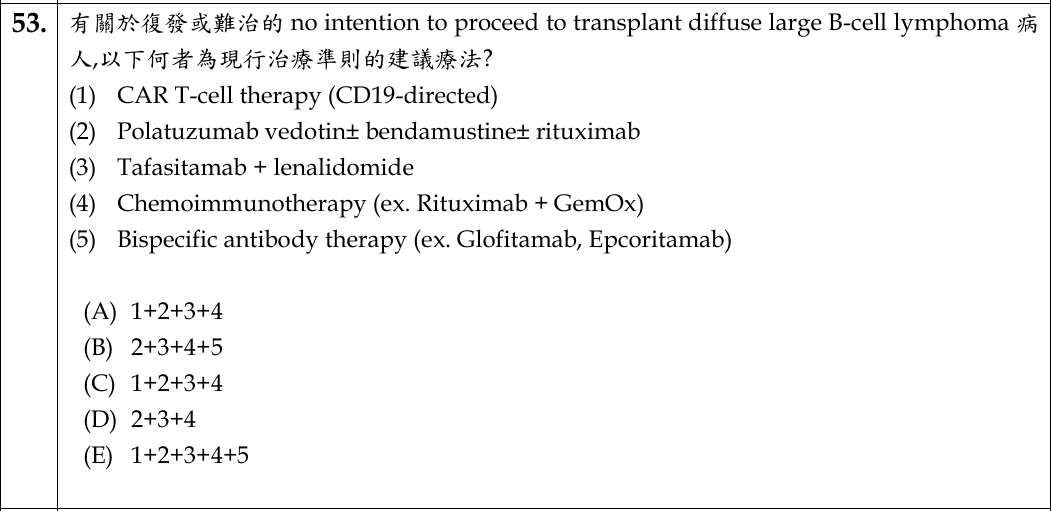
Q53. 有關於復發或難治的 no intention to proceed to transplant diffuse large B-cell lymphoma 病人,以下何者為現行治療準則的建議療法?
- (A) 1+2+3+4
- (B) 2+3+4+5
- (C) 1+2+3+4
- (D) 2+3+4
- (E) 1+2+3+4+5
點此顯示正解
(E) 1+2+3+4+5
詳解
Based on the NCCN guidelines (version 3.2026), option (E) "all of the above" is the INCORRECT statement because bispecific antibodies (glofitamab and epcoritamab) are NOT listed as recommended therapies for second-line treatment in transplant-ineligible patients with relapsed/refractory DLBCL when disease relapses >12 months after initial therapy3. The stem asks which therapies are recommended by current guidelines for R/R DLBCL patients with no intention to proceed to transplant, and option (E) incorrectly includes bispecific antibodies in this category.
Why (E) is the Incorrect Statement
The NCCN guidelines for second-line therapy in transplant-ineligible R/R DLBCL (relapsed >12 months) list the following as preferred regimens3: - CAR-T cell therapy (lisocabtagene maraleucel) - GEMOX + Epcoritamab or GEMOX + Glofitamab (combination with chemotherapy) - GEMOX + Polatuzumab vedotin + Rituximab - Lenalidomide + Tafasitamab - Polatuzumab vedotin ± Bendamustine ± Rituximab - Mosunetuzumab + Polatuzumab vedotin - Glofitamab + Polatuzumab vedotin
Critically, bispecific antibodies as monotherapy are NOT listed in the second-line transplant-ineligible recommendations. They appear only in combination with chemotherapy (GEMOX) or with polatuzumab vedotin3. As standalone monotherapy, epcoritamab and glofitamab are reserved for third-line and subsequent therapy2, where they are listed under "T-cell mediated therapy" alongside CAR-T products.
Therefore, if the question asks about "recommended therapies" for transplant-ineligible R/R DLBCL in general (without specifying line of therapy), bispecific antibodies as single agents would not be appropriate second-line options, making option (E) incorrect.
Why the Other Options Are Correct
Option (A): 1+2+3+4 (Pola-BR, Tafasitamab-lenalidomide, Loncastuximab, CAR-T)
All four therapies are guideline-recommended:
-
Polatuzumab vedotin + bendamustine + rituximab (Pola-BR): Listed as a preferred regimen for second-line therapy in transplant-ineligible patients3. The GO29365 trial demonstrated superior complete response rates (42.5% vs 17.5%) and reduced risk of death by 58% compared to bendamustine-rituximab alone1.
-
Tafasitamab + lenalidomide: Listed as a preferred regimen for second-line therapy in transplant-ineligible patients3. The L-MIND study showed an overall response rate of 57.5% with 40% complete responses in this population16.
-
Loncastuximab tesirine: Listed under "other recommended" regimens for third-line and subsequent therapy2. The LOTIS-2 study demonstrated efficacy in heavily pretreated R/R DLBCL patients[^16].
-
CAR-T cell therapy (axi-cel, liso-cel, tisa-cel): All three products are preferred for transplant-ineligible patients. Lisocabtagene maraleucel is specifically listed as preferred for second-line therapy in transplant-ineligible patients3, and all three are preferred options for third-line therapy2. The PILOT study demonstrated that liso-cel is effective in medically unfit/transplant-ineligible individuals7.
Options (B), (C), and (D) would also be correct if they excluded bispecific monotherapy, as all the other listed agents (Pola-BR, tafasitamab-lenalidomide, loncastuximab, and CAR-T) are guideline-recommended for transplant-ineligible R/R DLBCL patients.
Clinical Context
The distinction is important: while bispecific antibodies have demonstrated impressive activity in R/R DLBCL (glofitamab achieving 39% complete response rates, epcoritamab with similar efficacy)[15][17], they are FDA/EMA approved and guideline-recommended primarily for third-line and beyond as monotherapy[14][16], or in combination regimens for earlier lines3. For transplant-ineligible patients in second-line, the preferred approach includes CAR-T (if eligible), antibody-drug conjugates like polatuzumab, or tafasitamab-lenalidomide combinations38.
詳解 · 中文翻譯
根據 NCCN 指南(版本 3.2026),選項 (E)「以上所有」是不正確的陳述,因為在器官移植不適格患者的復發/難治性 DLBCL 中,雙特異性抗體(glofitamab 和 epcoritamab)未被列為初始治療後 >12 個月復發時的推薦二線治療3。題幹詢問對無意進行移植的 R/R DLBCL 患者現行指南推薦的治療方法,選項 (E) 錯誤地將雙特異性抗體包括在此類別中。
為何 (E) 是不正確的陳述
NCCN 移植不適格 R/R DLBCL(復發 >12 個月)二線治療指南將以下列為首選方案3: - CAR-T 細胞治療(lisocabtagene maraleucel) - GEMOX + Epcoritamab 或 GEMOX + Glofitamab(與化療組合) - GEMOX + Polatuzumab vedotin + Rituximab - Lenalidomide + Tafasitamab - Polatuzumab vedotin ± Bendamustine ± Rituximab - Mosunetuzumab + Polatuzumab vedotin - Glofitamab + Polatuzumab vedotin
關鍵是,雙特異性抗體作為單藥療法未列在二線移植不適格建議中。它們僅出現在與化療(GEMOX)組合或與 polatuzumab vedotin 組合3。作為單獨單藥療法,epcoritamab 和 glofitamab 被保留用於三線及後續治療2,在「T 細胞介導治療」項下與 CAR-T 產品一起列出。
因此,如果問題詢問移植不適格 R/R DLBCL「推薦治療方法」(不指定治療線),單個代理雙特異性抗體將不是適當的二線選項,使選項 (E) 不正確。
為何其他選項都正確
選項 (A):1+2+3+4(Pola-BR、Tafasitamab-lenalidomide、Loncastuximab、CAR-T)
四項治療都是指南推薦的:
-
Polatuzumab vedotin + bendamustine + rituximab (Pola-BR):列為移植不適格患者二線治療的首選方案3。GO29365 試驗與單獨 bendamustine-rituximab 相比,顯示更優的完全緩解率(42.5% 對 17.5%)且死亡風險降低 58%1。
-
Tafasitamab + lenalidomide:列為移植不適格患者二線治療的首選方案3。L-MIND 研究在該人群中顯示 57.5% 的整體緩解率和 40% 的完全緩解16。
-
Loncastuximab tesirine:在三線及後續治療「其他推薦」方案下列出2。LOTIS-2 研究在高度預治療的 R/R DLBCL 患者中顯示療效[^16]。
-
CAR-T 細胞治療(axi-cel、liso-cel、tisa-cel):所有三種產品對移植不適格患者都是首選。Lisocabtagene maraleucel 特別被列為移植不適格患者二線治療的首選3,所有三種都是三線治療的首選選項2。PILOT 研究顯示 liso-cel 對醫療上不適合/移植不適格個體有效7。
選項 (B)、(C) 和 (D) 如果排除雙特異性單藥療法,也將是正確的,因為所有其他列出的代理(Pola-BR、tafasitamab-lenalidomide、loncastuximab 和 CAR-T)對移植不適格 R/R DLBCL 患者被指南推薦。
臨床背景
這種區別很重要:雖然雙特異性抗體在 R/R DLBCL 中顯示了令人印象深刻的活性(glofitamab 達到 39% 完全緩解率,epcoritamab 具有類似療效)[15][17],它們主要被 FDA/EMA 批准和指南推薦用於三線及以上作為單藥療法[14][16],或在組合方案用於更早的線3。對於二線移植不適格患者,首選方法包括 CAR-T(如果適格)、抗體藥物偶聯物如 polatuzumab,或 tafasitamab-lenalidomide 組合38。
參考文獻 (AMA)
-
National Comprehensive Cancer Network. B-Cell Lymphomas. https://www.nccn.org/professionals/physician_gls/pdf/b-cell.pdf#page=79. ↩↩↩↩
-
Silkenstedt E, Salles G, Campo E, Dreyling M. B-Cell Non-Hodgkin Lymphomas. Lancet (London, England). 2024;403(10438):1791-1807. doi:10.1016/S0140-6736(23)02705-8. PMID:38614113. ↩↩↩↩↩↩
-
Kurte MS, Siefen AC, Jakobs F, et al. Cost-Effectiveness Analysis of Transplant-Ineligible Relapsed or Refractory Diffuse Large B-Cell Lymphoma Treatment Options-Experience of the Efficiency Frontier Approach. European Journal of Haematology. 2023;111(6):895-908. doi:10.1111/ejh.14095. PMID:37644352. ↩↩↩↩↩↩↩↩↩↩↩↩↩↩↩↩
-
Tarantini G, Miccolis RM, Arcuti E, et al. A New Era for Transplant-Ineligible R/R LBCL Patients: What's Changing?. Leukemia & Lymphoma. 2026;67(5):997-1004. doi:10.1080/10428194.2026.2636979. PMID:41774434. ↩
-
Dickinson MJ, Carlo-Stella C, Morschhauser F, et al. Glofitamab for Relapsed or Refractory Diffuse Large B-Cell Lymphoma. The New England Journal of Medicine. 2022;387(24):2220-2231. doi:10.1056/NEJMoa2206913. PMID:36507690. ↩
-
Minson AG, Dickinson MJ. New Bispecific Antibodies in Diffuse Large B-Cell Lymphoma. Haematologica. 2025;110(7):1483-1499. doi:10.3324/haematol.2024.285343. PMID:39911111. ↩↩
-
Schipani M, Bellia M, Sella C, et al. Bispecific Monoclonal Antibodies in Diffuse Large B-Cell Lymphoma: Dawn of a New Era in Targeted Therapy. Cancers. 2025;17(19):3258. doi:10.3390/cancers17193258. PMID:41097784. ↩↩
-
Sehn LH, Salles G. Diffuse Large B-Cell Lymphoma. The New England Journal of Medicine. 2021;384(9):842-858. doi:10.1056/NEJMra2027612. PMID:33657296. ↩↩
Figures