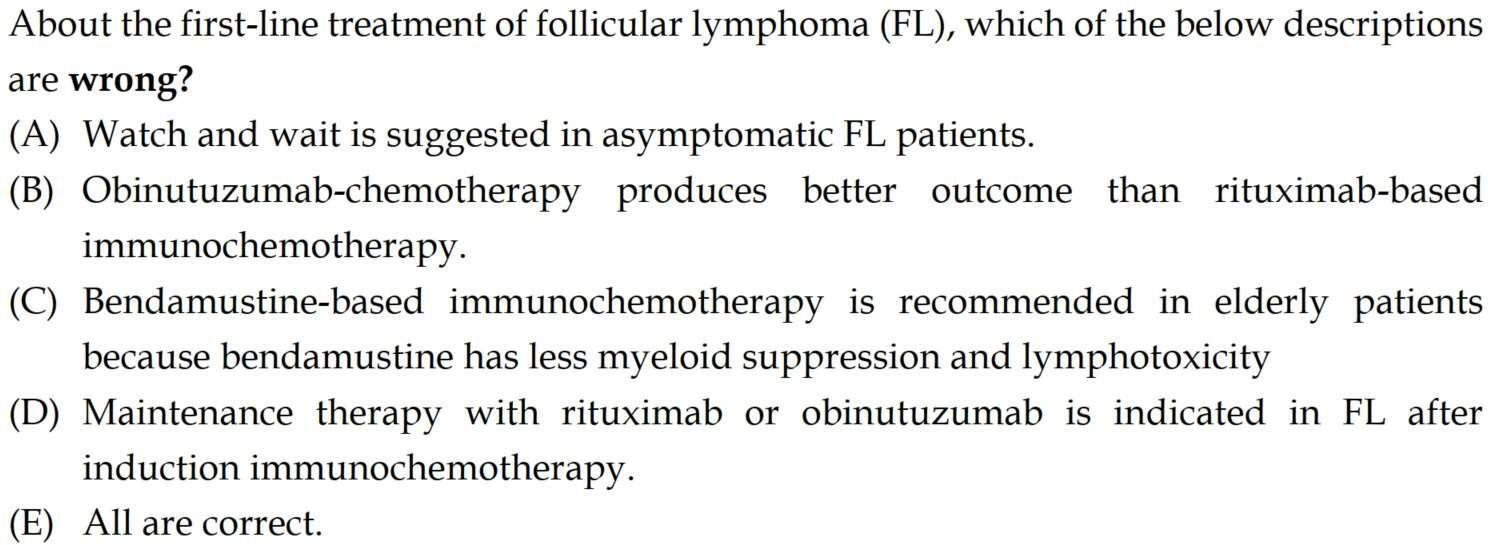
Q1. About the first-line treatment of follicular lymphoma (FL), which of the below descriptions are wrong?
- (A) Watch and wait is suggested in asymptomatic FL patients.
- (B) Obinutuzumab-chemotherapy produces better outcome than rituximab-based immunochemotherapy.
- (C) Bendamustine-based immunochemotherapy is recommended in elderly patients because bendamustine has less myeloid suppression and lymphotoxicity.
- (D) Maintenance therapy with rituximab or obinutuzumab is indicated in FL after induction immunochemotherapy.
- (E) All are correct.
點此顯示正解
(C) Bendamustine-based immunochemotherapy is recommended in elderly patients because bendamustine has less myeloid suppression and lymphotoxicity.
詳解
Analysis
The stem asks "which of the below descriptions are wrong" — so we are looking for the FALSE statement. The marked answer is (C).
1. Why (C) is the INCORRECT (false) statement
Bendamustine-based immunochemotherapy is NOT recommended in elderly patients because of less myeloid suppression and lymphotoxicity. In fact, bendamustine causes severe myelosuppression and is associated with significant lymphotoxicity[7][8][^9].
The FDA label for bendamustine explicitly states that it "caused severe myelosuppression (Grade 3 to 4) in 98% of patients" in NHL studies, with grade 3-4 neutropenia occurring in 60% of patients and grade 3-4 thrombocytopenia in 25%[7][8]. Lymphopenia is nearly universal (99% all grades, 94% grade 3-4)[^8]. The claim that bendamustine has "less myeloid suppression" is therefore factually incorrect.
Furthermore, bendamustine-obinutuzumab is specifically noted to have higher toxicity and should be used cautiously. One expert review states: "the combination of bendamustine and obinutuzumab is approved for previously untreated FL but the toxicity of this regimen should be weighed carefully...Generally, the combination of bendamustine and obinutuzumab should only be used in younger, fitter patients with bulky disease"5 — the exact opposite of the statement's claim about elderly patients.
2. Why the other options are TRUE statements
(A) Watch and wait is suggested in asymptomatic FL patients — TRUE
This is standard practice for low-burden, asymptomatic follicular lymphoma. Treatment initiation should only be based on the presence of B-symptoms, hematopoietic impairment, bulky disease, vital organ compression, ascites, pleural effusion, or rapid lymphoma progression2. In advanced cases with low tumor burden and no symptoms, observation or rituximab monotherapy are recommended options2.
(B) Obinutuzumab-chemotherapy produces better outcome than rituximab-based immunochemotherapy — TRUE
The landmark GALLIUM trial demonstrated that obinutuzumab-based immunochemotherapy resulted in significantly longer progression-free survival than rituximab-based therapy in first-line FL (3-year PFS 80.0% vs 73.3%; HR 0.66, 95% CI 0.51-0.85; P=0.001)4. A network meta-analysis confirmed that obinutuzumab maintenance had the highest effect size for PFS (HR 0.43, 95% CI 0.22-0.79)3.
(D) Maintenance therapy with rituximab or obinutuzumab is indicated in FL after induction immunochemotherapy — TRUE
Maintenance therapy with rituximab or obinutuzumab (every 2 months for 2 years) is recommended after induction immunochemotherapy, as it has been shown to improve progression-free survival after various induction regimens12. Both the GALLIUM trial (obinutuzumab maintenance)4 and multiple rituximab maintenance trials support this approach135.
(E) All are correct — FALSE (because C is incorrect)
詳解 · 中文翻譯
分析
題目要求「以下哪些敘述是錯誤的」— 所以我們尋找假的陳述。標記的答案是 (C)。
1. 為什麼 (C) 是不正確的(假的)敘述
苯達莫司汀為基礎的免疫化療不是因為具有較少骨髓抑制和淋巴毒性而在老年患者中推薦。事實上,苯達莫司汀造成嚴重骨髓抑制並與顯著淋巴毒性相關[7][8][^9]。
苯達莫司汀的 FDA 標籤明確指出其在 NHL 研究中「造成嚴重骨髓抑制(3-4 級)達 98% 患者」,其中 3-4 級中性粒細胞減少症發生於 60% 患者,3-4 級血小板減少症發生於 25%[7][8]。淋巴細胞減少症幾乎是通用的(所有級別 99%,3-4 級 94%)[^8]。因此,苯達莫司汀具有「較少骨髓抑制」的聲稱是事實上不正確的。
此外,苯達莫司汀-obinutuzumab 專門注明具有更高的毒性,應謹慎使用。一個專家評論指出:「苯達莫司汀和 obinutuzumab 的組合被批准用於先前未治療的 FL,但此方案的毒性應仔細權衡...一般來說,苯達莫司汀和 obinutuzumab 的組合應僅用於年輕、體質健康的患者具有腫塊病」5 — 與聲明對老年患者的主張完全相反。
2. 為什麼其他選項是真實陳述
(A) Watch and wait 建議在無症狀 FL 患者中 — 真實
這是低腫瘤負荷、無症狀濾泡淋巴瘤的標準實踐。只應基於存在 B 症狀、血液造血損害、腫塊病、重要器官壓迫、腹水、胸腔積液或淋巴瘤快速進展時開始治療2。在晚期病例,低腫瘤負荷且無症狀時,觀察或 rituximab 單藥治療是推薦的選項2。
(B) Obinutuzumab-化療比 rituximab 為基礎的免疫化療產生更好的結果 — 真實
標誌性的 GALLIUM 試驗證實,基於 obinutuzumab 的免疫化療導致 PFS 顯著更長相比 rituximab 為基礎的療法在一線 FL(3 年 PFS 80.0% vs 73.3%;HR 0.66,95% CI 0.51-0.85;P=0.001)4。網絡薈萃分析證實 obinutuzumab 維持療法對 PFS 具有最高的效應大小(HR 0.43,95% CI 0.22-0.79)3。
(D) Rituximab 或 obinutuzumab 的維持療法在歸納免疫化療後於 FL 中適應 — 真實
每 2 個月維持 rituximab 或 obinutuzumab(2 年)療法在歸納免疫化療後推薦,因為已顯示在各種歸納方案後改善無進展生存12。GALLIUM 試驗(obinutuzumab 維持)4和多個 rituximab 維持試驗都支持此方法135。
(E) 所有都是正確的 — 假的(因為 C 是不正確的)
參考文獻 (AMA)
-
Food and Drug Administration. Bendamustine Hydrochloride. 2025. https://dailymed.nlm.nih.gov/dailymed/drugInfo.cfm?setid=085dd54c-4212-d879-afef-ee52732a48c0. ↩↩↩↩
-
Peñalver FJ, Delgado J, Loscertales J, et al. Recommendations on the Clinical Use of Bendamustine in Lymphoproliferative Syndromes and Multiple Myeloma. European Journal of Haematology. 2016;96(5):532-40. doi:10.1111/ejh.12633. PMID:26179864. ↩↩↩↩↩↩
-
Jacobsen E. Follicular Lymphoma: 2023 Update on Diagnosis and Management. American Journal of Hematology. 2022;97(12):1638-1651. doi:10.1002/ajh.26737. PMID:36255040. ↩↩↩↩
-
Silkenstedt E, Salles G, Campo E, Dreyling M. B-Cell Non-Hodgkin Lymphomas. Lancet (London, England). 2024;403(10438):1791-1807. doi:10.1016/S0140-6736(23)02705-8. PMID:38614113. ↩↩↩↩
-
Marcus R, Davies A, Ando K, et al. Obinutuzumab for the First-Line Treatment of Follicular Lymphoma. The New England Journal of Medicine. 2017;377(14):1331-1344. doi:10.1056/NEJMoa1614598. PMID:28976863. ↩↩↩↩
-
Chu Y, Liu Y, Yu Z, et al. Maintenance and Consolidation Strategies for Patients With Untreated Advanced Follicular Lymphoma: A Systematic Review and Network Meta-Analysis of Randomized Trials. Cancer. 2024;130(7):1072-1082. doi:10.1002/cncr.35137. PMID:38041532. ↩
Figures