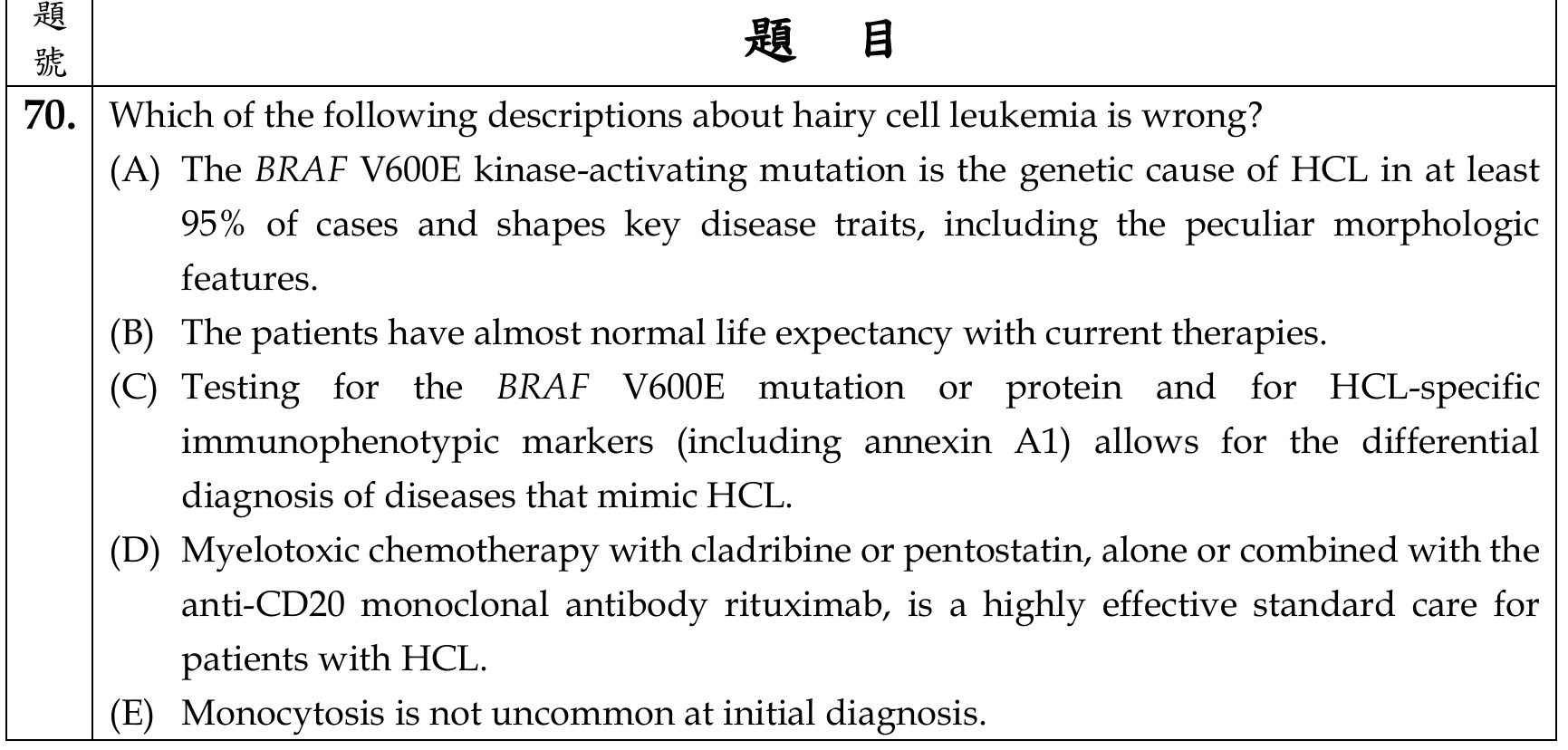
Q70. Which of the following descriptions about hairy cell leukemia is wrong?
- (A) The BRAF V600E kinase-activating mutation is the genetic cause of HCL in at least 95% of cases and shapes key disease traits, including the peculiar morphologic features.
- (B) The patients have almost normal life expectancy with current therapies.
- (C) Testing for the BRAF V600E mutation or protein and for HCL-specific immunophenotypic markers (including annexin A1) allows for the differential diagnosis of diseases that mimic HCL.
- (D) Myelotoxic chemotherapy with cladribine or pentostatin, alone or combined with the anti-CD20 monoclonal antibody rituximab, is a highly effective standard care for patients with HCL.
- (E) Monocytosis is not uncommon at initial diagnosis.
點此顯示正解
(E) Monocytosis is not uncommon at initial diagnosis.
詳解
Why option (E) is the FALSE statement: Monocytopenia, not monocytosis, is a pathognomonic feature of hairy cell leukemia at diagnosis. Monocytopenia occurs in active HCL and is so characteristic that it serves as a diagnostic clue, though automated hematology analyzers may erroneously report monocytes1. The consistent absence of monocytes distinguishes HCL from other lymphoproliferative disorders and reflects the unique biology of this disease2.
Why the other options are CORRECT:
(A) BRAF V600E mutation: The BRAF V600E kinase-activating mutation is present in at least 95% of HCL cases and is the genetic driver of the disease[7][9]. This mutation constitutively activates the RAF-MEK-ERK signaling pathway, which shapes the disease's key biologic features including the hairy morphology, specific gene expression signature, and antiapoptotic behavior[9][10]. The mutation is somatically and clonally present through the entire disease spectrum and clinical course[^9].
(B) Almost normal life expectancy: With current therapies, particularly purine analogues (cladribine and pentostatin), patients with HCL have a life expectancy almost identical to the normal population2. This represents one of the major therapeutic success stories in hematologic malignancies.
(C) Diagnostic utility of BRAF V600E and annexin A1: Testing for BRAF V600E mutation or protein, combined with HCL-specific immunophenotypic markers including annexin A1, allows accurate differential diagnosis between HCL and its mimics[7][10]. This is clinically essential because HCL variant and splenic marginal-zone lymphoma lack BRAF V600E, have worse prognoses, and do not respond well to purine analogues[9][10]. Sensitive molecular assays for BRAF V600E enable better distinction of HCL from HCL-like disorders that require different treatment approaches[^10].
(D) Standard treatment with purine analogues ± rituximab: Cladribine or pentostatin, alone or combined with rituximab, represents highly effective standard care for HCL[^7]. These myelotoxic chemotherapy regimens produce excellent response rates, and the addition of rituximab may improve depth and duration of response13.
詳解 · 中文翻譯
為什麼選項 (E) 是虛假敘述:單核細胞減少症,而不是單核細胞增多症,是診斷時毛細胞白血病的病理特徵。單核細胞減少症發生在活躍的 HCL 中,其特徵性如此,以至於它作為診斷線索,儘管自動血液學分析儀可能錯誤地報告單核細胞1。單核細胞的一致缺失區分了 HCL 與其他淋巴增殖性疾病,反映了此疾病的獨特生物學2。
為什麼其他選項是正確的:
(A) BRAF V600E 突變:BRAF V600E 激酶激活突變存在於至少 95% 的 HCL 病例中,是該疾病的遺傳驅動者[7][9]。此突變組成型激活 RAF-MEK-ERK 信號通路,塑造疾病的關鍵生物特徵,包括毛髮狀形態、特定基因表達簽名和抗凋亡行為[9][10]。突變是體細胞和克隆性地存在於整個疾病譜和臨床過程中[^9]。
(B) 幾乎正常的預期壽命:有了目前的治療,特別是嘌呤類似物(cladribine 和 pentostatin),HCL 患者的預期壽命幾乎與正常人群相同2。這代表血液惡性腫瘤中主要治療成功故事之一。
(C) BRAF V600E 和 annexin A1 的診斷效用:BRAF V600E 突變或蛋白的檢測,結合 HCL 特異性免疫表型標誌物(包括 annexin A1),允許在 HCL 及其模仿物間進行準確鑑別診斷[7][10]。這在臨床上至關重要,因為 HCL 變體和脾邊緣帶淋巴瘤缺乏 BRAF V600E、預後更差,對嘌呤類似物反應不佳[9][10]。BRAF V600E 的敏感分子檢測使 HCL 與需要不同治療方法的 HCL 型疾病的更好區分成為可能[^10]。
(D) 使用嘌呤類似物 ± 利妥昔單抗的標準治療:Cladribine 或 pentostatin,單獨或與利妥昔單抗結合,代表 HCL 的高度有效的標準護理[^7]。這些骨髓毒性化療方案產生優異的反應率,利妥昔單抗的添加可能改善反應的深度和持續時間13。
參考文獻 (AMA)
-
Falini B, Tiacci E. Hairy-Cell Leukemia. The New England Journal of Medicine. 2024;391(14):1328-1341. doi:10.1056/NEJMra2406376. PMID:39383460. ↩↩↩↩
-
Troussard X, Maître E, Paillassa J. Hairy Cell Leukemia 2024: Update on Diagnosis, Risk-Stratification, and Treatment-Annual Updates in Hematological Malignancies. American Journal of Hematology. 2024;99(4):679-696. doi:10.1002/ajh.27240. PMID:38440808. ↩↩↩↩
-
Tiacci E, Pettirossi V, Schiavoni G, Falini B. Genomics of Hairy Cell Leukemia. Journal of Clinical Oncology : Official Journal of the American Society of Clinical Oncology. 2017;35(9):1002-1010. doi:10.1200/JCO.2016.71.1556. PMID:28297625. ↩↩
-
Falini B, Martelli MP, Tiacci E. BRAF V600E Mutation in Hairy Cell Leukemia: From Bench to Bedside. Blood. 2016;128(15):1918-1927. doi:10.1182/blood-2016-07-418434. PMID:27554081. ↩
-
Troussard X, Maître E, Cornet E. Hairy Cell Leukemia 2022: Update on Diagnosis, Risk-Stratification, and Treatment. American Journal of Hematology. 2022;97(2):226-236. doi:10.1002/ajh.26390. PMID:34710243. ↩
Slide annotations
Usually pancytopenia
Figures