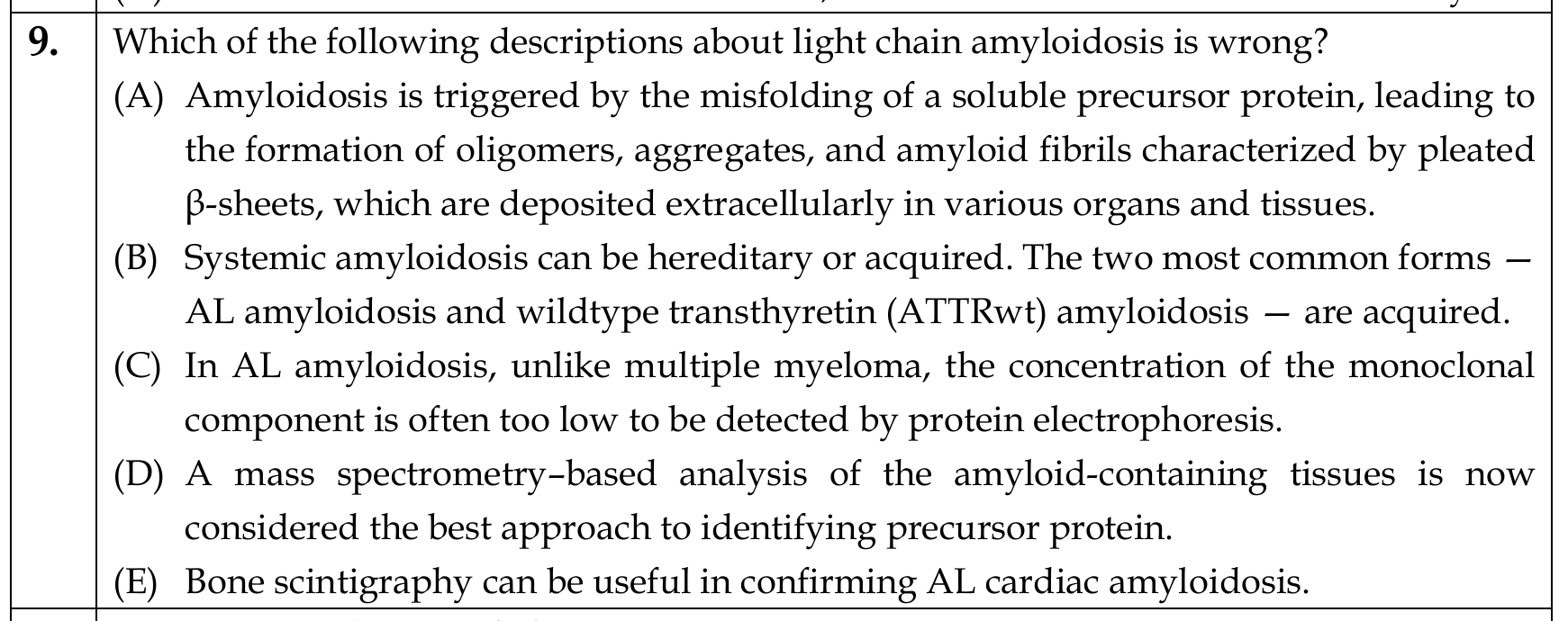
Q9. Which of the following descriptions about light chain amyloidosis is wrong?
- (A) Amyloidosis is triggered by the misfolding of a soluble precursor protein, leading to the formation of oligomers, aggregates, and amyloid fibrils characterized by pleated β-sheets, which are deposited extracellularly in various organs and tissues.
- (B) Systemic amyloidosis can be hereditary or acquired. The two most common forms — AL amyloidosis and wildtype transthyretin (ATTRwt) amyloidosis — are acquired.
- (C) In AL amyloidosis, unlike multiple myeloma, the concentration of the monoclonal component is often too low to be detected by protein electrophoresis.
- (D) A mass spectrometry-based analysis of the amyloid-containing tissues is now considered the best approach to identifying precursor protein.
- (E) Bone scintigraphy can be useful in confirming AL cardiac amyloidosis.
點此顯示正解
(E) Bone scintigraphy can be useful in confirming AL cardiac amyloidosis.
詳解
Analysis of Board Question: Why (E) is WRONG and (A)-(D) are CORRECT
Statement (E) is the FALSE statement. Bone scintigraphy with technetium-99m bone-seeking tracers (99mTc-PYP, 99mTc-DPD, 99mTc-HMDP) is not useful for confirming AL cardiac amyloidosis. In fact, the opposite is true: bone scintigraphy is the test of choice for ATTR cardiac amyloidosis, not AL amyloidosis.
Why (E) is wrong:
AL cardiac amyloidosis typically shows minimal or no cardiac tracer uptake (grade 0-1) on bone scintigraphy, whereas ATTR cardiac amyloidosis characteristically demonstrates grade 2-3 uptake124. The mechanism relates to differential binding to microcalcifications, which are more abundant in ATTR than AL fibrils5. In a large international multicenter study of 1,217 patients, grade ≥2 myocardial radiotracer uptake in the absence of a monoclonal protein had very high specificity for ATTR-CM1. Importantly, 99mTc-PYP scans may occasionally be positive even in AL amyloidosis, which is why bone scintigraphy alone cannot distinguish ATTR from AL—concomitant testing for light chains is mandatory3. A grade 0 scan occurs in most patients with AL cardiac amyloidosis and essentially excludes ATTR-CM2.
The diagnostic algorithm for cardiac amyloidosis requires excluding AL amyloidosis first through serum and urine immunofixation and serum free light chains before using bone scintigraphy to diagnose ATTR non-invasively348. Thus, bone scintigraphy is used to confirm ATTR, not AL cardiac amyloidosis.

Why the other statements are CORRECT:
(A) is correct: Amyloidosis results from misfolding of soluble precursor proteins into oligomers, aggregates, and amyloid fibrils with characteristic β-pleated sheet structure, which deposit extracellularly in organs and tissues8. This fundamental pathophysiology applies to all forms of amyloidosis.
(B) is correct: Systemic amyloidosis can be hereditary (e.g., hereditary ATTR or ATTRv) or acquired. The two most common forms are indeed both acquired: AL amyloidosis (from clonal plasma cell disorder) and wild-type ATTR (ATTRwt) amyloidosis10. ATTRwt is an age-related acquired condition distinct from hereditary ATTR variants.
(C) is correct: Unlike multiple myeloma, where large amounts of monoclonal protein typically produce abnormal bands on serum/urine protein electrophoresis (SPEP/UPEP), AL amyloidosis often has very low levels of circulating paraprotein. SPEP/UPEP are normal in approximately 50% of AL amyloidosis patients[^11]. This is why immunofixation electrophoresis (IFE) of serum and urine plus serum free light chain (sFLC) assay are required—together these tests have >99% sensitivity for AL amyloidosis37910. The statement accurately captures this critical diagnostic distinction.
(D) is correct: Mass spectrometry-based analysis (specifically laser-capture tandem mass spectrometry, LC-MS/MS) of amyloid-containing tissue is now considered the gold standard for identifying the amyloid precursor protein7810. This technique is superior to immunohistochemistry, which has known limitations8. LC-MS/MS is particularly important when there is coexistence of monoclonal gammopathy with suspected ATTR amyloidosis, as Congo red staining alone cannot distinguish amyloid types7.

詳解 · 中文翻譯
血液委員會試題分析:為何 (E) 錯誤及 (A)-(D) 正確
敘述 (E) 是虛假敘述。 使用鎝-99m 尋求骨的示蹤劑的骨閃爍攝影(99mTc-PYP、99mTc-DPD、99mTc-HMDP)不用於確認 AL 心臟澱粉樣變。實際上相反是真:骨閃爍攝影是 ATTR 心臟澱粉樣變的首選檢驗,不是 AL 澱粉樣變。
為何 (E) 錯誤:
AL 心臟澱粉樣變典型在骨閃爍攝影上顯示 最少或無心臟示蹤劑攝取(級別 0-1),而 ATTR 心臟澱粉樣變特徵性展現 級別 2-3 攝取124。機制與微鈣化所不同結合相關,微鈣化在 ATTR 纖維中比 AL 纖維更豐富5。在 1,217 名患者的大型國際多中心研究中,無單克隆蛋白在心肌放射性示蹤劑攝取 ≥ 級別 2 對 ATTR-CM 有極高特異性1。重要地,99mTc-PYP 掃描偶爾可能在 AL 澱粉樣變中陽性,這是為何骨閃爍攝影單獨無法區分 ATTR 從 AL—須強制進行伴隨輕鏈檢驗3。級別 0 掃描發生在多數 AL 心臟澱粉樣變患者且本質上排除 ATTR-CM2。
心臟澱粉樣變的診斷算法需要 先排除 AL 澱粉樣變通過血清和尿液免疫固定電泳及血清遊離輕鏈,然後使用骨閃爍攝影非侵襲性診斷 ATTR348。因此,骨閃爍攝影用於確認 ATTR,不是 AL 心臟澱粉樣變。
為何其他敘述正確:
(A) 正確:澱粉樣變源於可溶性前體蛋白的錯誤折疊進入寡聚體、聚集體及澱粉樣纖維,具特徵β-摺疊單層結構,其在器官和組織中細胞外沉積8。此基礎病理生理學適用於所有澱粉樣變形式。
(B) 正確:全身性澱粉樣變可為遺傳性(例如遺傳性 ATTR 或 ATTRv)或獲得性。兩種最常見形式確實皆為獲得性:AL 澱粉樣變(源於隆骨髓細胞病症)及野生型 ATTR(ATTRwt)澱粉樣變10。ATTRwt 是年齡相關獲得性狀態,區別於遺傳性 ATTR 變異。
(C) 正確:不同於多發性骨髓瘤,其中大量單克隆蛋白通常在血清/尿液蛋白電泳(SPEP/UPEP)上產生異常帶,AL 澱粉樣變常具非常低的迴圈副蛋白水準。SPEP/UPEP 在約 50% AL 澱粉樣變患者中正常[^11]。這是為何免疫固定電泳(IFE)血清和尿液加上血清遊離輕鏈(sFLC)檢驗須進行—合併這些檢驗對 AL 澱粉樣變有超過 99% 敏感性37910。敘述精確地捕捉此關鍵診斷區別。
(D) 正確:質量分析法基礎分析(特別是激光捕獲串聯質量分析法,LC-MS/MS)含澱粉樣組織現被認為是識別澱粉樣前體蛋白的 金標準7810。此技術優於免疫組織化學,其具已知局限8。LC-MS/MS 特別重要當存在單克隆球蛋白病與疑似 ATTR 澱粉樣變共存時,因剛果紅著色單獨無法區分澱粉樣類型7。
參考文獻 (AMA)
-
Hanna M, Ruberg FL, Maurer MS, et al. Cardiac Scintigraphy With Technetium-99m-Labeled Bone-Seeking Tracers for Suspected Amyloidosis: JACC Review Topic of the Week. Journal of the American College of Cardiology. 2020;75(22):2851-2862. doi:10.1016/j.jacc.2020.04.022. PMID:32498813. ↩↩↩↩
-
Rauf MU, Hawkins PN, Cappelli F, et al. Tc-99m Labelled Bone Scintigraphy in Suspected Cardiac Amyloidosis. European Heart Journal. 2023;44(24):2187-2198. doi:10.1093/eurheartj/ehad139. PMID:36946431. ↩↩↩↩
-
Ruberg FL, Grogan M, Hanna M, Kelly JW, Maurer MS. Transthyretin Amyloid Cardiomyopathy: JACC State-of-the-Art Review. Journal of the American College of Cardiology. 2019;73(22):2872-2891. doi:10.1016/j.jacc.2019.04.003. PMID:31171094. ↩↩↩↩↩↩
-
Heidenreich PA, Bozkurt B, Aguilar D, et al. 2022 AHA/ACC/HFSA Guideline for the Management of Heart Failure: A Report of the American College of Cardiology/American Heart Association Joint Committee on Clinical Practice Guidelines. Journal of the American College of Cardiology. 2022;79(17):e263-e421. doi:10.1016/j.jacc.2021.12.012. PMID:35379503. ↩↩↩↩
-
Dorbala S, Ando Y, Bokhari S, et al. ASNC/AHA/ASE/EANM/HFSA/ISA/SCMR/SNMMI Expert Consensus Recommendations for Multimodality Imaging in Cardiac Amyloidosis: Part 1 of 2-Evidence Base and Standardized Methods of Imaging. Circulation. Cardiovascular Imaging. 2021;14(7):e000029. doi:10.1161/HCI.0000000000000029. PMID:34196223. ↩↩
-
Ruberg FL, Maurer MS. Cardiac Amyloidosis Due to Transthyretin Protein: A Review. Jama. 2024;331(9):778-791. doi:10.1001/jama.2024.0442. PMID:38441582. ↩
-
Falk RH, Alexander KM, Liao R, Dorbala S. AL (Light-Chain) Cardiac Amyloidosis: A Review of Diagnosis and Therapy. Journal of the American College of Cardiology. 2016;68(12):1323-41. doi:10.1016/j.jacc.2016.06.053. PMID:27634125. ↩↩↩↩↩↩
-
Kittleson MM, Ruberg FL, Ambardekar AV, et al. 2023 ACC Expert Consensus Decision Pathway on Comprehensive Multidisciplinary Care for the Patient With Cardiac Amyloidosis: A Report of the American College of Cardiology Solution Set Oversight Committee. Journal of the American College of Cardiology. 2023;81(11):1076-1126. doi:10.1016/j.jacc.2022.11.022. PMID:36697326. ↩↩↩↩↩↩↩↩
-
Sanchorawala V. Systemic Light Chain Amyloidosis. The New England Journal of Medicine. 2024;390(24):2295-2307. doi:10.1056/NEJMra2304088. PMID:38924733. ↩↩
-
Gertz MA. Immunoglobulin Light Chain Amyloidosis: 2024 Update on Diagnosis, Prognosis, and Treatment. American Journal of Hematology. 2024;99(2):309-324. doi:10.1002/ajh.27177. PMID:38095141. ↩↩↩↩↩↩
Figures