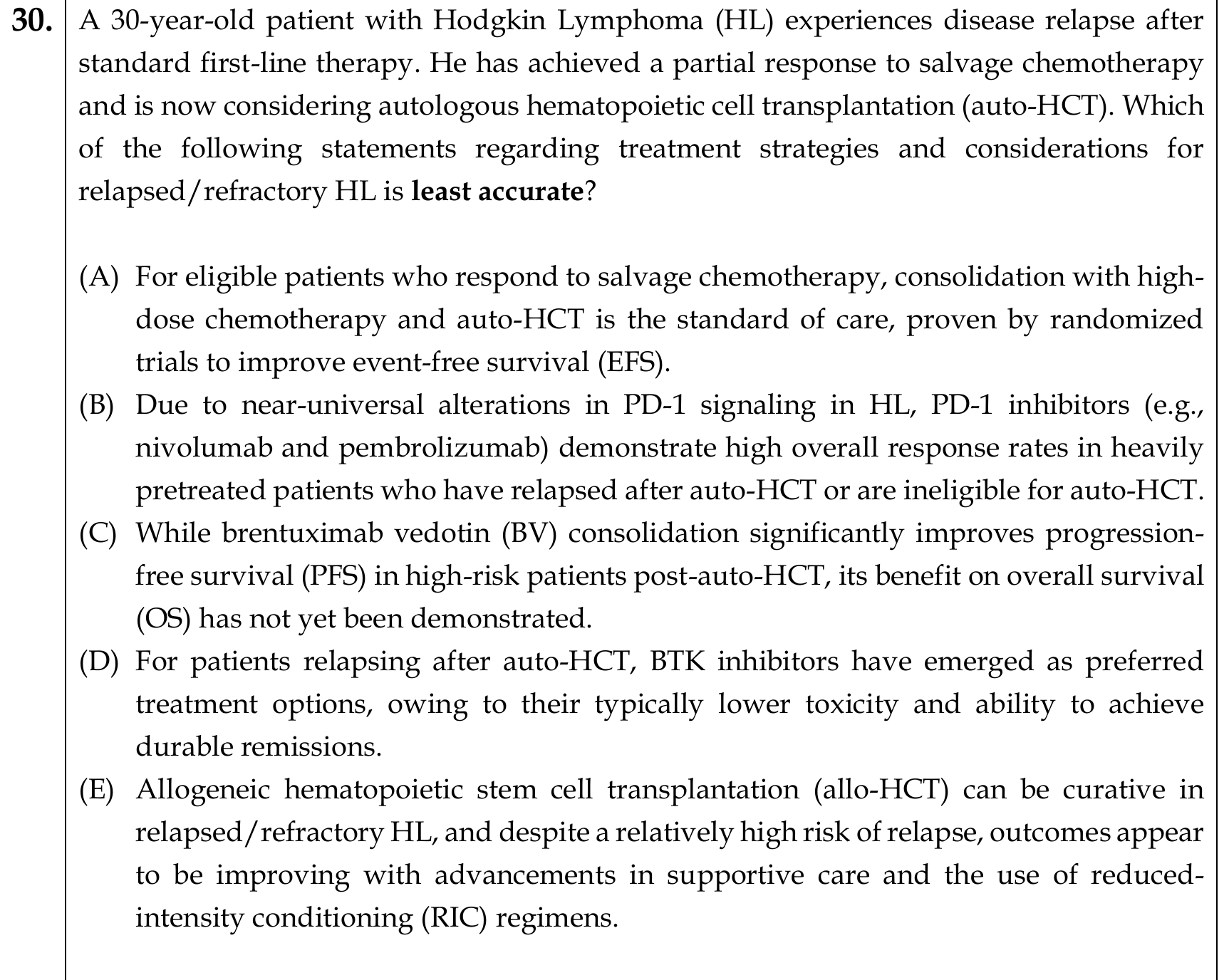
Q30. A 30-year-old patient with Hodgkin Lymphoma (HL) experiences disease relapse after standard first-line therapy. He has achieved a partial response to salvage chemotherapy and is now considering autologous hematopoietic cell transplantation (auto-HCT). Which of the following statements regarding treatment strategies and considerations for relapsed/refractory HL is least accurate?
- (A) For eligible patients who respond to salvage chemotherapy, consolidation with high-dose chemotherapy and auto-HCT is the standard of care, proven by randomized trials to improve event-free survival (EFS).
- (B) Due to near-universal alterations in PD-1 signaling in HL, PD-1 inhibitors (e.g., nivolumab and pembrolizumab) demonstrate high overall response rates in heavily pretreated patients who have relapsed after auto-HCT or are ineligible for auto-HCT.
- (C) While brentuximab vedotin (BV) consolidation significantly improves progression-free survival (PFS) in high-risk patients post-auto-HCT, its benefit on overall survival (OS) has not yet been demonstrated.
- (D) For patients relapsing after auto-HCT, BTK inhibitors have emerged as preferred treatment options, owing to their typically lower toxicity and ability to achieve durable remissions.
- (E) Allogeneic hematopoietic stem cell transplantation (allo-HCT) can be curative in relapsed/refractory HL, and despite a relatively high risk of relapse, outcomes appear to be improving with advancements in supportive care and the use of reduced-intensity conditioning (RIC) regimens.
點此顯示正解
(D) For patients relapsing after auto-HCT, BTK inhibitors have emerged as preferred treatment options, owing to their typically lower toxicity and ability to achieve durable remissions.
詳解
The question stem asks for the least accurate statement, meaning we are looking for the FALSE statement.
Why (D) is the Least Accurate (FALSE) Statement
BTK inhibitors have no established role in Hodgkin lymphoma and are not treatment options for relapsed/refractory HL after auto-HCT124. BTK inhibitors (such as ibrutinib, acalabrutinib) are used in B-cell malignancies like chronic lymphocytic leukemia, mantle cell lymphoma, and Waldenström macroglobulinemia, but not in Hodgkin lymphoma. The statement is completely inaccurate.
For patients relapsing after auto-HCT, the actual preferred treatment options include PD-1 inhibitors (pembrolizumab, nivolumab) and brentuximab vedotin124. Recent randomized data show pembrolizumab demonstrates superior progression-free survival compared to brentuximab vedotin, supporting PD-1 blockade as the preferred first treatment option for patients who relapse post-autologous transplant1[^11].
Why the Other Options Are TRUE
(A) TRUE: High-dose chemotherapy with auto-HCT is the standard of care for relapsed/refractory HL patients who respond to salvage chemotherapy, with randomized trials demonstrating improved event-free survival35. Auto-HCT can cure approximately 50% of relapsed/refractory patients in the second line3.
(B) TRUE: PD-1 inhibitors (nivolumab and pembrolizumab) demonstrate very high overall response rates in heavily pretreated HL patients who have relapsed after auto-HCT or are ineligible for transplant12[^11]. This is due to near-universal alterations in PD-1 signaling pathways in classical Hodgkin lymphoma, with response rates of 65-75% and complete response rates of 20-25%12[^11].
(C) TRUE: The AETHERA trial demonstrated that brentuximab vedotin consolidation significantly improves progression-free survival in high-risk patients post-auto-HCT (43% reduction in risk of progression or death)7[10][12]. However, overall survival benefit has not been demonstrated7[^12].
(E) TRUE: Allogeneic HCT can be curative in relapsed/refractory HL, and outcomes have improved with reduced-intensity conditioning regimens and better supportive care245. While relapse risk remains relatively high, allo-HCT represents a potentially curative option for patients who fail auto-HCT, particularly when bridged with novel agents like PD-1 inhibitors or brentuximab vedotin25.
詳解 · 中文翻譯
題幹要求最不準確的敘述,意味著我們尋找虛假的敘述。
為什麼 (D) 是最不準確的(虛假的)敘述
BTK 抑制劑在何杰金淋巴瘤中沒有確立的作用,不是自體 HCT 後復發/難治性 HL 的治療選項124。BTK 抑制劑(如 ibrutinib、acalabrutinib)用於 B 細胞惡性腫瘤如慢性淋巴細胞白血病、套細胞淋巴瘤和 Waldenström 巨球蛋白血症,但不用於何杰金淋巴瘤。該敘述完全不準確。
對於自體 HCT 後復發的患者,實際的首選治療選項包括 PD-1 抑制劑(pembrolizumab、nivolumab)和 brentuximab vedotin124。最近的隨機數據顯示 pembrolizumab 相比 brentuximab vedotin 表現出優越的無進展生存期,支持 PD-1 阻滯作為對接受自體移植後復發患者的首選治療選項1[^11]。
為什麼其他選項是正確的
(A) 正確:高劑量化療加自體 HCT 是對反應於搶救化療的復發/難治性 HL 患者的標準護理,隨機試驗證明改善無事件生存期35。自體 HCT 可以治癒約 50% 的二線復發/難治性患者3。
(B) 正確:PD-1 抑制劑(nivolumab 和 pembrolizumab)在已接受多次治療且自體 HCT 後復發或不符合移植資格的 HL 患者中表現出非常高的整體反應率12[^11]。這是因為經典何杰金淋巴瘤中 PD-1 信號通路的幾乎普遍改變,反應率為 65-75%,完全反應率為 20-25%12[^11]。
(C) 正確:AETHERA 試驗證明 brentuximab vedotin 鞏固治療在自體 HCT 後高危患者中明顯改善無進展生存期(進展或死亡風險減少 43%)7[10][12]。然而,整體生存益處尚未被證明7[^12]。
(E) 正確:異體 HCT 可以治癒復發/難治性 HL,並且隨著減強度調理方案和更好的支持護理,結果已改善245。雖然復發風險仍相對較高,異體 HCT 代表對失敗自體 HCT 的患者的潛在治癒選項,特別是當用 PD-1 抑制劑或 brentuximab vedotin 等新型藥物橋接時25。
參考文獻 (AMA)
-
Ansell SM. Hodgkin Lymphoma: 2025 Update on Diagnosis, Risk-Stratification, and Management. American Journal of Hematology. 2024;99(12):2367-2378. doi:10.1002/ajh.27470. PMID:39239794. ↩↩↩↩↩↩↩↩↩↩
-
Domingo-Domènech E, Sureda A. Treatment of Hodgkin Lymphoma Relapsed After Autologous Stem Cell Transplantation. Journal of Clinical Medicine. 2020;9(5):E1384. doi:10.3390/jcm9051384. PMID:32397141. ↩↩↩↩↩↩↩↩↩↩↩↩
-
Alinari L, Blum KA. How I Treat Relapsed Classical Hodgkin Lymphoma After Autologous Stem Cell Transplant. Blood. 2016;127(3):287-95. doi:10.1182/blood-2015-10-671826. PMID:26576863. ↩↩↩↩
-
Varma G, Diefenbach C. The Role of Autologous Stem-Cell Transplantation in Classical Hodgkin Lymphoma in the Modern Era. Seminars in Hematology. 2024;61(4):253-262. doi:10.1053/j.seminhematol.2024.06.003. PMID:39039012. ↩↩↩↩↩↩
-
Shah GL, Moskowitz CH. Transplant Strategies in Relapsed/Refractory Hodgkin Lymphoma. Blood. 2018;131(15):1689-1697. doi:10.1182/blood-2017-09-772673. PMID:29500170. ↩↩↩↩↩↩
-
Brice P, de Kerviler E, Friedberg JW. Classical Hodgkin Lymphoma. Lancet (London, England). 2021;398(10310):1518-1527. doi:10.1016/S0140-6736(20)32207-8. PMID:33493434. ↩
-
Scott LJ. Brentuximab Vedotin: A Review in CD30-Positive Hodgkin Lymphoma. Drugs. 2017;77(4):435-445. doi:10.1007/s40265-017-0705-5. PMID:28190142. ↩↩↩↩
-
Kanate AS, Kumar A, Dreger P, et al. Maintenance Therapies for Hodgkin and Non-Hodgkin Lymphomas After Autologous Transplantation: A Consensus Project of ASBMT, CIBMTR, and the Lymphoma Working Party of EBMT. JAMA Oncology. 2019;5(5):715-722. doi:10.1001/jamaoncol.2018.6278. PMID:30816957. ↩
Figures