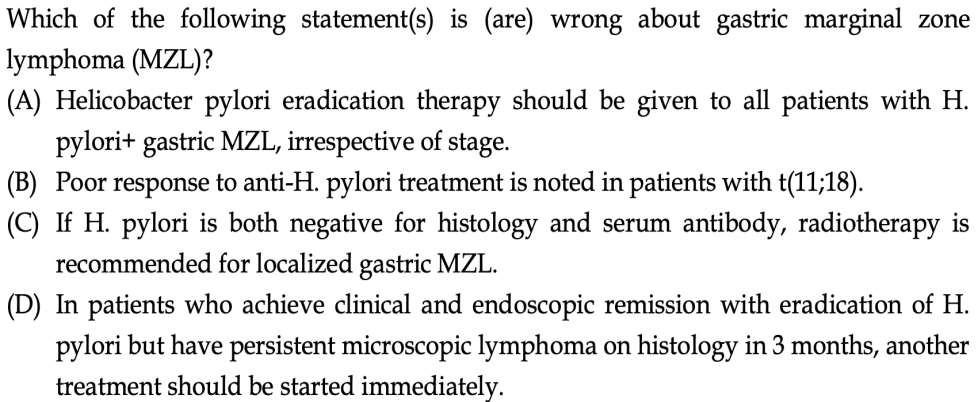
Q1. Which of the following statement(s) is (are) wrong about gastric marginal zone lymphoma (MZL)?
- (A) Helicobacter pylori eradication therapy should be given to all patients with H. pylori+ gastric MZL, irrespective of stage.
- (B) Poor response to anti-H. pylori treatment is noted in patients with t(11;18).
- (C) If H. pylori is both negative for histology and serum antibody, radiotherapy is recommended for localized gastric MZL.
- (D) In patients who achieve clinical and endoscopic remission with eradication of H. pylori but have persistent microscopic lymphoma on histology in 3 months, another treatment should be started immediately.
點此顯示正解
(D) In patients who achieve clinical and endoscopic remission with eradication of H. pylori but have persistent microscopic lymphoma on histology in 3 months, another treatment should be started immediately.
詳解
1. Why (D) is the WRONG statement
Option (D) is incorrect because immediate additional treatment is NOT indicated for patients who achieve clinical and endoscopic remission after H. pylori eradication but have persistent microscopic lymphoma at 3 months. The correct management is continued observation with a "watch and wait" strategy.
Clinical rationale: Persistent minimal histologic residuals after successful H. pylori eradication are common and do not represent treatment failure. The lymphoma regression process is slow and progressive, often requiring 12 months or more of surveillance before defining refractory disease1[^8]. A landmark international series demonstrated that 94% of patients with minimal histologic residuals after H. pylori eradication had a favorable disease course without oncological treatment—32% eventually achieved complete histologic remission, and 62% had stable residual disease that remained indolent5. Only 5% experienced local progression over a mean follow-up of 42 months5.
Guideline-based timing: Most guidelines recommend at least 12 months of endoscopic surveillance before switching to another treatment1[^8]. It is common for patients to achieve macroscopic (endoscopic) improvement but have persistent histologic disease, and many will eventually achieve complete histologic response at later timepoints1. The 3-month timeframe mentioned in option (D) is far too early to declare treatment failure or initiate additional therapy.
2. Why the other options are CORRECT
(A) H. pylori eradication should be given to all H. pylori+ gastric MZL patients, irrespective of stage — CORRECT
H. pylori should be eradicated in all patients with gastric MZL and H. pylori infection, irrespective of stage46[^10]. Even in advanced-stage disease, H. pylori eradication is the initial treatment and results in lymphoma regression in approximately 75% of cases1[^8]. This principle is supported by NCCN guidelines and multiple expert reviews46[^9].
(B) Poor response to anti-H. pylori treatment is noted in patients with t(11;18) — CORRECT
Gastric MALT lymphomas harboring the t(11;18)(q21;q21) translocation are resistant to antibiotic treatment, with response rates <5%[^9]. These tumors have a significantly lower progression-free survival (26% at 10 years) compared to those without this translocation (57%)6. The t(11;18) translocation occurs in approximately 25% of gastric MZL cases and predicts both resistance to H. pylori eradication and higher relapse risk126[^8]. NCCN guidelines specifically recommend considering upfront radiotherapy in addition to antibiotics for t(11;18)-positive cases[^9].
(C) If H. pylori is negative by both histology and serum antibody, radiotherapy is recommended for localized gastric MZL — CORRECT
For H. pylori-negative gastric MZL (confirmed by both histology and serology), involved-site radiotherapy (ISRT) is the recommended treatment for localized disease4[7][9]. NCCN guidelines explicitly state that if H. pylori is negative by both histology and serum antibodies, ISRT is recommended[^9]. Radiotherapy (typically 24 Gy) provides excellent disease control with complete remission in almost all patients and relapses in only 5-10%4[^7]. While empiric H. pylori eradication therapy may occasionally be tried in minimally symptomatic patients, only ~15% respond, making radiotherapy the standard of care1[^8].
詳解 · 中文翻譯
1. 為什麼 (D) 是錯誤的敘述
(D) 選項不正確,因為對於在幽門螺桿菌根除後達到臨床及內視鏡緩解但在 3 個月時有持續顯微淋巴瘤的患者,不指示立即進行額外治療。正確的管理是持續觀察採用「觀察等待」策略。
臨床基礎: 成功幽門螺桿菌根除後的持續最小組織學殘留很常見,不代表治療失敗。淋巴瘤消退過程是緩慢且漸進的,通常需要12 個月或更長時間的監測才能確定難治疾病1[^8]。一項地標性國際系列研究證明 94% 的幽門螺桿菌根除後有最小組織學殘留的患者有良好疾病過程,無需腫瘤治療 — 32% 最終達成完全組織學緩解,62% 有穩定殘留疾病保持惰性5。只有 5% 在平均 42 個月隨訪期間經歷局部進展5。
基於指南的時間: 大多數指南建議至少進行 12 個月的內視鏡監測才能轉向其他治療1[^8]。患者達成宏觀(內視鏡)改善但有持續組織學疾病很常見,許多人最終在後來的時間點達成完全組織學反應1。(D) 選項所述的 3 個月時間框架對於宣布治療失敗或開始額外治療而言太早了。
2. 為什麼其他選項都正確
(A) H. pylori 根除應給予所有 H. pylori+ 胃邊緣區淋巴瘤患者,無論分期 — 正確
應在所有患有胃邊緣區淋巴瘤和幽門螺桿菌感染的患者中根除幽門螺桿菌,無論分期46[^10]。即使在晚期疾病中,幽門螺桿菌根除是初始治療且在約 75% 的病例中導致淋巴瘤消退1[^8]。此原則由 NCCN 指南和多個專家評論支持46[^9]。
(B) 在 t(11;18) 患者中觀察到對抗幽門螺桿菌治療的反應不佳 — 正確
具有 t(11;18)(q21;q21) 易位的胃 MALT 淋巴瘤對抗生素治療耐受,反應率 <5%[^9]。這些腫瘤的無進展生存期明顯更低(10 年時 26%)與沒有此易位的相比(57%)6。t(11;18) 易位發生在約 25% 的胃邊緣區淋巴瘤病例中,預示幽門螺桿菌根除耐受和更高復發風險126[^8]。NCCN 指南特別建議對 t(11;18) 陽性病例考慮結合抗生素的直接放射治療[^9]。
(C) 如果幽門螺桿菌在組織學和血清抗體上都為陰性,推薦對局限性胃邊緣區淋巴瘤進行放射治療 — 正確
對於幽門螺桿菌陰性胃邊緣區淋巴瘤(由組織學和血清學確認),受累部位放射治療(ISRT)是推薦的局限性疾病治療4[7][9]。NCCN 指南明確指出如果幽門螺桿菌在組織學和血清抗體上都為陰性,建議 ISRT[^9]。放射治療(通常 24 Gy)提供優越的疾病控制,幾乎所有患者的完全緩解及僅 5-10% 的復發4[^7]。儘管在症狀最少的患者中可能偶爾嘗試經驗性幽門螺桿菌根除治療,只有約 15% 反應,使得放射治療成為標準護理1[^8]。
參考文獻 (AMA)
-
Cheah CY, Seymour JF. Marginal Zone Lymphoma: 2023 Update on Diagnosis and Management. American Journal of Hematology. 2023;98(10):1645-1657. doi:10.1002/ajh.27058. PMID:37605344. ↩↩↩↩↩↩↩↩↩↩↩↩
-
Fischbach W, Goebeler ME, Ruskone-Fourmestraux A, et al. Most Patients With Minimal Histological Residuals of Gastric MALT Lymphoma After Successful Eradication of Helicobacter Pylori Can Be Managed Safely by a Watch and Wait Strategy: Experience From a Large International Series. Gut. 2007;56(12):1685-7. doi:10.1136/gut.2006.096420. PMID:17639089. ↩↩
-
Rossi D, Bertoni F, Zucca E. Marginal-Zone Lymphomas. The New England Journal of Medicine. 2022;386(6):568-581. doi:10.1056/NEJMra2102568. PMID:35139275. ↩
-
Silkenstedt E, Salles G, Campo E, Dreyling M. B-Cell Non-Hodgkin Lymphomas. Lancet (London, England). 2024;403(10438):1791-1807. doi:10.1016/S0140-6736(23)02705-8. PMID:38614113. ↩↩↩↩↩↩↩↩
-
National Comprehensive Cancer Network. B-Cell Lymphomas. https://www.nccn.org/professionals/physician_gls/pdf/b-cell.pdf#page=30. ↩↩↩↩
-
Armitage JO, Gascoyne RD, Lunning MA, Cavalli F. Non-Hodgkin Lymphoma. Lancet (London, England). 2017;390(10091):298-310. doi:10.1016/S0140-6736(16)32407-2. PMID:28153383. ↩↩↩↩↩↩↩↩
Figures