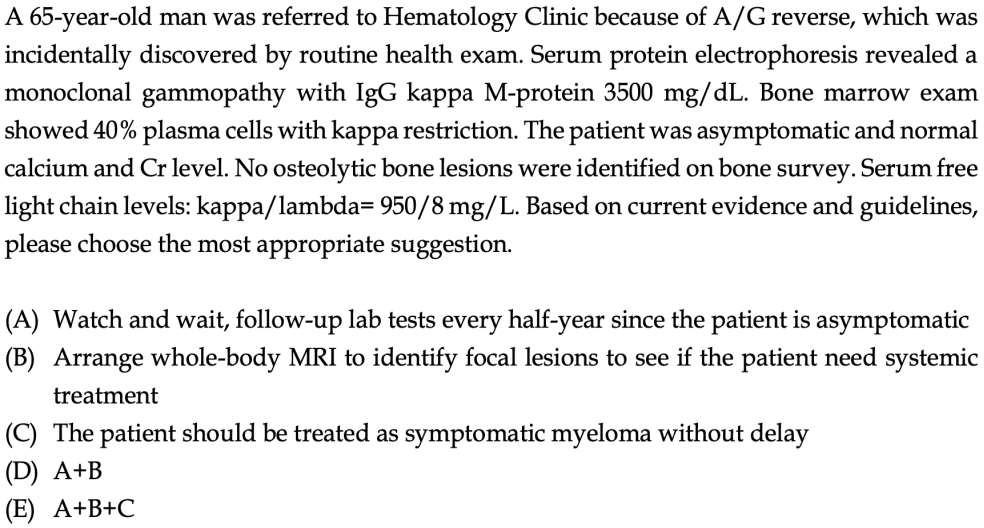
Q1. A 65-year-old man was referred to Hematology Clinic because of A/G reverse, which was incidentally discovered by routine health exam. Serum protein electrophoresis revealed a monoclonal gammopathy with IgG kappa M-protein 3500 mg/dL. Bone marrow exam showed 40% plasma cells with kappa restriction. The patient was asymptomatic and normal calcium and Cr level. No osteolytic bone lesions were identified on bone survey. Serum free light chain levels: kappa/lambda = 950/8 mg/L. Based on current evidence and guidelines, please choose the most appropriate suggestion.
- (A) Watch and wait, follow-up lab tests every half-year since the patient is asymptomatic
- (B) Arrange whole-body MRI to identify focal lesions to see if the patient need systemic treatment
- (C) The patient should be treated as symptomatic myeloma without delay
- (D) A+B
- (E) A+B+C
點此顯示正解
(C) The patient should be treated as symptomatic myeloma without delay
詳解
Answer (C) is correct because this patient meets the IMWG 2014 criteria for active multiple myeloma based on a myeloma-defining biomarker (SLiM-MDE), specifically an involved/uninvolved serum free light chain (FLC) ratio ≥100 with involved FLC ≥100 mg/L, which mandates treatment regardless of the absence of symptoms or CRAB features.6[^13]

Why Answer (C) is Correct: FLC Ratio ≥100 is a Myeloma-Defining Event
The IMWG updated diagnostic criteria in 2014 to include three biomarkers of malignancy as myeloma-defining events (MDEs), in addition to traditional CRAB criteria (hypercalcemia, renal insufficiency, anemia, bone lesions). These biomarkers allow diagnosis of active multiple myeloma requiring treatment before end-organ damage develops61:
- Clonal bone marrow plasma cells ≥60%
- Involved/uninvolved serum FLC ratio ≥100 (with involved FLC ≥100 mg/L)
-
1 focal lesion on MRI (≥5 mm)
This patient's laboratory values demonstrate: - FLC ratio = 950/8 = 118.75 (≥100) ✓ - Involved kappa FLC = 950 mg/L (≥100 mg/L) ✓ - Bone marrow plasma cells = 40% (≥10% required for MM diagnosis) ✓
The FLC ratio ≥100 criterion was established based on data from Larsen and colleagues showing that patients with smoldering myeloma and an FLC ratio ≥100 had a 72% risk of progression to multiple myeloma within 2 years and a 79% risk of progression to MM or AL amyloidosis—approaching the 80% threshold used to define myeloma-defining biomarkers.6[^13] Importantly, 27% of patients with FLC ratio ≥100 presented with acute renal failure as their myeloma-defining event, underscoring the need for early treatment.[^17]
The 2014 IMWG criteria represent a paradigm shift allowing early diagnosis and initiation of therapy before irreversible end-organ damage occurs.45[^10] Once a myeloma-defining event is present, the patient has active (symptomatic) multiple myeloma by definition and requires treatment without delay.6[^11]
Why the Other Answers are Incorrect
Answer (A) - Watch and wait is WRONG: This patient does not have smoldering myeloma. Despite being clinically asymptomatic, the presence of an FLC ratio ≥100 with involved FLC ≥100 mg/L reclassifies this patient from smoldering to active multiple myeloma.6[^11] Watch-and-wait is only appropriate for smoldering myeloma (absence of myeloma-defining events) or MGUS. This patient meets criteria for active disease requiring immediate treatment.1[^16]
Answer (B) - MRI is unnecessary because diagnosis is already established: While whole-body MRI can identify focal lesions (another potential myeloma-defining event), it is not needed in this case because the diagnosis of active multiple myeloma is already confirmed by the FLC ratio ≥100 criterion.6[^11] The patient already meets one myeloma-defining event; additional imaging to look for another MDE would not change management—treatment is already indicated.
Answers (D) and (E) are WRONG by extension: Since both (A) and (B) are incorrect, any combination including them is also incorrect.
Important Contemporary Controversy
It should be noted that recent 2026 data have questioned whether FLC ratio ≥100 alone should remain a myeloma-defining event. Population-based registry data suggest the actual 2-year progression risk may be as low as 30.4%, and >70% of patients with FLC ratio ≥100 have 24-hour urine monoclonal protein <200 mg with particularly low progression risk (13.5% at 2 years).2[^14] Some experts now propose removing FLC ratio ≥100 as a standalone MDE.2[14][21] However, for board examination purposes and current clinical practice guidelines, the IMWG 2014 criteria remain the standard, and FLC ratio ≥100 (with involved FLC ≥100 mg/L) is still considered a myeloma-defining event requiring treatment.6[11][18]
詳解 · 中文翻譯
答案 (C) 是正確的因為此患者符合 IMWG 2014 活躍多發性骨髓瘤標準基於骨髓瘤定義生物標誌物 (SLiM-MDE),特別是涉及/未涉及血清遊離輕鏈 (FLC) 比 ≥100 伴涉及 FLC ≥100 mg/L,不論缺乏症狀或 CRAB 特徵,需要治療6[^13]。
為什麼答案 (C) 正確:FLC 比 ≥100 是骨髓瘤定義事件
IMWG 在 2014 年更新了診斷標準,除了傳統 CRAB 標準(高鈣血症、腎功能不全、貧血、骨病變),包括三個惡性生物標誌物作為骨髓瘤定義事件 (MDE)。這些生物標誌物允許診斷需要治療的活躍多發性骨髓瘤在終末器官損傷發展之前61:
- 克隆骨髓漿細胞 ≥60%
- 涉及/未涉及血清 FLC 比 ≥100(伴涉及 FLC ≥100 mg/L)
- MRI 上 >1 個病灶(≥5 mm)
此患者的實驗室值表明: - FLC 比 = 950/8 = 118.75(≥100)✓ - 涉及 kappa FLC = 950 mg/L(≥100 mg/L)✓ - 骨髓漿細胞 = 40%(多發性骨髓瘤診斷需要 ≥10%)✓
FLC 比 ≥100 標準是基於 Larsen 及同事的數據建立,顯示患有惰性骨髓瘤和 FLC 比 ≥100 的患者有 72% 風險在 2 年內進展為多發性骨髓瘤和 79% 風險進展為 MM 或 AL 澱粉樣變—接近用於定義骨髓瘤定義生物標誌物的 80% 閾值6[^13]。重要的是,27% 的 FLC 比 ≥100 患者表現為急性腎衰竭作為其骨髓瘤定義事件,強調了早期治療的需要[^17]。
2014 IMWG 標準代表一種典範轉變允許早期診斷和在不可逆轉的終末器官損傷發生前開始治療45[10]。一旦存在骨髓瘤定義事件,根據定義患者具有活躍(症狀性)多發性骨髓瘤並需要立即治療6[11]。
為什麼其他答案是不正確的
答案 (A) - Watch and wait 是錯誤的:此患者沒有惰性骨髓瘤。儘管臨床上無症狀,FLC 比 ≥100 伴涉及 FLC ≥100 mg/L 的存在使此患者從惰性重新分類為活躍多發性骨髓瘤6[^11]。Watch-and-wait 僅適用於惰性骨髓瘤(缺乏骨髓瘤定義事件)或 MGUS。此患者符合需要立即治療的活躍病標準1[^16]。
答案 (B) - MRI 不必要因為診斷已建立:雖然全身 MRI 可識別病灶(另一個潛在骨髓瘤定義事件),但在此病例中不需要因為活躍多發性骨髓瘤的診斷已通過 FLC 比 ≥100 標準確認6[^11]。患者已符合一個骨髓瘤定義事件;尋找另一個 MDE 的額外影像不會改變管理—治療已指示。
答案 (D) 和 (E) 是錯誤的擴展:由於 (A) 和 (B) 都是不正確的,包含它們的任何組合也是不正確的。
重要當代爭議
應注意最近 2026 數據質疑 FLC 比 ≥100 單獨是否應保留為骨髓瘤定義事件。基於人口登記數據表明實際 2 年進展風險可能低至 30.4%,>70% 的 FLC 比 ≥100 患者具有 24 小時尿單克隆蛋白 <200 mg,特別低進展風險(2 年時 13.5%)2[^14]。一些專家現在提議去除 FLC 比 ≥100 作為獨立 MDE2[14][21]。但是,為了委員會考試目的和當前臨床實踐指南,IMWG 2014 標準仍為標準,FLC 比 ≥100(伴涉及 FLC ≥100 mg/L)仍被認為是需要治療的骨髓瘤定義事件6[11][18]。
參考文獻 (AMA)
-
Rajkumar SV, Dimopoulos MA, Palumbo A, et al. International Myeloma Working Group Updated Criteria for the Diagnosis of Multiple Myeloma. The Lancet. Oncology. 2014;15(12):e538-48. doi:10.1016/S1470-2045(14)70442-5. PMID:25439696. ↩↩↩↩
-
National Comprehensive Cancer Network. Multiple Myeloma. https://www.nccn.org/professionals/physician_gls/pdf/myeloma.pdf#page=16. ↩↩↩↩
-
Cowan AJ, Green DJ, Kwok M, et al. Diagnosis and Management of Multiple Myeloma: A Review. Jama. 2022;327(5):464-477. doi:10.1001/jama.2022.0003. PMID:35103762. ↩
-
Rajkumar SV. Multiple Myeloma: 2024 Update on Diagnosis, Risk-Stratification, and Management. American Journal of Hematology. 2024;99(9):1802-1824. doi:10.1002/ajh.27422. PMID:38943315. ↩↩
-
Rajkumar SV. Multiple Myeloma: 2022 Update on Diagnosis, Risk Stratification, and Management. American Journal of Hematology. 2022;97(8):1086-1107. doi:10.1002/ajh.26590. PMID:35560063. ↩↩
-
Rajkumar SV. Multiple Myeloma: 2020 Update on Diagnosis, Risk-Stratification and Management. American Journal of Hematology. 2020;95(5):548-567. doi:10.1002/ajh.25791. PMID:32212178. ↩↩↩↩↩↩↩↩↩↩↩↩↩↩
-
Chakraborty R, Mohyuddin GR. Time to Revise Myeloma Diagnostic Criteria? A Decade of Accumulated Evidence on a Serum Free Light Chain Ratio of ≥100. Blood. 2026;147(13):1412-1415. doi:10.1182/blood.2025031907. PMID:41557896. ↩
-
Hicks LK, Messersmith HJ, Al Hadidi S, et al. Treatment of Multiple Myeloma: ASCO-Ontario Health (Cancer Care Ontario) Living Guideline. Journal of Clinical Oncology : Official Journal of the American Society of Clinical Oncology. 2026;:JCO2502587. doi:10.1200/JCO-25-02587. PMID:41494138. ↩
Figures